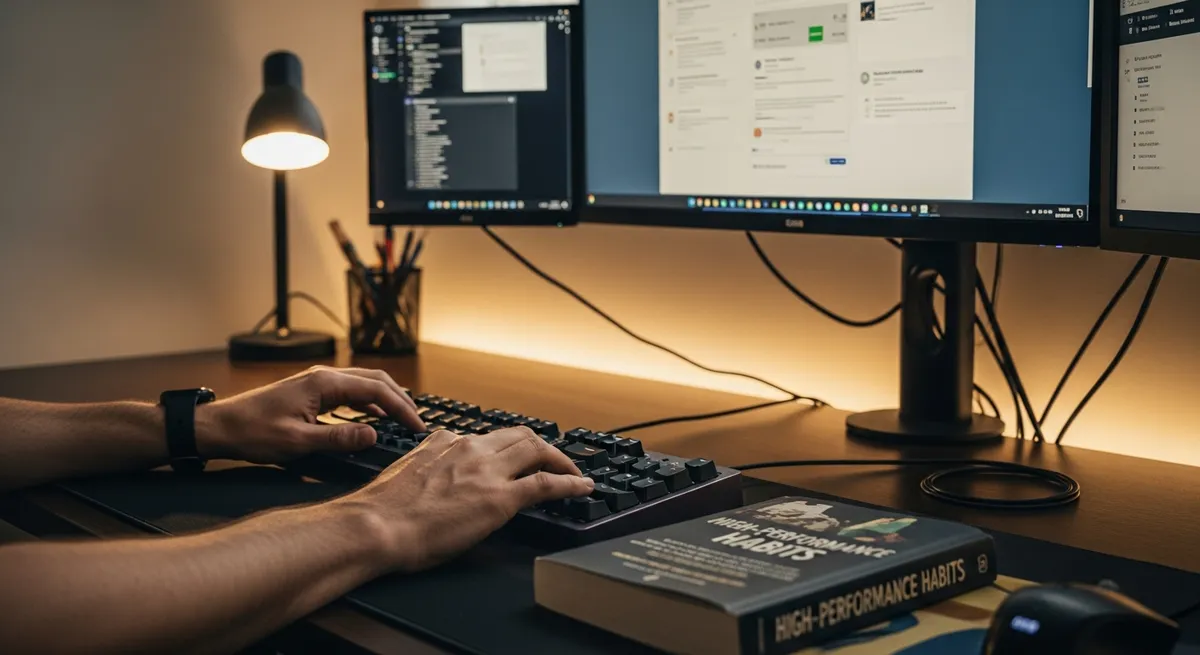
You drink the coffee. You make the list. You feel ready. Then 2 PM hits, right on schedule, and your brain turns into wet cement. (I know the feeling. It's brutal.) You end up doom-scrolling just to feel something. It feels like a personal failure, like you just don't have the discipline, but that is actually nonsense. The data on this is loud and clear: pushing harder against a biological wall does not work. It never works. Instead of treating your body like a machine that just needs more fuel (caffeine), we need to treat it like a biological system with specific gears. If you grind those gears, you break. If you grease them, you fly. Let's fix your routine using actual biology, not just "hustle culture" grit.¹
The Hidden Rhythm & The Chemistry of the Crash
Everyone knows about circadian rhythms. (Sleep, wake, repeat. We get it.) But almost nobody talks about ultradian rhythms.
These are the shorter cycles, usually 90 to 120 minutes, where your brain can actually focus. High performance isn't a marathon. It is a series of sprints. After about 90 minutes, your neurons basically go on strike. They need a reset. (And they will take it, whether you like it or not.)
If you ignore this biological dip and keep typing? Bad news. Your body doesn't just get tired. It panics.
Literally.
It dumps cortisol, the stress hormone, into your system to keep you awake. That "tired but wired" feeling you get at 4 PM? That isn't energy. It's a chemical fire drill. A panic response. And (this is the part that drives me crazy) it destroys your sleep later that night. It is a vicious cycle.
To fix the problem, you have to understand the fuel. Or rather, the waste. Deep inside your brain, there is a chemical called adenosine. Picture adenosine like soot. Or ash. Just building up in a fireplace. (Weird analogy? Maybe. But stick with me.) Every minute you are awake, your neurons are burning fuel, and this "ash" accumulates in the synapses. It is the biological signal for "time to sleep."
When you drink coffee, you aren't actually removing the ash. You're just... tape-over-the-check-engine-light blocking the sensor. Caffeine parks itself in the adenosine receptors so your brain cannot feel the fatigue. But here is the catch, the ash is still building up underneath. When the caffeine wears off? The dam breaks. You get hit with 6 hours of fatigue all at once. That is the crash.
The Solution: Biological Protocols
Habit 1: The "Light Diet" (It Is Not What You Think)
Most people starve themselves of light. Then they binge on it at the wrong time.
Stanford neurobiologist Dr. Andrew Huberman talks about this constantly (and for good reason).² Your eyes are not just cameras; they are clocks. If you do not get bright light, ideally sunlight, but bright artificial light works in a pinch, into your eyes within 60 minutes of waking up, your body clock stays in "night mode."
So, you drag. You chug coffee. You feel foggy.
The Fix: Get outside. Five minutes. Ten minutes. Just do it. Do not look at the sun directly (please do not blind yourself), but let the light hit your retina. It triggers a cortisol spike early in the day, which is actually what you want. It sets a timer for melatonin release 12-14 hours later.
Five minutes of actual sky, not through a window or windshield, resets your circadian rhythm better than any supplement on the shelf. Just step out on the porch. Do it before noon.
Habit 2: Temperature as a Switch
We like to be comfortable. I get it. I like 72 degrees and a blanket.
But comfort is the enemy of alertness.
Your body temperature naturally drops before sleep and rises before waking. You can hack this. If you are groggy, you are likely too cold (internally). If you cannot sleep, you are likely too hot.
A cold plunge works, if you are into that sort of torture, but a simple cold shower for 30 seconds does the trick too. It spikes adrenaline. Dopamine follows. Focus returns.
On the flip side? A hot bath or sauna at night mimics the body's natural cooling process. (Wait, heat cools you down? Yes.) When you get out of the heat, your body rapidly dumps temperature, signaling to your brain that it is time to crash.³
Habit 3: The Caffeine Curfew
Okay, let's talk about the coffee. (Sorry. I know.)
Caffeine has a half-life of about five to six hours. Do the math. If you drink a double-shot at 4 PM, half of that stimulant is still spinning through your veins at 10 PM. You might fall asleep, but your sleep quality? Trash.
Deep sleep suffers. You wake up unrefreshed. You drink more coffee. Repeat until burnout.
The Rule: No caffeine 8-10 hours before bed. It sounds impossible. Try it for three days. You will hate me on day one, but by day three, you will realize how tired you actually were.
Habit 4: The Brain Fuel You Are Missing
Sometimes, habits aren't enough. Sometimes, the tank is just empty. This brings us to the most overlooked aspect of cognitive performance: Magnesium.
Now, before you say "I eat spinach," hear me out. Most of us are deficient. Our soil isn't what it used to be. But here is the kicker, most magnesium supplements are useless for your brain. If you grab a generic bottle of Magnesium Oxide off the shelf, it is basically a laxative. It does great things for your digestion (maybe too great), but it does zero for your focus.
Why? Because of the Blood-Brain Barrier.
This barrier is your brain's bouncer. It keeps toxins out. Unfortunately, it also keeps most minerals out. Generic magnesium physically cannot get in. It is basically like trying to jam a semi-truck into a compact parking spot. It just bounces off.
The Solution: Magnesium L-Threonate
This is the cheat code. Scientists figured out a way to bind magnesium to threonic acid (a vitamin C metabolite), and suddenly, the truck fits in the spot. Magnesium L-Threonate is one of the few forms shown to significantly increase magnesium levels in the brain.⁴ ⁵
Why does this matter? Because magnesium is the "chill pill" for your neurons. It calms the NMDA receptors that get over-excited when you are stressed. It reduces that background buzz of anxiety so you can actually think.
I take it right around 2 PM. It doesn't make me sleepy; it just makes the noise stop. It clears the fog.
Stop "Trying" and Start Tuning
Forget the 8-hour workday. It is a myth left over from the industrial revolution.
Knowledge work does not scale like factory work. You cannot just "work harder" for 8 hours.
Try the 90/20 split instead:
Why 20 minutes? Because your brain needs to clear out metabolic waste products, that adenosine we talked about earlier, that build up during intense focus. If you scroll Instagram during your "break," you are not resting. You are just processing different data. That is not a break.
Here is the reality.
Willpower is a finite resource. Biology is not.
You can try to white-knuckle your way through the afternoon slump, fueling yourself with anxiety and espresso. It works, for a while. Until it doesn't.
Or you can align your schedule with the machinery you are already living in. Respect the ultradian dip. Get the light. Use the cold. Consider the chemistry (seriously, look into L-Threonate). It feels like cheating because it is easier. But it is not cheating. It is just... working.
So, try the light thing tomorrow morning. Just step outside. See what happens. You might be surprised.
FAQ: Because You Probably Have Questions
Q: Will Magnesium L-Threonate make me sleepy at work?
No, well, not "sleepy" like a sleeping pill. Think of it as removing the static from a radio station. You can hear the music better, but the volume is not turned down. It promotes calm focus, not drowsiness.
Q: Can I just eat more spinach?
I mean, you should eat spinach. Popeye was right. But to get clinical doses of magnesium (especially the kind that reaches the brain), you would need to eat a comical amount of greens. Supplementing is just more efficient for this specific goal.
Q: How long until I feel it?
Some people feel the "quieting" effect within 45 minutes. For the memory and long-term cognitive benefits, the studies suggest consistent use for about 3-4 weeks. Patience is key (unfortunately).
Q: Is the cold shower really necessary?
Necessary? No. Effective? Extremely. If you hate it, try just splashing ice-cold water on your face for 15 seconds. It triggers the "mammalian dive reflex" which slows your heart rate and clears your head.
Q: Can I drink decaf during the curfew?
Mostly yes. Decaf still has tiny amounts of caffeine, but unless you are extremely sensitive, it shouldn't wreck your sleep architecture. Just don't drink a gallon of it.
Disclaimer: This content is for informational purposes only and does not constitute medical advice. Consult a physician before starting any new supplement or health routine.
References1. National Institute of General Medical Sciences. "Circadian Rhythms." 2023. 2. Huberman Lab. "Using Light to Optimize Health." Stanford University School of Medicine, 2022. 3. National Sleep Foundation. "Temperature and Sleep." 2024. 4. Slutsky, I., et al. "Enhancement of Learning and Memory by Elevating Brain Magnesium." Neuron, 2010. 5. Sun, Q., et al. "Regulation of Structural and Functional Synapse Density by L-Threonate." Neuropharmacology, 2016.