
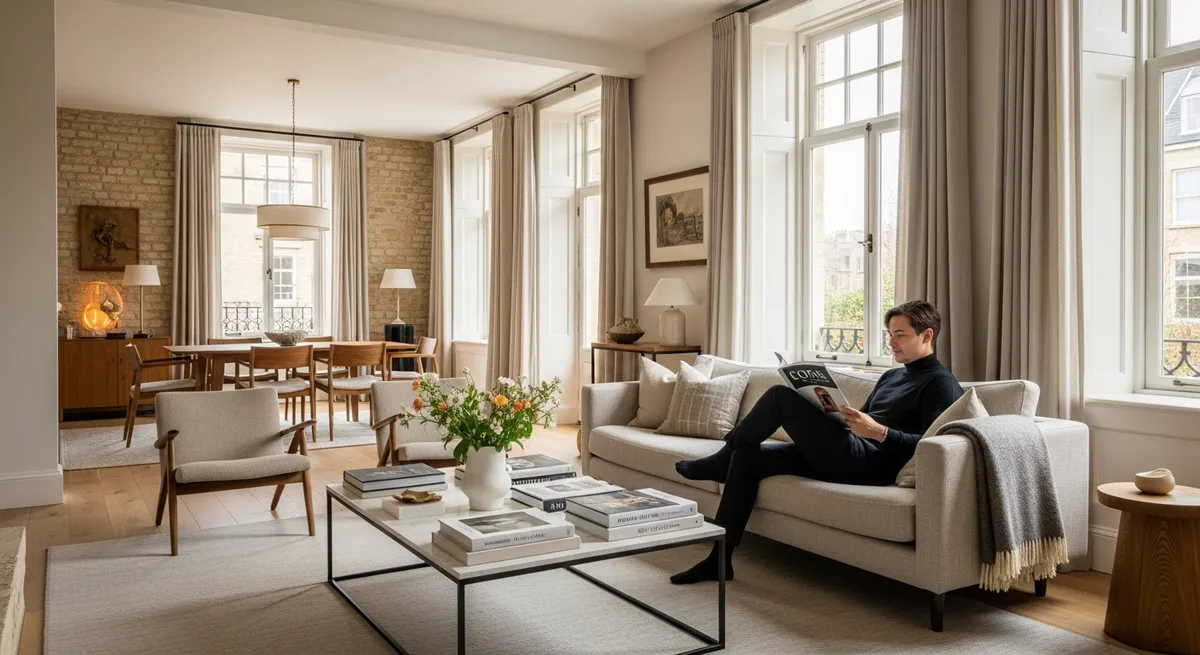
You know that specific feeling? You swipe the keycard, push open the heavy door to a hotel room - maybe a Westin, or even just a clean Marriott - and your shoulders physically drop two inches. It’s immediate. Bam. Relaxation. Most people think it’s the thread count (which helps) or the fact that someone else cleans the toilet (which definitely helps). But that’s not the real trigger. The real reason your brain unspools in a hotel room is simply the absence of decisions. At home, you see a pile of mail and think "bills." You see the toaster and think "crumbs." Your brain is constantly processing "to-do" lists based on visual cues. In a hotel? Blank slate. It’s quiet. Visually quiet. And we spend a fortune trying to replicate this vibe in 2025 with throw pillows when we should be looking at the biology of how our eyes process clutter.
The "Threat Detection" Machine in Your Skull
Here’s the thing about your brain - and I say this with love - it’s kind of paranoid. Your brain is running ancient software. Evolutionary biology (the really old stuff) suggests our eyes are basically security cameras scanning for threats.
It sounds dramatic, but think about the primitive function of the eye. It wants to know what is happening in the environment. Is that a snake? A spider? Or just a stack of unpaid parking tickets on the counter?
When you walk into a room, your subconscious doesn't care about your Crown Molding (sorry, it really doesn't). It's scanning for chaos. It’s looking for disorder. It is looking for anything that breaks the pattern. This is known as "cognitive load." Every object in your peripheral vision that isn't where it belongs requires a micro-calculation from your brain:
- The Pile: "Do I need to move it?"
- The Stain: "Is it dirty?"
- The Outlier: "What is that?"
You don't hear these thoughts, but they are burning glucose in the background.
According to researchers at the Princeton University Neuroscience Institute, visual clutter actually competes with your brain's ability to focus.¹ It’s like having 15 browser tabs open in your head. Eventually, the system slows down. (Mine crashes around 4 PM, usually.)
So, if the baseline of your living room is "chaotic," no amount of decoration is going to fix it. You’re just... well, putting lipstick on a pig. (Sorry. Blunt, but true.) You can add the nicest home interior design ideas in the world, but if the foundation screams "mess," your cortisol levels aren't going down. The hotel room works because it is predictable. Symmetrical. Safe.
There is a specific phenomenon called the "Cortisol Loop." When you see mess, your cortisol spikes. When cortisol spikes, you feel overwhelmed. When you feel overwhelmed, you have less energy to clean the mess. So the mess stays. To break the loop, you don't need a dumpster; you need to trick the eye into seeing order.
Fix #1: The Lighting Trap (And How to Escape)
Here is where almost everyone - myself included - gets it wrong. For years.
Walk into your kitchen. Turn on the light. Does it feel like an operating room? Does it feel like a midnight interrogation scene?
If that sounds familiar, check your bulbs - you're probably running "Daylight" versions. These are usually rated at 5000K (Kelvin), which is way too high for a living space. And they are terrible. I mean, functionally useful for spotting a contact lens on the floor, but terrible for your mental state. Blue-white light suppresses melatonin.³ It tells your ancient, caveman brain: "It is noon. The sun is high. Be alert. Hunt things."
Let's break down the Kelvin scale because nobody explains this at the store:
- 2700K (Warm White): This is the "cozy" zone. Think pubs, old libraries, and luxury hotel lobbies. It has a yellow/orange tint.
- 3000K (Soft White): A little cleaner, a little less yellow. Good for bathrooms, but still warm.
- 4000K (Cool White): This is an office. It's efficient. It's clinical.
- 5000K+ (Daylight): This is a hospital. Or a garage. It signals alertness and anxiety.
Hotels don't do this.
The Hotel Secret: They use 2700K or 3000K bulbs. Always. This is "Warm White." It mimics sunset. It tells your brain: "The day is over. Fire is burning. You are safe."
Switching your bulbs is the single cheapest upgrade you can make in 2025. It changes the whole texture of the room. It softens the edges. It hides the dust bunnies - and let’s be honest, we all have them - lurking under the sofa. Shadows are actually your friend here. You want pools of light, not a floodlight.
The Rule of Three
One ceiling light? That’s prison lighting. (Okay, maybe that is harsh, but it is definitely giving off "school cafeteria" vibes.) To get the best lighting for living room relaxation (and actually relax), you need layers. 1. Overhead (Ambient) 2. Task (Reading lamp) 3. Accent (Corner lamp or strip light)
When you layer them, the room feels "designed." Even if it’s just IKEA stuff.
Fix #2: The Tactile Lie (Touch Matters)
Your eyes can be fooled. Your hands? Harder to trick.
Ever grabbed a cheap door handle? You know the type - it rattles. It felt hollow. Light. Temporary. Now think about the luxury hotel room design. The handle is heavy. Solid. It doesn't jiggle.
This is subconscious "signaling." Heavy hardware signals safety and permanence. It taps into "proprioception" - the body's sense of self in space. When you interact with a heavy object, your muscles engage differently. It feels grounded. Subconsciously, your brain assumes that if the handle is solid, the building is solid. If the building is solid, you are safe.
I swapped the knobs in my rental kitchen last year. The old ones were sticky, hollow plastic junk. I bought a pack of solid brass pulls (heavy ones). Cost me maybe $45. But every time I open a drawer now, my brain registers "quality." It’s a tiny dopamine hit. A cabinet hardware update is the interior design equivalent of a facelift - it tightens everything up without major surgery.
Let's Talk Numbers (Because We Have To)
You don't need a renovation loan. You really don't. Here is what this actually costs versus what people think it costs.
| The Upgrade | Estimated Cost (2025) | Impact Level (1-10) |
| Lighting Swap (2700K Bulbs) | $30 - $50 | 10 (Immediate mood shift) |
| Heavy Hardware (Kitchen/Doors) | $40 - $80 | 8 (Tactile quality) |
| Decluttering (Visual Quiet) | $0 (Just sweat) | 9 (Mental clarity) |
| New Sofa (What most people do) | $1,200+ | 4 (Doesn't fix the lighting) |
Fix #3: The "Tray" Hack (Visual Quiet)
You can't just throw everything away. Real life doesn't work like that. You need your keys. You need your wallet. You need that random tube of chapstick.
But - and this is a big "but" - scattered items register as chaos. Grouped items register as a "collection."²
This is the oldest trick in the book. Interior designers use trays. Put the keys, the wallet, and the chapstick on a physical tray. Suddenly? It is not clutter anymore. It’s a "vignette." It sounds stupid, I know. (It feels stupid when you first do it.) But it contains the mess. It gives the eye a boundary. The brain sees "one thing" (the tray) instead of "five things" (the junk).
You can take this a step further with "The Drop Zone." In high-stress homes, items migrate. Keys end up on the counter. Mail ends up on the sofa. By establishing a dedicated Drop Zone at the entry - a small table with a tray and a bowl - you create an airlock. The chaos stops there. It doesn't infect the living room.
Your Saturday Morning Plan (The 2025 Sprint)
Stop overthinking it. Paralysis by analysis is a real thing. Just do this sequence next Saturday:
First: Head to the hardware store. Grab a box of 2700K LED bulbs. Warm white. If the box says "Daylight," put it back. Run away.
Second: Swap the bulbs in the room where you actually hang out. Just that one room. Just sit with it. Feel the difference.
Third: Tighten every single screw you can find. Door handles. Cabinet pulls. Loose legs on chairs. If it wobbles, it makes you nervous (subconsciously). Stability creates calm.
Fourth: If you have the budget, buy one heavy thing. A stone coaster set. A solid brass lamp base. Something that anchors the room.
FAQ: The Stuff You’re Probably Wondering
Can I mix light temperatures?
Please don't. (I’m begging you.) Mixing a blue-white bulb next to a yellow-warm bulb looks like a mistake. It looks like you ran out of money. Keep the color temp consistent in a single room (no mixing). If you need bright light for reading, get a brighter bulb (more lumens) - not a bluer one (higher Kelvin).
What if I rent?
That’s the beauty of the hardware trick. Keep the old cheap knobs in a Ziploc bag. When you move out, swap them back. Take your nice brass handles to the next place. It’s the only investment that travels with you effortlessly.
Is "minimalism" the only way?
No. Minimalism is hard. (And kind of cold, honestly.) You don't need an empty room. You just need intentional placement. A stack of books is fine. A pile of mail is stress. You have to know the difference.
Do warm bulbs use more energy?
Not at all. The warmth (Kelvin) has nothing to do with power consumption. A 2700K LED uses the exact same amount of electricity as a 5000K LED. Just make sure you are buying LEDs, not old-school incandescents.
Where can I find heavy hardware cheap?
You don't need the fancy showroom stuff. I check Amazon for bulk packs (look for "solid brass," not hollow) or even Habitat for Humanity ReStores. Sometimes the heavy vintage stuff just needs a quick polish.
References
- McMains, S., & Kastner, S. (2011). Interactions of top-down and bottom-up mechanisms in human visual cortex. The Journal of Neuroscience, 31(2), 587-597.
- Augustin, S. (2009). Place Advantage: Applied Psychology for Interior Architecture. Wiley.
- CDC - NIOSH. (2020). Effects of Blue Light on Sleep and Circadian Rhythms.
Disclaimer: This article is for informational purposes only and does not constitute medical, psychological, or professional design advice. The information regarding cortisol levels and biological responses to light is based on general research and should not be used to diagnose or treat any condition. Product prices and availability are subject to change. Consult a professional for specific home renovation or health needs.


