
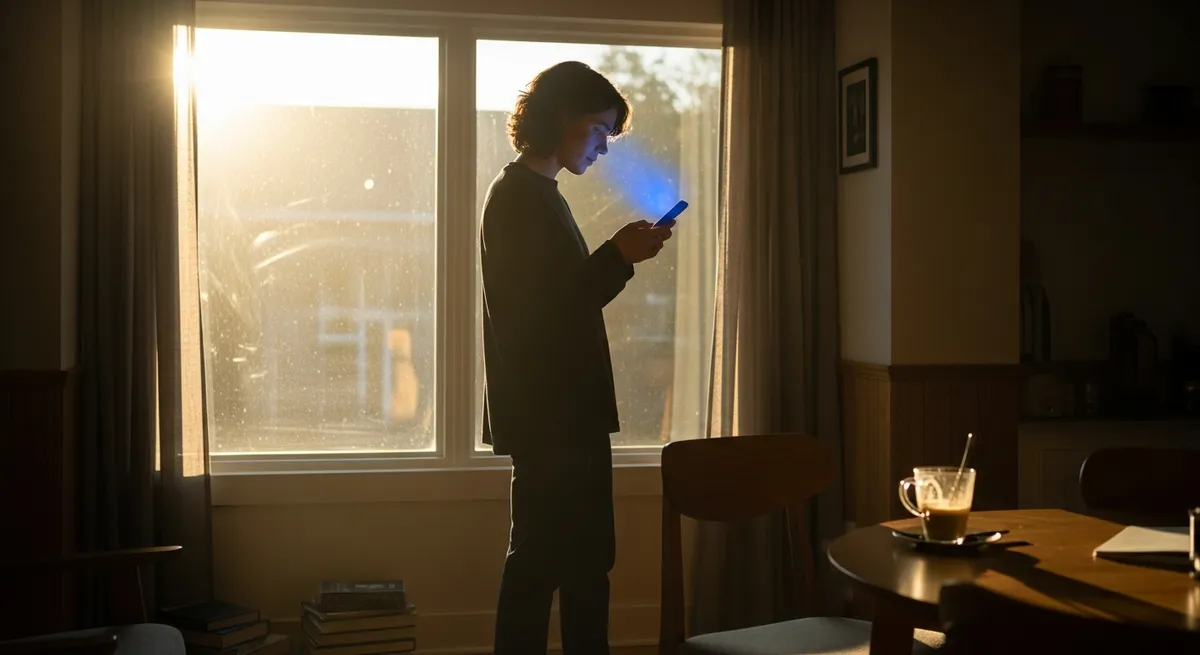
I am currently lurking in my own hallway at precisely four minutes past three in the morning, squinting at the microwave display as if it were a malevolent visitor from another galaxy. (It is three in the morning and those neon green digits are currently skewering my retinas with the unbridled fury of a supernova.) We have been lectured for several decades that the exterior world is far too bright, but we rarely discuss the luminescent betrayal occurring within our own four walls. It is a quiet, shimmering insurrection. I have spent years wondering why I feel like a dehydrated zombie every morning, only to realize that my own hallway is gaslighting my brain into thinking it is high noon in the Sahara. It is quite a predicament for someone who just wants to sleep through a Tuesday without contemplating the heat death of the universe.
The American Medical Association has warned for years that excessive artificial light during nocturnal hours is not merely a minor annoyance; it is a profound physiological disruptor that effectively halts melatonin production and throws our internal clocks into a state of absolute, unmitigated anarchy. I am not being hyperbolic, although I do appreciate a touch of the dramatic when I am sleep-deprived. We are essentially forcing our brains to reside in a state of perpetual afternoon that never concludes. It is utterly exhausting. (I suspect this is why I recently attempted to start a conversation with a particularly tall floor lamp.) The sheer weight of this light-induced fatigue is enough to make a person question every technological advancement since the invention of the candle.
The High Price of High Definition
I once handed over four thousand dollars for a mattress that allegedly utilized "lunar alignment technology," only to discover that a fifty-cent LED on my power strip was the actual culprit behind my chronic inability to lose consciousness. It was a humiliating realization. (I felt like a fool who bought a sports car only to find there was no engine.) My neighbor Bob - a gentleman who once attempted to repair a significant plumbing failure with nothing but industrial-strength chewing gum and a prayer - thinks I am being entirely too sensitive. (Bob is also the gentleman who insists on wearing dark sunglasses inside the house during a thunderstorm, so his authority on the matter of light is somewhat localized.) Bob prefers his residence to be illuminated with enough intensity that it could likely be spotted by an astronaut on the International Space Station. He calls it "security," but I call it a biological crime scene.
The fundamental issue is that our brains are incredibly ancient pieces of hardware currently attempting to run a very modern, very glaring operating system that they simply do not comprehend. (It is remarkably similar to trying to run a high-end, three-dimensional video game on a handheld calculator from 1984.) As Harvard Health puts it, blue light has a dark side: our internal circuitry is simply not equipped for this constant bombardment. For approximately six million years, the only illumination our ancestors encountered after the sun vanished below the horizon came from the moon or the flickering, orange radiance of a communal campfire. These are "warm" lights. They do not send a signal to the brain that it is time to wake up and pursue a mastodon. I personally have not pursued anything more dangerous than a discounted rotisserie chicken at the supermarket, but the biological imperative remains firmly lodged in my DNA. Our ancestors had the good sense to go to sleep when it got dark. We, however, have invented the six-way chandelier and the high-definition tablet. It is a mess.
The Science of the Blue Menace
The primary antagonist in this domestic tragedy is the blue light spectrum. It is ubiquitous. It is emanating from your smartphone. It is shining from your flat-screen television. It is pulsing from those energy-efficient light bulbs that make your cozy living room look like a sterile interrogation room at a maximum-security facility. Lighting researchers have repeatedly found that reducing blue light exposure in the two hours prior to bedtime improves sleep latency. That is the sophisticated scientific terminology for "not staring at the ceiling for forty-five minutes while you mentally replay every embarrassing thing you said during your high school prom." (I attempted this reduction for a single week and I actually felt like a functioning, coherent human being, which was a deeply unsettling sensation for me.)
And here is another thing that often goes unmentioned: this light pollution at home is a quiet risk for mental health. Chronic exposure to artificial light at night has been linked to increased rates of depression and mood disorders in multiple studies. It turns out that when you mess with the master clock in your brain - the suprachiasmatic nucleus - you mess with everything. (I have always suspected that my internal clock was more of a suggestion than a rule, but science apparently disagrees.) I have made the expensive mistake of thinking a brighter house was a safer, more modern house. I was profoundly, embarrassingly incorrect. I spent three months living in a rental property with floor-to-ceiling windows and zero curtains because I convinced myself I liked the "minimalist aesthetic." (The aesthetic was apparently "exhausted raccoon with a severe caffeine dependency.") My sleep quality plummeted into the abyss, my irritability spiked to record highs, and I found myself getting into a genuine, heated argument with my toaster over the definition of medium-brown.
The Tactical Room-by-Room Audit
Now, we must discuss the tactical room-by-room audit, which is far less tedious than it sounds if you imagine yourself as a sophisticated secret agent hunting down glow-in-the-dark enemies. (I find that wearing a trench coat and maintaining a sense of self-importance help the process significantly.) I have taken to covering every tiny, blinking LED in my bedroom with small pieces of black electrical tape. It looks slightly as if my house is being held together by tape, which is not entirely inaccurate, but the psychological and physiological relief is immense. I also recently swapped my bedside lamp for a bulb that emits a soft, sunset orange glow. (My wife claims it makes the bedroom look like a 1970s airport lounge, but I have never slept better in my entire life.)
Next, you must move to the kitchen. Take a long, hard look at the display on your oven and your microwave. If they are glowing with a bright blue or stark white light, check the manual to see if there is a setting to deactivate the display when it is not in use. (My kitchen currently looks like it is mourning the loss of a very bright, very annoying friend, but I do not care.) Sleep experts recommend turning off all screens at least thirty to sixty minutes before bed to allow your brain to enter a state of pre-sleep equilibrium. I also recommend a low-tech approach to evening entertainment. If you are going to watch television, dim the screen brightness to its lowest comfortable setting. Better yet, try reading a physical book under a warm-toned lamp. I am fully aware of how this sounds. A book is just a tablet that does not have applications or a backlight, but that is precisely why it works. When I switched to reading by a small amber light, my falling asleep time dropped from an hour of tossing and turning to about fifteen minutes. It was not a miracle; it was just me finally stopping the intentional assault on my own nervous system.
Finally, you must address the exterior of your home. Streetlights are a public utility, but they are also a biological hazard when they bleed through your window. You want your bedroom to be so dark that you cannot see your own hand in front of your face. It sounds slightly claustrophobic, but it is actually the most natural state for a human being to inhabit during the night. Purchase a set of heavy blackout curtains for the bedroom. If you have motion-sensor lights outside, ensure they are angled downward so they do not blast light into your windows or your neighbors windows. I once had a neighbor whose security light was so poorly aimed that it illuminated my bedroom every time a stray cat walked by. I felt like I was living in a perpetual police interrogation. Be the person who understands that darkness is a resource, just like clean water or fresh air. Read that again. We have spent a century trying to banish the night, and we are finally realizing that we actually needed it all along.
Pro Tip
Switch your evening bulbs to those with a warm, amber hue. It makes your house look less like a hospital and more like a cozy tavern where nobody knows your name and you can finally sleep. If you wake up at two in the morning to use the facilities, do not flick on a one-hundred-watt fluorescent bulb. Your brain instantly assumes the sun has exploded. Instead, use a very dim, red-toned nightlight for your navigation.
💡 Frequently Asked Questions
❓ Are red lights really better for sleep than traditional bulbs?
The short answer is a resounding yes because red light possesses a much longer wavelength. Unlike blue or white light, red wavelengths do not suppress melatonin production as aggressively, which makes them the ideal choice for late-night illumination. I have replaced my hallway nightlights with red bulbs, and I no longer feel like I am being interrogated by federal agents during my midnight trips to the kitchen. It is a small change that yields a massive difference in how quickly you can return to sleep.
❓ Should I wear blue-light-blocking glasses all day long?
This depends entirely on your environment, but generally speaking, you actually want blue light during the day. Daytime blue light from the sun helps regulate your mood and your alertness; the problem only arises when you are exposed to it after the sun has set. Save the specialized glasses for the evening hours when natural light has vanished. (I look like a bargain-bin version of a futuristic scientist when I wear mine, but the results are worth the aesthetic sacrifice.)
❓ Can a simple sleep mask replace the need for blackout curtains?
It is a decent temporary fix, especially if you are traveling, but it is not a total solution for most people. Some masks can be uncomfortable or slip off during the night. Making the entire room dark is always the superior choice because masks slip, leak light at the edges, and come off during the night. You want to create a cave, not just a blindfold.
❓ Is it okay to have a nightlight for children who are afraid of the dark?
The long-term health of their sleep cycle is vital, so if a nightlight is absolutely necessary, ensure it is very dim and strictly in the red or orange spectrum. Avoid the common cool white or blue nightlights found in most big-box stores, as these can actually make it harder for the child to fall back asleep after waking. (My own daughter once insisted on a light so bright I could have performed surgery in her room, but we eventually negotiated down to a soft amber glow that satisfied her need for safety and my need for her to actually go to sleep.)
❓ Does the brightness of my digital alarm clock actually matter?
The reality is that even a small, bright LED can disrupt your depth of sleep if it is in your direct line of sight. If you can see the time clearly from across the room in the dark, the display is likely too bright and should be dimmed, covered, or turned away from the bed. I ended up putting a piece of tinted film over my clock, which solved the problem without forcing me to guess the time at six in the morning.


