
A note before we begin: the people in this essay, Elena, Marcus, and Dr. Aris, are illustrative composites, drawn to make the mechanics of health data vivid. They are not interviews or named sources. The companies, research, and regulatory gaps described around them are real.
I was sitting at a remarkably loud bistro last Tuesday with my friend Elena - a woman who manages high-stakes hedge funds with ruthless efficiency but somehow cannot remember where she parked her German sedan - when her wrist suddenly began to vibrate like a caffeinated hornet. It was a jarring sound that interrupted my monologue about the decline of artisanal mustard. She glanced at the sleek, metallic ring on her finger and informed me, with a mixture of genuine awe and a hint of existential terror, that her basal body temperature had spiked and her cycle was precisely three days away. (I am still convinced that the mushroom risotto we were eating was catastrophically overcooked, but that is a grievance for another time and perhaps another column.) It felt like a scene from a science fiction novel where the protagonist realizes the machines know her better than she knows herself. Elena felt empowered by this stream of biological data, but I felt a cold shiver of professional skepticism travel down my spine.
The Intimacy Economy
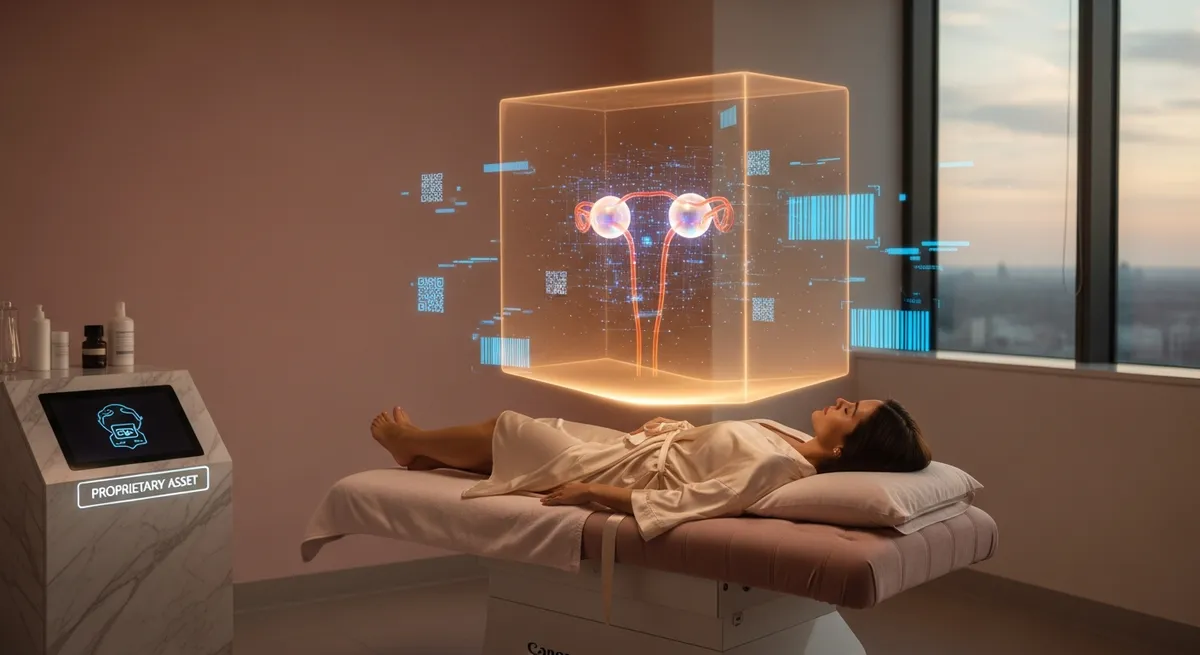
We are currently living through a period where our most private biological rhythms have been transformed into a global commodity. Surveys by the Pew Research Center consistently find that most Americans are concerned about how private entities handle their personal data. That is a majority of the population walking around in a state of digital anxiety. Yet, despite this fear, we willingly hand over the most intimate rhythms of the female body to massive corporations that view biological milestones as nothing more than profitable data points to be harvested. It is a Faustian bargain of the highest order. (My neighbor Bob, who legitimately thinks a pedometer is a type of small dinosaur, is perhaps the only person I know with his dignity and privacy still intact.) We trade our fundamental privacy for a glowing push notification that tells us something our bodies have been trying to communicate for millennia. It is a strange trade to make for a piece of shiny hardware.
Picture a software developer, call him Marcus, a man who drinks four double espressos before noon and has not seen direct sunlight since the winter of 2019. Anyone who has worked on these systems will tell you what Marcus stands in for here: the anonymization of this health data is often a convenient fiction designed to soothe the masses. Even when your name and social security number are removed from the file, the sheer uniqueness of a menstrual cycle combined with your location data makes re-identification trivial for a halfway decent algorithm. It is remarkably easy. (It is like trying to hide a neon-painted elephant in a quiet library; eventually, someone is going to notice the trunk sticking out from behind the biographies.) Your biological cycle is as unique as a fingerprint. In this world, the word "anonymous" is often just a marketing term used to make us feel better about the fact that we are being tracked across the digital landscape like migratory birds.
The Regulatory Chasm and the Smart Mattress Disaster
There is a massive, gaping problem with how these health applications are governed in the modern world. Research published in the Journal of Medical Internet Research indicates that a staggering number of health and fitness applications do not meet the basic privacy standards of the Health Insurance Portability and Accountability Act. Why is this allowed to happen? It is because HIPAA follows the relationship, not the gadget. The law covers healthcare providers, health plans, and the companies working on their behalf; a consumer app or ring you buy on your own is generally none of those things, no matter how medical its measurements feel. This regulatory loophole is a chasm large enough to drive a fleet of semi-trucks through without touching the sides. (I once spent three thousand dollars on a "smart" mattress that told me I was technically dead because I forgot to plug it in before a nap, so I know a thing or two about the spectacular failures of consumer tech.) We are essentially giving these companies a front-row seat to our hormonal fluctuations, and they are selling tickets to the show without offering us a single cent in return for this payment of our most private information.
It is a gross imbalance of power that we have collectively accepted because the user interface is shiny and the step-counting feature provides a momentary hit of dopamine. Furthermore, the ethical implications of this data collection extend far beyond targeted advertisements for organic tampons or dark chocolate. The manipulation is subtle, but the impact on our future is profound. We are being nudged, prodded, and analyzed by algorithms that understand our biological vulnerabilities better than we do. My dentist, Dr. Aris, who frankly scares me with his collection of antique drill bits and his refusal to use background music, once told me that the most dangerous thing in the world is a person who thinks they are in control when they are actually being managed by a third party. (He was talking about gingivitis at the time, but the logic holds up for data privacy as well.)
The Illusion of Control
My sister, Sarah, who once ran a marathon in a literal rainstorm just to prove she could defeat nature, now refuses to go for a casual walk if her watch is charging because she believes those steps will not count toward her digital total. It is a psychological pitfall that turns health into a performance for an invisible audience. Do not despair just yet, as there are ways to navigate this digital minefield. You do not have to become a luddite or bury your smart devices in a hole in the backyard. The key is to shift your mindset from a passive consumer to an active gatekeeper of your own information. You must start by scrutinizing the privacy settings of every single application you use. Many of these devices allow you to opt-out of data sharing with third parties, but they bury these options deep within menus that require a map, a compass, and a glass of wine to navigate. (I am usually the first person to complain about government bureaucracy, but when it comes to someone selling my genetic predispositions to a marketing firm, I am suddenly a huge fan of heavy-handed regulation.)
This should not be a premium feature that you pay extra for; it should be the baseline for every piece of technology that touches our skin or records our pulse. Finally, we need to demand better legislation from our representatives. The existing framework is outdated and completely insufficient for the challenges of the twenty-first century. We need laws that specifically protect biometric and reproductive data from being treated as a tradable commodity in the marketplace. Until then, the burden of protection falls squarely on you. The intersection of technology and female health is a frontier that offers immense promise, but it is currently a lawless land where privacy is often the first casualty of the gold rush. We have allowed ourselves to be lured in by the convenience of automated tracking and the allure of self-knowledge, without considering the long-term cost of our digital footprint. (I am just as guilty as anyone; I once spent an entire hour trying to sync a smart water bottle that I eventually used as a paperweight because the battery died.)
A Turning Tide
However, the tide is starting to turn as consumers become more savvy. As more people become aware of the clandestine trade in biometric data, the demand for privacy-first technology is growing. This is not just about keeping your cycle private; it is about maintaining the boundary between our private lives and the corporate interests that seek to monetize every aspect of our existence. You have the power to choose where your data goes. By selecting devices that respect your privacy and advocating for stronger legal protections, you are sending a clear message to the tech industry that your body is not for sale. It is a slow process, and it requires more effort than simply clicking a button, but it is a necessary step if we want to live in a world where technology serves us, rather than the other way around. (And honestly, if you can navigate the settings menu on a modern smart television, you are more than capable of protecting your biometric data.) Stay informed, stay vigilant, and remember that the most important data point in your life is one that an algorithm will never be able to capture: your autonomy.
🤔 Frequently Asked Questions
❓ Is it safe to use a cycle-tracking app if I do not share my data?
Here is the reality about safety in the digital world: it is rarely absolute or guaranteed. Even if you do not actively share your data with friends or social media, the act of storing it on a remote server creates a permanent vulnerability. If the application does not offer local encryption, your information is potentially accessible to the company's employees or hackers in the event of a security breach. It is always better to look for an application that explicitly states it uses local-only storage, which keeps your personal information on your smartphone rather than in the cloud. (I once had my email hacked by someone who just wanted to send links to discount boots, so I take these things quite personally now.)
❓ Can my employer access my wearable tech data?
The short answer surprises most people because it is often tied directly to your insurance policy or wellness incentives. If you have signed up for a workplace wellness program that provides a discount on your health insurance in exchange for wearing a tracker, you have likely granted your employer or the insurance provider access to certain metrics. While they may not see every individual detail of your Tuesday afternoon, they often receive aggregated reports that can influence long-term policy decisions. You should always read the specific terms of any workplace wellness initiative before participating. (I would rather pay full price for insurance than tell my boss how many times I woke up to eat cheese in the middle of the night.)
❓ How do data brokers get my health information from these apps?
This depends on your specific situation, but the most common method is through software development kits or SDKs. Many app developers include third-party tools to help with things like analytics or advertising. These tools often collect data in the background and send it back to their parent companies without you ever noticing. Unless the app has a very strict privacy policy that forbids this, your biometrics can be bundled with thousands of other users and sold as a data package to companies looking to target specific demographics. It is a high-tech version of a garage sale, except you are the item being sold. (And trust me, you are worth more than a five-dollar lamp.)
❓ Does deleting the app also delete my data from the company servers?
Actually, deleting the app from your phone usually does nothing to the data already stored on the company's hardware in some distant server farm. In most cases, you must manually go into your account settings and request that your account be deleted and all associated data be purged forever. Some companies make this process intentionally difficult, requiring you to send an email or fill out a specific form that feels like it was designed by a medieval clerk. It is a tedious task, but it is the only way to ensure that your digital footprint does not continue to exist long after you have stopped using the service. (I am still trying to delete an account from a defunct social media site from 2006, so I understand the struggle.)
❓ Are there any wearable devices that do not track location?
The reality is that many wearables use your phone's GPS rather than having their own built-in sensor, but they still record that data to provide you with maps of your runs or walks. If privacy is your primary concern, you can usually disable location permissions for the health app in your phone's settings menu. This might break some of the functionality, like your distance tracking or your pace maps, but it prevents the company from knowing exactly where you live, work, and spend your time. It is a trade-off that many people are increasingly willing to make for the sake of anonymity. (I do not need a map to tell me I went to the bakery; the crumbs on my shirt are evidence enough.)


