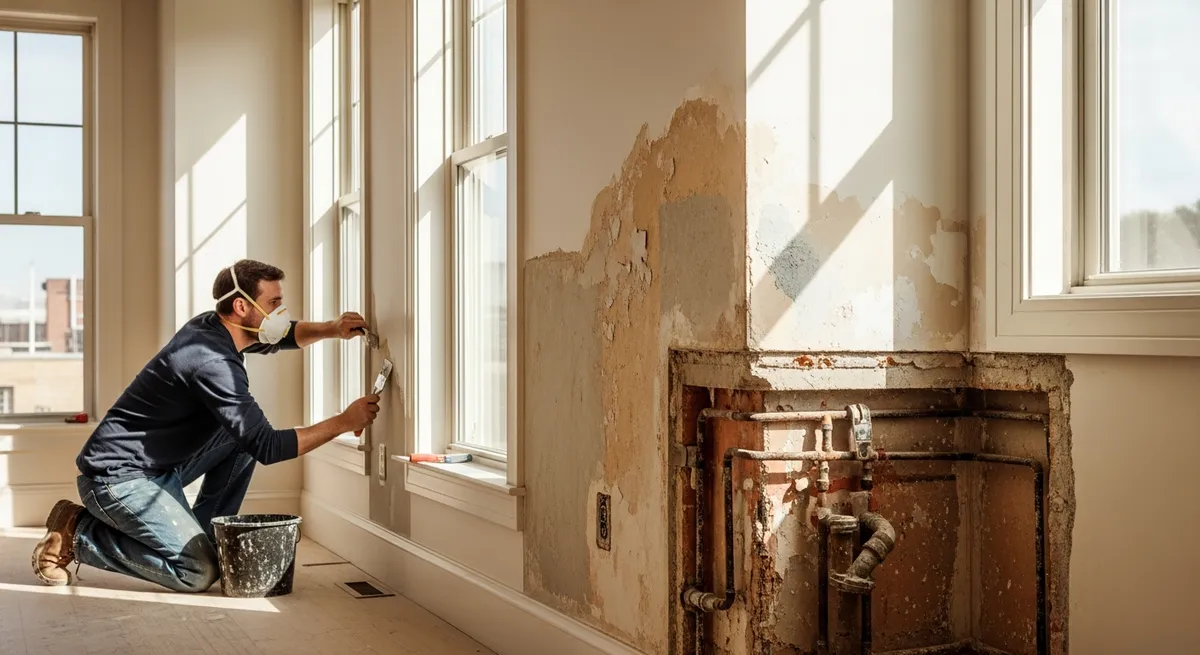
Back in 2014, I signed my life away for a Victorian heap that possessed crown molding capable of making a grown man weep and a porch that practically shouted for a rocking chair and a double pour of gin. (I was painfully young and dangerously stupid, which is a catastrophic mix when one is tethered to a thirty-year mortgage for a pile of bricks and optimistic delusions.) I truly believed I was purchasing a sturdy piece of American history. In reality, I was taking title to a very expensive, very beautiful museum of toxic heavy metals. (My bank neglected to mention that specific architectural feature in the closing documents, which I still find quite suspicious.)
My contractor was a fellow named Silvio who inhaled tobacco like it was oxygen and treated the local building codes as if they were polite suggestions from an annoying aunt. (I once observed him measure a complex door frame using nothing but his forearm and a squint.) Silvio took one solitary look at my window sills and let out a heavy, theatrical sigh. "The lead is here, my friend," he announced, pointing a calloused thumb at that gorgeous, alligator-patterned paint I had been busy admiring. I did not believe him at first, mostly because I did not want to spend the money. I was wrong. I am frequently wrong when my ego and my bank account are involved in a disagreement. (It is a character flaw I am working on, albeit with glacial speed.)
The Toxic Phantoms Lurking in Our Infrastructure
It is a specifically American brand of insanity, do you not think? We admit a substance is a lethal neurotoxin, we ban the stuff, and then we dump the entire cleanup bill on some poor soul who just wanted a roof that did not leak. (It is remarkably similar to finding out your new car is powered by pure spite and raw asbestos.) The Environmental Protection Agency suggests that between 6 and 10 million lead service lines are still rotting beneath our feet.² Six million. At least. (It is the kind of statistic that makes you want to stop drinking tap water entirely and start bathing in expensive mineral water.)
These pipes were laid in the ground during a distant epoch when lead was the industry gold standard, praised by engineers for its durability and its wonderful malleability. (We were so incredibly clever back then, were we not?) Now, those very same pipes are ticking time bombs of bureaucratic indifference. We saw this disaster unfold in Flint, and we are witnessing it repeated in cities across the nation that simply do not have the cash to dig up every single street. It is a systemic failure of the highest order. (If you think your local government is proactively on top of this, I have a very nice bridge in Brooklyn I would like to sell you at a premium.)
The Environmental Protection Agency released their 7th Drinking Water Infrastructure Needs Survey and Assessment in 2023, which suggests that billions of dollars are needed just to identify where these lines are hiding.² (I find it comforting that we have the money for a new stadium but not for pipes that do not poison the toddlers.) This is not just an urban problem or a rural problem; it is a geographic lottery where the prize is a heavy metal that your body never learned how to process. (I do not like lotteries where I am the one paying for the privilege of losing.)
My Neighbor Bob And The Cult Of Denial
My neighbor Bob once argued that the lead panic was a hoax because he survived a house full of it and "turned out fine." (Bob also forgets where he parked his car three times a week, so I take his medical assessments with a substantial grain of salt.) The actual truth is significantly more ghoulish than Bob and his shaky memory would have you believe. The Centers for Disease Control and Prevention is remarkably blunt on this: there is no such thing as a safe blood lead level for a child.³ None. Zero. (I find it difficult to argue with the CDC, mostly because they own more microscopes than I do.)
Even low levels of exposure are linked to cognitive decline and behavioral issues that can last a lifetime.³ Yet, the burden of remediation falls squarely on the homeowner. If you discover lead pipes in your basement, the city might replace the part under the street, but the rest? That is your problem. (It is like a dentist offering to fix half a cavity and leaving the rest for you to handle with a rotary tool.) Lead does not just vanish into the atmosphere. It lingers. It hides in the soil where your tomatoes grow. It flakes off the siding of the house next door. It leaches into the morning coffee you drink while wondering why you feel so incredibly sluggish. (I used to think my chronic brain fog was just a result of the aging process, but now I suspect the plumbing.)
According to a 2021 study published in the journal Science, millions of people were exposed to high levels of lead as children during the peak years of leaded gasoline and paint.⁵ The long-term effects on cognitive function are well-documented and deeply depressing. (I am not being dramatic; I am being observant, which is often mistaken for drama.) We are effectively living in a museum of toxic materials, and we are the curators who never asked for the job. It is not just about the health risks; it is about the constant, low-level anxiety that comes with knowing your sanctuary is technically a hazardous waste site.
The Industrial Romance of 1978
Before it was finally banned in 1978, lead was the secret sauce that made paint last forever and maintain its vibrant colors through the harshest winters. (If only our modern electronics were built with such longevity, I would not have to buy a new phone every eighteen months.) Every time a window is opened or a door is shut in one of these old houses, microscopic lead dust is released into the air. A study from the Department of Housing and Urban Development found that 35 percent of homes in the U.S. still have some form of lead-based paint hazard.⁴ That is roughly 30 million homes. (I checked that math because I hoped I was wrong, but I am unfortunately correct.)
I find it fascinating, in a deeply depressing way, how we handle this as a society. When I sold that Victorian, I had to sign a stack of papers acknowledging that I knew lead was there. I felt like a criminal, even though I had done nothing wrong besides buying a house with nice windows. (The buyer did not seem to care at all, which says something about the current housing market that I am not quite ready to unpack without a third glass of wine.) This is not a weekend DIY project that you can learn from a ten-minute video. (Unless you enjoy wearing a full hazmat suit and explaining to the neighbors why your house looks like a set from a science fiction movie.)
You can try to paint over it, which is a process known as encapsulation. It works for a while, but it is essentially a temporary ceasefire with a monster that lives in your walls. I remember talking to a young couple who bought the house next to my old Victorian. They were vibrating with excitement, talking about knocking down walls and sanding the original pine floors. I had to be the ghost of Christmas past and warn them about the dust. The look of pure terror on their faces is something I will never forget. (I felt like I was telling them their brand-new puppy had rabies.)
The High Cost Of Doing Nothing
Replacing a lead service line is not cheap. It is an invasive, muddy, expensive nightmare that involves backhoes and ruined landscaping. (I know this because I had to pay for part of mine, and I still have the credit card debt to prove my commitment to clean water.) But what is the alternative? We keep drinking from the lead straw because the paperwork is too hard? That is not a policy. That is a surrender. (I do not like surrendering, especially to a piece of metal buried in my front yard.)
While there are some grants and low-interest loans available through programs like HUD, they are often buried under mountains of paperwork and restricted to specific income levels.⁴ It is like being offered a life vest that is tied to the bottom of the ocean. The solution, of course, would be a massive, federally funded effort to remove lead from every home and street in the country. But that would cost billions, and our political system is not exactly known for its long-term vision or its willingness to spend money on things that are not flashy. (Replacing a lead pipe is not as exciting as building a new stadium, apparently.)
Instead, we leave it to the individual. We tell them to buy filters, to wash their hands, and to keep their children away from the windows. It is a classic case of privatizing a public health problem. We are asking homeowners to be scientists, contractors, and public health officials all at once. I do not know about you, but I can barely manage to keep my lawn mowed, let alone oversee a complex lead abatement project. (I once tried to fix a leaky faucet and ended up calling a plumber at two in the morning; I am not the man for this job.)
The psychological toll is also significant. You start seeing every chip of paint as a threat. You look at your faucet and wonder what is really coming out of it. It changes the way you feel about your home. A house should be a sanctuary, a place where you feel safe. When that safety is compromised by the very materials the house is made of, the foundation of your well-being starts to crack. (And I am not just talking about the plaster.)
Navigating the Path Forward Without Losing Your Mind
If you find yourself in a home with lead paint or pipes, the first thing to do is breathe. (Just make sure you are not breathing in lead dust while you do it.) You are not alone, and while the situation is frustrating, it is manageable if you are methodical. The most important step is education. You have to understand the difference between presence and hazard. Presence means it is there; hazard means it is accessible and dangerous. (It is the difference between a lion in a cage and a lion in your kitchen.)
If your lead paint is in good condition and not on a friction surface like a door frame, it might be safer to leave it alone than to try and remove it. The act of removal is often more dangerous than the lead itself because it creates the very dust we are trying to avoid. It is one of those frustrating paradoxes of life, like how the more you try to clean a stain, the bigger it gets. If you are planning to renovate an older home, do not assume a simple lead test kit from the store is foolproof. These kits are notorious for false negatives. Hire a certified lead inspector who uses an XRF (X-ray fluorescence) analyzer. It is more expensive up front, but it is the only way to know for sure what is hiding under those layers of paint before you start creating a dust storm.
For the pipes, you can buy a water filter. But you must be careful. Not every filter works. You need one specifically certified for lead removal. You must also be wary of using hot water from the tap for cooking or making baby formula, as lead dissolves more easily in hot water than in cold. These are small adjustments, but they are the front line of defense in the absence of systemic change. (It is not a perfect solution, but in an imperfect world, it is the most honest path we have.)
Ultimately, we need to be our own advocates. Contact your local representatives and ask what they are doing about lead service line replacement. Support policies that provide funding for low-income lead abatement.⁶ We have to make enough noise that the people in power can no longer ignore the toxic legacy we are living with. It is a daunting task, and it is easy to feel like you are yelling into a void. But the health of our children and the safety of our homes are worth the effort. We did not ask for this toxic inheritance, but we are the ones who have to decide how it ends. We can either keep painting over the problem, or we can finally start digging up the roots. The choice is ours, even if the bill is not particularly fair.
Did You Know?
The word "plumbing" actually comes from the Latin word "plumbum," which means lead. (So, the toxic problem is literally baked into the vocabulary we use every day.)
⏱️ Quick Takeaways
The Bottom Line
The presence of lead paint and pipes in our homes is a sobering reminder that our living spaces are inextricably linked to history, policy, and sometimes, corporate negligence. It is a problem that we would all rather ignore, but ignoring it only allows the risks to compound over time. As homeowners, we are thrust into a role that we did not sign up for, balancing the heavy costs of repair with the moral imperative to protect ourselves and our neighbors. It is a difficult, messy, and often expensive journey, but it is one that we must navigate with both eyes open. While the systemic failures that allowed lead to remain in our infrastructure are frustrating, we do have tools at our disposal. From specialized filtration systems to professional abatement services, there are ways to mitigate the danger. The key is to act from a place of knowledge rather than fear. We must demand more from our government while simultaneously taking the necessary steps to secure our own households. We should aim for a future where no child has to worry about the water they drink or the walls they touch, even if we have to pay the price for that future ourselves.
💡 Frequently Asked Questions
❓ How do I know if my home has lead pipes?
The short answer involves a magnet and a screwdriver, but it is rarely that simple. You should locate your water meter and find the pipe entering the wall; if it is dull gray and a magnet does not stick to it, you likely have a lead service line. It is also wise to check your local utility records, although they are often as incomplete as a teenager's homework assignment. If you are still unsure, many cities offer lead testing kits for water, which can provide a much clearer picture of what is actually flowing through your faucets.
❓ Can I just paint over lead-based paint?
This approach is known as encapsulation, and while it is a valid strategy, it is not a permanent fix. However, if the paint is already peeling or if it is on a surface that rubs - like a window frame - you are merely putting a bandage on a gunshot wound. In those cases, the friction will continue to create lead dust, and the only real solution is to have the paint professionally removed or the entire component replaced.
❓ Is it legal to sell a house with lead paint?
It is perfectly legal in most jurisdictions, provided you follow the federal disclosure rules to the letter. You are required to give buyers a specific EPA pamphlet and disclose any known lead hazards. It is a bit like telling someone the cake you sold them might contain arsenic; they can still buy it, but they cannot say you did not warn them. Most buyers in older neighborhoods expect some level of lead, but being transparent about what you know can save you from immense legal headaches down the road.
❓ What is the cost of lead pipe replacement?
The price tag varies wildly depending on how deep the pipe is buried and how much of your landscaping you are willing to sacrifice. Most homeowners find themselves looking at a bill between three thousand and ten thousand dollars. It is an expensive way to buy peace of mind, but considering the alternative, it is a necessary pill to swallow. Some municipalities have started offering reimbursement programs or low-interest loans, so it is always worth checking with your local water department before you write the check.⁶
❓ Does a standard water filter remove lead?
Your basic pitcher filter might not be up to the task unless it is specifically certified for lead removal. You must look for filters that meet NSF/ANSI Standard 53 or 58. Anything less is just psychological comfort rather than actual chemical protection. Always read the fine print on the packaging, as many filters are designed to improve taste and odor rather than remove heavy metals. It is one area where you definitely do not want to cut corners to save a few dollars.
References
Disclaimer: This article is for informational purposes only and does not constitute professional medical, legal, or construction advice. Lead exposure is a serious health risk. Consult with a qualified environmental professional or health care provider before making decisions regarding lead abatement or testing in your home.