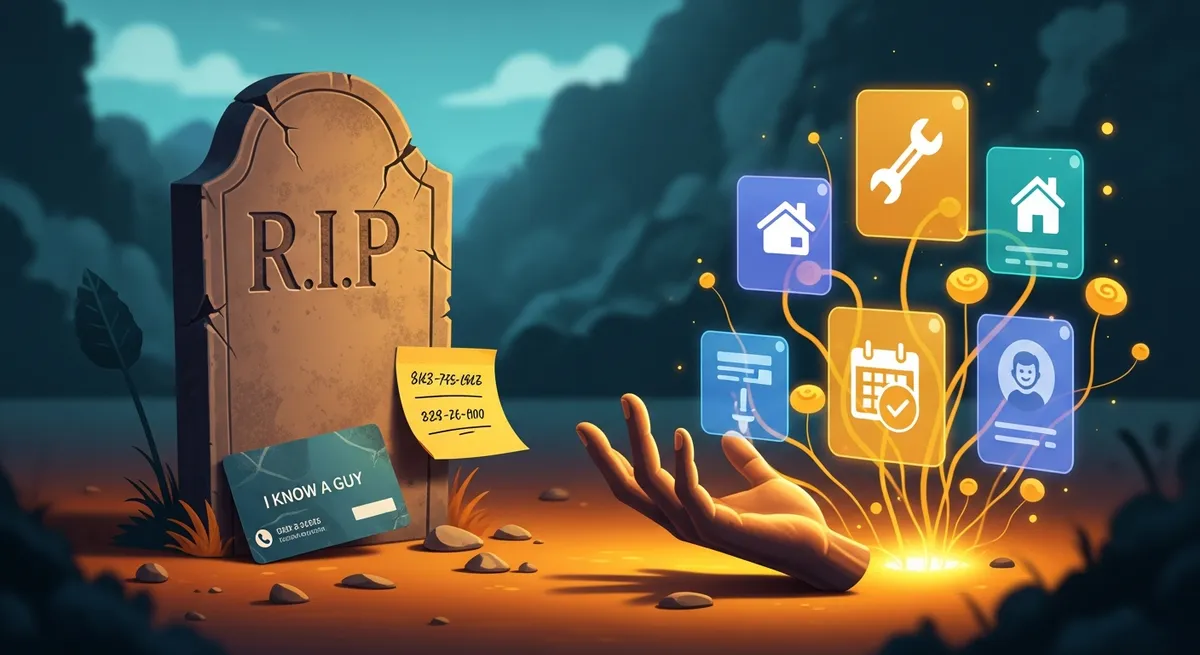
Remember the old way? (It wasn't that long ago, actually.) You needed a plumber. You asked your neighbor, Bob. Bob gave you a number on a sticky note. You called. No answer. You called again. Maybe-if the stars aligned-you got a call back three days later with a quote that felt... made up. Because it probably was. This system (if you can call it that) was built on opacity. It thrived on you not knowing what things cost. But that era is dying. Rapidly. And honestly? Good riddance. The shift to app-based home services isn't just about convenience; it's about killing the "friend of a friend" tax that's been draining our wallets for decades.
We are watching a fundamental shift in how we maintain our biggest asset. For fifty years, home maintenance was a black market of sorts. Unregulated, cash-heavy, and based entirely on hearsay. If you didn't have a plugged-in neighbor or a dad who knew carpentry, you were a mark. You were the person who paid $400 to change a flapper valve on a toilet. But the digitization of this industry is finally shining a light on those dark corners, and the results are actually putting leverage back in the hands of the homeowner.
The "Quote Roulette" (Why the Old Way Sucked)
Let's be real about the "good old days." They were a total black box. You ask Jim next door what he paid for gutters, and he says four hundred bucks. Call that exact same guy five minutes later from a different area code? Suddenly the price is $1,200. Just like that. (Funny how that works-or maybe it isn't funny at all.)
This happened because pricing was largely based on: A) How busy the contractor was that week. B) How expensive your house looked from the street. C) Whether or not they actually wanted the job.
It was arbitrary. It was frustrating. And if the work was terrible? You had zero recourse. Your only option was to complain to your neighbor, who would just shrug and say, "Well, he did a good job for me." Great. Thanks, Jim.
Data backs this up. A recent industry survey suggested that price variance for identical home services in the same zip code could swing by as much as 300%¹. That's not a market fluctuation. That's a gouge. It meant that two neighbors could pay vastly different sums for the exact same water heater installation, purely based on who answered the phone and what kind of car was parked in the driveway. It is a predatory inefficiency that only survived because we had no way to fact-check the numbers in real-time.
The Algorithm as the Great Equalizer
Enter the apps. (I won't name specific brands-you know the ones.)
People complain about technology ruining personal connections, and sure, maybe that's true for dating. But for fixing a leaky toilet? Give me the algorithm every time. Here is why the app model is actually cheaper for the consumer (usually):
1. The "Empty Seat" Economics Think of it like an airline. If a plane takes off with empty seats, that cash is gone. Poof. Vaporized. A contractor sitting at home on a Tuesday morning loses money. Apps fill those specific gaps. When a pro needs to fill a Tuesday slot, the price drops. It's simple supply and demand, finally applied to your drywall. By aggregating demand, these platforms allow service providers to optimize their routes and schedules. They stop driving across town for a quote and start actually working. That efficiency-less fuel, less downtime-eventually trickles down to the price you see on the screen.
2. The Fear of the 1-Star Review Contractors behave differently when a 1-star review hangs over their head like a guillotine. In the old days, a bad contractor could burn you and just move to the next town. Now? That digital stain follows them. It forces accountability. This is the "reputation economy" at work. A contractor with a 4.9 rating can charge a premium, sure, but they have to earn it every single day. One disaster job doesn't just ruin their week; it ruins their ranking. That pressure ensures that they show up on time, wear boot covers, and actually clean up the sawdust before they leave.
3. The Escrow Safety Net One major advantage people overlook is the payment structure. In the old model, you wrote a check for 50% upfront and hoped the guy came back. With apps, the money usually sits in escrow. You pay the platform, not the guy. The pro doesn't get those funds until the job is marked complete. This eliminates the classic "take the deposit and run" scam that has plagued the renovation industry for decades. It turns a transaction based on blind faith into one based on fulfilled contracts.
Let's Look at the Numbers
I hate citing averages because every house is different, but the pricing structures are undeniable when you compare the models side-by-side. The transparency alone changes the negotiation leverage.
The Old "Cash Discount" Trap
Okay, say you are ready to pull the trigger. You find a great pro on the platform with solid reviews. He shows up, looks at the job, and then hits you with the line:
"Hey, if we do this off the app, I can knock 10% off. Cash only."
Don't take the bait. Seriously. Just don't.
I know, I know-everyone loves saving a buck. And sticking it to the "corporate middleman" feels good. But that 10% discount? It comes with a 100% loss of protection. If he puts his foot through your ceiling five minutes after you hand him the cash, the app won't help you. You're on your own. (And he probably won't answer his phone.)
The platform fee isn't just for the introduction; it's insurance. It's the ability to hit a "Dispute" button and actually get a human to freeze the payment. In the chaotic world of home repair, that button is worth way more than the forty bucks you'd save paying cash. Plus-and this is the part nobody thinks about until it is too late-if an uninsured worker gets injured in your home while working "off the books," guess who is liable? You are. Suddenly, that forty dollars you saved turns into a forty-thousand-dollar medical lawsuit against your homeowner's insurance policy. It is simply not worth the gamble.
So, How Do You Navigate This Mess?
The solution isn't to blindly trust every profile with five stars. (Bot reviews are a thing-obviously.) You have to be smart about it.
First, look for the "Verified" badge. It means a human actually looked at their license and insurance paperwork. That badge confirms a real person reviewed their insurance docs. It acts as a primary filter. If they couldn't bother to upload a PDF of their liability insurance to the app, do you really want them re-wiring your kitchen?
Second, read the three-star reviews. The five-star ones are often fake; the one-star ones are often crazy people. But the three-star reviews? That's where the truth lives. "He did good work but was an hour late." That's an honest review. It tells you the technician is competent but maybe disorganized. You can work with disorganized. You can't work with incompetent.
And finally, define the scope before they arrive. Send photos. Lots of them. The biggest cause of "price creep" isn't malice-it's miscommunication. If they know exactly what they're walking into, the price stays locked. Take a picture of the problem from three feet away, then another from ten feet away. Context matters. A plumber needs to know if that leaking pipe is easily accessible or buried behind a vintage 1980s vanity cabinet that needs to be demolished to reach the leak.
Another insider trick? Ask questions in the app chat. Don't just book. Send a message first: "Hi, I have a standard toilet replacement, have you installed this specific brand before?" Why do this? Because their response time tells you everything. If they take 24 hours to reply to a simple text, they will take 24 days to fix a problem if something goes wrong. You want the pro who replies in ten minutes. Speed of communication is the single best proxy for professionalism in the gig economy.
FAQ: The Real Questions
Is it really safer than hiring a local company?
"Safer" is a loaded word. A local company with a physical office in your town is usually the safest bet-but they are also the most expensive. Compared to a random handyman from a flyer? Yes, the app is safer. Much safer. You have a digital paper trail. You have GPS data showing they were there. You have a third party holding the money. It removes the "he said, she said" dynamic that ruins so many renovation projects.
Do these apps actually background check people?
Yes, but don't assume it's FBI-level clearance. Usually, it's a standard criminal search³. It catches the big stuff, but it doesn't mean the guy is a saint. Trust, but verify. Be skeptical until the work is done. Never give a stranger a key to your house, regardless of how many stars they have on an app. Treat them like a professional, but protect your space like a fortress.
What if they damage my house?
If you stayed on the platform, most major apps have a "Happiness Guarantee" or liability coverage up to $1 million. If you paid cash? You better hope your homeowner's insurance covers "negligence by uncontracted workers" (Spoiler: It usually doesn't). This is the nuclear scenario. If a pipe bursts and floods your downstairs, the app's insurance policy kicks in. If you went off-app, you are likely paying for that restoration out of pocket.
Why are the quotes sometimes higher than "Bob's" quote?
Because Bob might be underbidding to get the job, planning to hike the price later, or he simply doesn't carry insurance. Legitimate businesses have overhead. The app price reflects the market rate for a compliant, insured professional. Bob's price reflects a guy with a truck and zero liability coverage. The difference in price is the cost of your peace of mind.
Can I negotiate the price on the app?
Usually, no. The price is the price. That is the whole point. However, for custom jobs (like "build me a deck"), you might get a range. If the app allows bidding, don't just pick the cheapest option. Pick the middle one. The cheapest one is desperate; the middle one is fair.
References
Disclaimer: This article is for informational purposes only and does not constitute professional, financial, or legal advice. Always verify contractor credentials and insurance coverage independently before hiring.