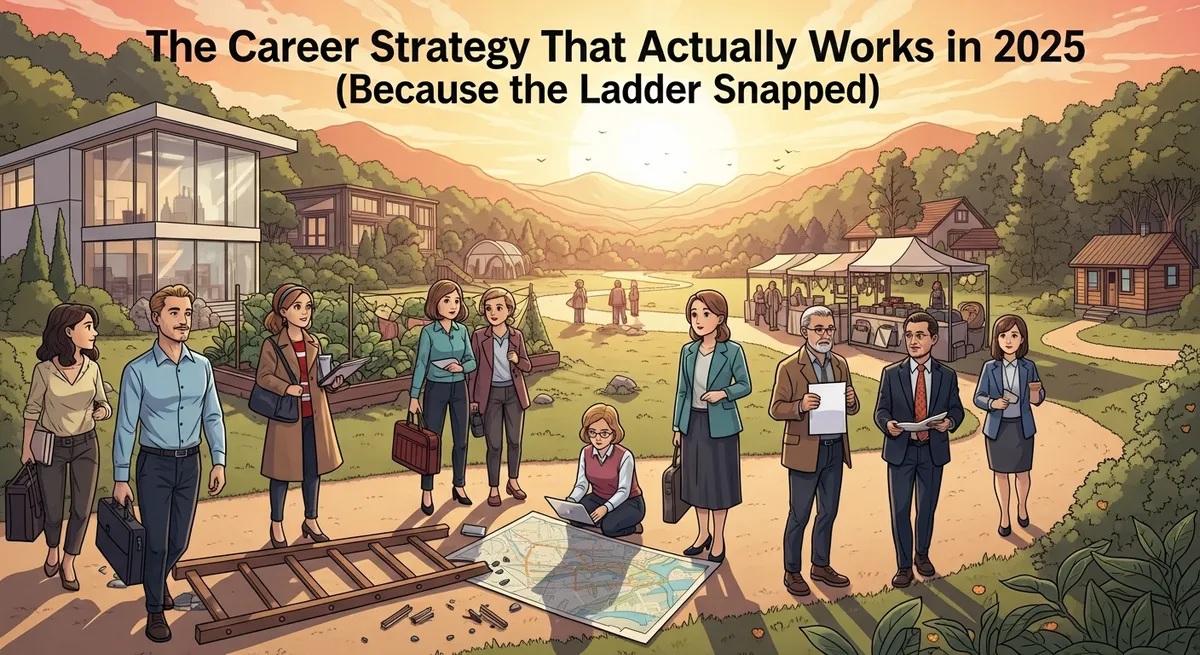
We all know the script. It is burned into our brains. Well-meaning parents put it there. High school guidance counselors reinforced it (even though most haven't applied for a real job since the Reagan administration). The promise was simple - dangerously simple. Get the degree. Land the entry-level role. Keep your head down. Wait for seniority to save you. It sounds nice. Comforting, even. But if you are banking on that straight-line path in 2025, you aren't just being optimistic - you are taking a massive gamble with your financial future. The game has changed completely. Actually, "changed" is too polite. The board was flipped over. The rules? They aren't just different. They are gone. If you don't pivot your strategy immediately - like, today - you might find yourself climbing a corporate ladder that is leaning against a burning building. Or a condemned one.
Why the "Straight Line" is a Trap (And a Dangerous One)
Here’s the thing about the old advice. It worked. Once. Back when pensions were real and "company loyalty" wasn't a punchline.
But today? That advice is dangerous. Actually - scratch that. It is negligent.
We tell 22-year-olds to wait their turn. To grind. To pay dues. But looking at the modern market - and I’ve been tracking job market trends in 2025 closely - waiting your turn is just a great way to get left behind. The Bureau of Labor Statistics (BLS) drops data about job tenure that makes you want to scream. The average tenure? About four years. That’s it.¹
That’s barely enough time to figure out where the good coffee filters are kept.
So if you're planning a 30-year climb at one firm, you're planning for a world that evaporated twenty years ago. The "Straight Line" assumes stability. And if the last few years have taught us anything (looking at you, 2020), it’s that stability is a ghost.
There is another silent killer here: The Loyalty Tax. You might have heard of it. It’s the phenomenon where employees who stay at a company for more than two years get paid 50% less² over their lifetime than those who switch jobs. Think about that. By being "loyal," you are actively subsidizing your employer's bottom line with your own potential earnings. While you accept a 3% "cost of living" adjustment (which, let's be honest, doesn't even cover the price hike on eggs), the new hire sitting next to you is coming in at a market rate that is 20% higher³ than your salary. It hurts. But it is the math.
The Layoff Wake-Up Call
Remember the "Year of Efficiency"?
Tech giants. Media companies. Banks. They didn't just trim fat. They cut bone. Look at the carnage from late 2023 and throughout 2024. Thousands of people who did everything "right" - the late nights, the extra projects, the "being a team player" nonsense - got the email.
Access revoked. Laptop bricked. See ya.
It’s brutal. (I know, I’ve been there. It stings.) But it shattered the illusion. The company isn't your family. It's a business. And in this economy, your skills are the only leverage you have. If you’re relying on a job title to keep you safe, you’re already in trouble.
I saw this happen to a friend of mine recently. Let's call him Dave. Dave was a middle manager at a logistics firm. Good guy. Worked 60 hours a week. He thought his "institutional knowledge" made him indispensable. Then an algorithm update automated 40% of his department's workflow. Dave wasn't fired because he was bad at his job. He was fired because his job ceased to exist as a human function. This is the reality of the 2025 environment. Automation isn't coming for the factory floor anymore; it is coming for the cubicles. It is coming for the spreadsheets.³
Let's Look at the Numbers
I hate math. Really. But sometimes you have to look at the ledger. When we compare the old "wait for a raise" method against the new "aggressive upskilling" approach, the difference is... well, it's offensive.
See that bottom row? That's the cheat code. The people winning right now aren't the ones with the most seniority. They're the ones stacking skills like Legos.
The Solution: Become a Mercenary (Ideally, a Nice One)
Okay. I know. Mercenary sounds harsh. Maybe "free agent" is better? No, let's stick with mercenary. It implies you are fighting for yourself.
The fix isn't to stop working hard. It's to stop working hard for vague promises. Instead, you need to focus on tangible, portable value. This is where the best online certifications come into play - and I don't mean those generic "Leadership 101" courses that HR makes you watch at 2x speed.
I'm talking about hard skills. The stuff that scares people.
Data analytics. Project management (PMP). Specialized coding. Cloud architecture. These aren't just buzzwords; they are currency. If you have them, you can walk into a negotiation with leverage. If you don't? You're just hoping the boss is in a good mood.
Consider the difference between a generic "Marketing Manager" and a "Growth Marketer with SQL and Python proficiency." The first one is fighting for a job against 500 other applicants with the same resume. The second one? Recruiters are sliding into their DMs daily. Why? Because the second one solves a math problem for the business, while the first one just fills a seat. This is what I mean by leverage. You want to be the painkiller, not the vitamin.
The beauty of the internet age - and yes, it has downsides, but hear me out - is that you don't need to go back to grad school for two years and rack up $80k in debt to pivot. You can learn high-paying remote skills on a Saturday morning. Or Tuesday night. Whenever.
Action Plan: Stop "Waiting" and Start "Stacking"
So, what now? Quit your job tomorrow? (Please don't. Rent is due.)
But you need to shift gears. Mentally, at least. Stop viewing your career as a ladder and start viewing it as a portfolio. You are an asset manager. The asset is you.
Here is what I’d tell my younger self if I could go back and shake him:
1. Audit your "Hire-ability" ruthlessly. Go to LinkedIn. Look at the job descriptions for the role above yours. Or the role you actually want. Do you have 80% of those keywords? If not, you have a gap. Don't ignore it. Fix it. Be honest with yourself here. If the job requires Tableau and you only know Excel, you are not "close enough." You are unqualified. Identify the gap, then find the specific certification that bridges it. This is surgical career management.
2. Chase the "Boring" Certifications. Everyone wants to be a "Creative Director." Nobody wants to be a "Supply Chain Analyst." But guess which one survives a downturn? (Okay, nothing is fully recession-proof - let's be real - but some jobs are definitely safer than others.) Look for industries that keep the lights on. Healthcare. Logistics. Cybersecurity. These sectors aren't sexy. They don't have cool offices with ping-pong tables. But they have payrolls that clear every two weeks, regardless of what the stock market is doing.
3. Use the "2-Year Rule." If you haven't learned a significant new skill or received a significant raise (above inflation) in two years, you are stagnating. The market is moving forward. If you are standing still, you are falling behind. It’s physics. Sort of. You need to be constantly updating your software (your brain). If you are running on Career OS 2021, you are going to crash when you try to open the 2025 opportunities.
4. Build a "Public Portfolio." Resumes are boring. Nobody reads them. They scan them for six seconds. If you want to stand out, show your work. Build a simple website. Write articles on LinkedIn about problems you solved. Share your code on GitHub. When a hiring manager Googles you (and they will), you want them to find evidence of your competence, not just your high school track times. Make your expertise visible.
FAQ: Real Talk About Your Career
Is a college degree totally useless now?
No. Definitely not. It helps you get past the ATS (Applicant Tracking System) bots. But think of it as the floor. Not the ceiling. It gets you in the room. It does not get you the corner office. Or the remote setup (which is arguably better anyway).
Is it too late to pivot if I am over 40?
I hear this constantly. "I am too old to learn Python." "I am too old for digital marketing." Garbage. Absolute garbage. In fact, your experience is an asset. You know how to talk to humans (something Gen Z is... working on). Combine that soft skill with a hard technical skill, and you are dangerous.
What if I pick the wrong skill?
Then you learn another one. The cost of being wrong is a few months of study and maybe a few hundred bucks. The cost of doing nothing? That’s the real risk. That’s the one that leaves you stranded when the next "restructuring" email hits.
Can I do this while working full-time?
Yes. In fact, you have to. Don't quit your day job to "find yourself." Find yourself between 7 PM and 9 PM on Tuesdays. It's grueling. It's tiring. But it is the only way to build a bridge to the next level without setting fire to your current financial safety net.
Will AI replace the jobs I am training for?
If you train to be a copy-paster? Yes. If you train to be a problem solver who uses AI? No. The goal isn't to beat the robot. It is to be the person who tells the robot what to do. That role isn't going anywhere.
References
Disclaimer: This article is provided for informational purposes only and does not constitute financial, career, or legal advice. Individual results may vary based on location, industry, and economic conditions.