I was sitting in my favorite leather chair, nursing a glass of something expensive and French (it was a 2015 Bordeaux that cost significantly more than my first car), when my neighbor Sheila called. Sheila is a woman who treats a restaurant menu like a legal deposition. (I once watched her cross-examine a waiter about the precise geological origin of a shallot for fifteen minutes.) She asked me what I thought about posthumous sperm retrieval. I nearly dropped my glass. It is a topic that sounds like something out of a poorly written science fiction novel, yet it is a brutal, cold reality for more people than you might think. (I have realized that life usually finds a way to be weirder than fiction at the worst possible moments.)
I was loitering in a hospital waiting room that smelled like lemon bleach and deferred hope when the unthinkable happened to a close friend. (The fluorescent lights in those places are designed to make everyone look like they have been dead for three days.) Your partner is gone, yet a frantic, electric thought flashes through your mind before you can even process the grief. You want a piece of them to stay. You want their DNA. You want a legacy. It is a spectacular, head-on collision between twenty-first-century medical wizardry and the kind of ancient, primal grief that leaves you unable to remember your own middle name. I once forgot my own zip code for three weeks after my dog died. (I am not being hyperbolic; I actually had to look it up on a piece of mail.) I cannot imagine the mental fog that accompanies a human loss of this magnitude.
The Biological Clock and the Ethical Framework That Is Failing
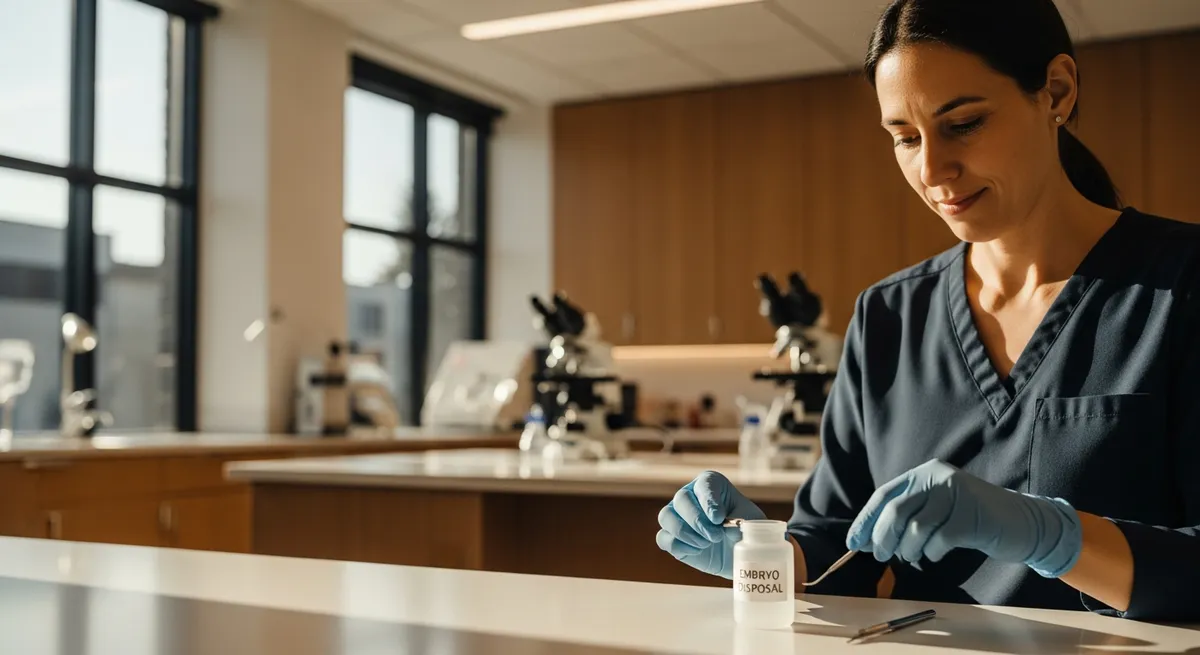
Here is the cold, hard reality that nobody wants to discuss at a cocktail party. The biological window for this procedure is vanishingly small. (We are talking about twenty-four to thirty-six hours, tops, before nature takes its course and the cells decide they have had enough.) The American Society for Reproductive Medicine points out that requests for posthumous gamete retrieval are ballooning, yet our ethical frameworks are as fragile as a Victorian tea set.¹ (I suspect this rise is because we are all collectively terrified of our own expiration dates and looking for a technological loophole.) However, the legal framework for this is a disaster. It is a messy, bureaucratic nightmare being handled with all the grace of a toddler in a porcelain shop. Most hospitals have no earthly idea what to do when a grieving spouse shows up with a lawyer at two in the morning.
It is a bureaucratic migraine of the highest order. Not even close to being simple. I spoke with my old friend Arthur. (He is a medical lawyer who drinks more espresso than is strictly healthy for a man in his sixties; he vibrates when he stands still.) Arthur told me that most people assume their marriage license is a universal key to their partner's body. It is not. The law does not work that way. A study published in the Journal of Law and the Biosciences highlights that without explicit prior consent, we are essentially guessing at a dead person's intent.² We are playing a high-stakes game of "I think he would have liked this" with genetic material. It is guesswork. Pure and simple. (And let us be honest, I cannot even trust my partner to pick the right kind of bread at the grocery store, so why would I trust them to guess my reproductive intent after I am gone?)
The Legal Nightmare of Assuming Consent Where None Exists
Try to picture yourself as a urologist on call at three in the morning. (I am not a doctor, but I have seen enough medical dramas to know that the lighting is always terrible and the coffee is always cold.) A grieving spouse bursts in with a court order, demanding you perform a surgical retrieval on a corpse that has not even cooled yet. You are suddenly the general manager of a biological legacy that you never actually asked to curate. It is entirely too much for any one person to carry. It is, frankly, a total mess. It is a lottery where the stakes are life itself. (My own partner, God bless her, cannot even decide on a brand of toothpaste without a three-minute debate, so the idea of assuming her eternal reproductive wishes feels like a massive stretch.)
The medical community is also quite twitchy about this, and for good reason. If the deceased never signed a paper saying "Yes, please use my DNA after I am gone," the hospital is essentially committing a form of battery. The American Medical Association is very clear on informed consent.³ Death does not magically erase the right to bodily autonomy. I checked. The rules are firm even if the emotions are fluid. The core ethical tension lies between the rights of the deceased to bodily autonomy and the desires of the survivor to find some semblance of continuity. (I am not trying to be a buzzkill, but someone has to say it: your grief does not grant you ownership of someone else's cells.)
How to Navigate This Environment and Protect Your Future
You need to talk about this. Now. (I know, it is about as fun as a root canal without anesthesia, but it is necessary.) Do not wait for a tragedy to find out where your partner stands. I sat down with my partner last night and asked the question. It was awkward. I felt like a ghoul. But now I know. (For the record, she said no, which was surprisingly insulting to my ego, but I respect the honesty.) We often focus on the rights of the adults, but what about the person who is born ten years after their father has passed away? The ethics are not just about the moment of retrieval; they are about the decades of parenting that follow. If you are doing this to fill a hole in your heart, you are asking a child to do a job that no human should ever have to do. It is a delicate balance. (It is a distinction that is incredibly difficult to make when you are blinded by the initial fog of bereavement.)
The American Society for Reproductive Medicine suggests that clinics should require written consent for posthumous use during the initial egg or sperm freezing process. But what about everyone else? What about the people who are not planning for infertility? They are the ones left in the lurch. They are the ones calling Sheila or Arthur at midnight. Do not be that person. Write it down. Put it in your will. Put it on a sticky note on the fridge if you have to. If you are reading this and thinking that you should probably update your will, you are absolutely right. (I have a folder in my desk labeled "In Case I Kick The Bucket," and while it sounds morbid, it gives me a strange sense of peace.)
Myth vs. Fact
Myth: Being married gives you automatic legal rights to your partner's sperm or eggs after they die.
Fact: Without a written directive, many hospitals and clinics will refuse retrieval to avoid legal battery charges and ethical violations.
We think we have time. We do not. The world is a chaotic place, and the law is a blunt instrument. (I have spent twenty years watching people make expensive mistakes because they thought they had more time.) Do not let your legacy be a court case. It is too important for that. It is your life. Or what remains of it. Navigating the legal terrain requires more than just good intentions; it requires a specialized reproductive law attorney rather than a general practitioner. Without clear documentation, you might find yourself fighting for the right to use the material while the storage fees continue to mount. It is a cruel irony that the more you have to fight for your rights, the less money you will have left to actually raise the child you are fighting for. (I have seen people make this choice and regret it, and I have seen people who find immense joy in it.)
❓ Is posthumous reproduction legal everywhere?
Here is the thing about our legal system: it is a patchwork quilt made by people who cannot agree on the color of the thread. In the United States, there is no federal law, meaning each state is left to its own devices. If you are outside the United States, countries like France and Germany have historically been much stricter, often banning the practice entirely. It is a geographic lottery, and you need to know the rules of the game in your specific area. (I once tried to understand the tax laws in Delaware and ended up with a migraine; reproductive law is ten times worse.)
❓ How long do you have to retrieve sperm or eggs after death?
Most medical experts agree that the window for viable retrieval is between twenty-four and thirty-six hours post-mortem. After that, the quality of the genetic material degrades significantly, making successful fertilization much less likely. It is a frantic, high-pressure situation that requires immediate coordination between the family, the hospital, and a fertility specialist. If you wait for the weekend to pass, you have likely missed your chance. (Time is a thief, but in this case, it is more like a professional burglar.)
❓ Can a court order retrieval without a will?
The short answer surprises most people: technically, a court can order retrieval without prior written consent, but it is an uphill battle that usually ends in heartbreak. Most reputable clinics and hospitals will absolutely refuse to touch a body without a clear, written directive from the deceased. This is to protect themselves from liability and to uphold the ethical principle of bodily autonomy. Without that piece of paper, you are asking a judge to guess what your partner would have wanted, and judges are notoriously bad at guessing. Prior consent is your golden ticket in this scenario.
❓ What about the rights of the deceased's parents?
There have been cases where parents have won the right to retrieve their son's sperm to create a grandchild, but these are the exceptions, not the rule. Usually, these cases involve proof that the deceased had a strong desire to be a parent. Without that evidence, most courts will rule in favor of the deceased person's bodily integrity over the parents' desire for a legacy. (I love my mother, but the thought of her litigating my testicles in open court is enough to make me want to live forever.)
❓ What are the long-term legal implications for the child?
This is where it gets truly messy. In the 2012 Supreme Court case Astrue v. Capato, the court ruled that children conceived posthumously may not be eligible for Social Security survivor benefits unless state law specifically allows it.⁴ You are protecting the person you love from a bureaucratic nightmare and ensuring that any future child is born into a situation of intentionality rather than legal chaos. According to the American Bar Association, having these documents in place is the single most effective way to avoid the legal quagmire that follows a sudden death.⁵ (Life is unpredictable, but your reproductive intent does not have to be.)
At the end of the day, we are all just trying to make sense of our time on this spinning rock. If science gives us a way to extend our connection to those we love, it is a powerful tool. It is messy, it is clinical, and it is entirely necessary to handle it with the care it deserves. Now, go have that uncomfortable conversation, and then go buy yourself a very nice bottle of wine. (You are going to need it.)
References
Disclaimer: This article is for informational purposes only and does not constitute legal or medical advice. The laws surrounding posthumous reproduction are complex and vary significantly by jurisdiction. You should consult with a qualified attorney and medical professional before making any decisions related to this topic.