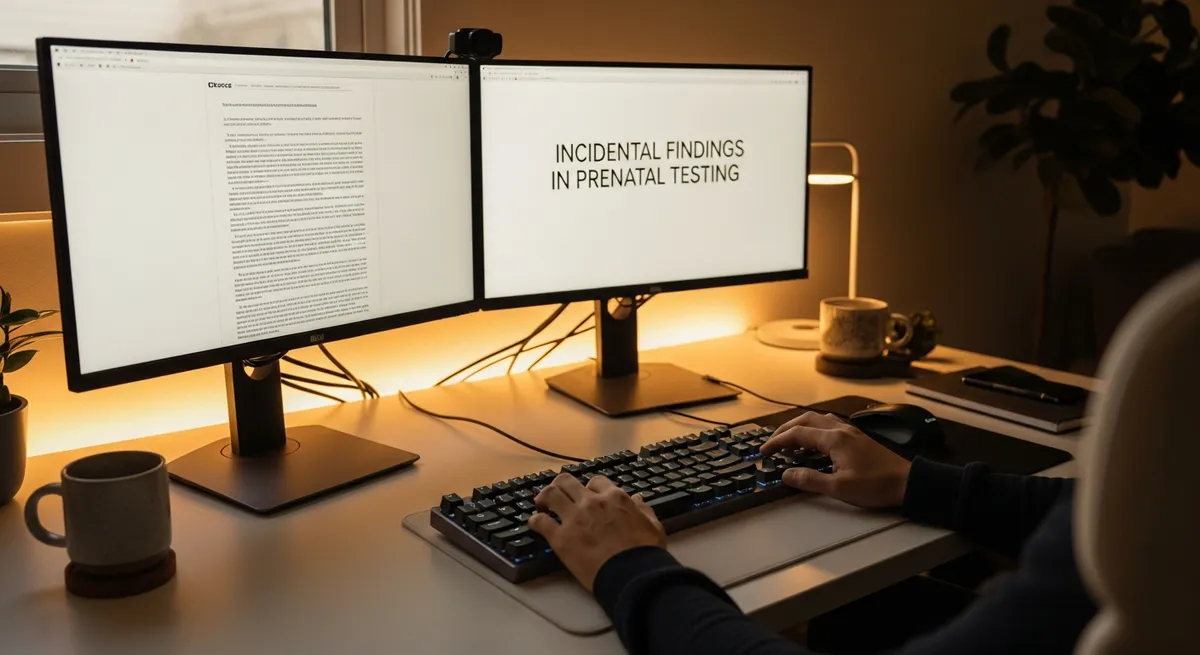
I was perched atop that atrocious, crinkly medical paper - the variety that sounds like a thousand candy wrappers screaming in unison - while I waited for Dr. Aris to inform me that all was well. (I am firmly convinced that this specific brand of paper exists solely to ensure that no patient ever feels truly dignified.) I had visited the office for a routine non-invasive prenatal test. I wanted to verify the chromosomal health of the fetus. It was supposed to be a straightforward affair. It was not. (Science complicates a Tuesday afternoon faster than a toddler with a marker.)
However, when the physician enters the room, he does not appear to be a harbinger of tidings that are glad; rather, he resembles a stern federal auditor prepared to announce a ruinous financial penalty from the mid-nineties. He informed me that the baby was healthy, but there was what he called an incidental finding. It was not the information I requested. It was not even in the same zip code as the information I requested. (I felt my heart descend into my footwear, which were, regrettably, very sensible and unstylish loafers.) Suddenly, I was no longer a person who was merely pregnant; I was an amateur geneticist frantically searching for medical terminology that looked as though a feline had wandered across a keyboard. This is the contemporary, disorganized reality of prenatal care. (It is a world where we have more data than we have sanity, and the exchange rate is not in our favor.)
The Curse of the Overachieving Machine
We have entered a strange era of medical surveillance. We have constructed sophisticated machinery that possesses the capability to see everything. However, we have not quite determined if we are actually required to observe every minute detail. It is a quintessential instance of technological capabilities far exceeding our emotional capacity to process the results. (I blame the engineers, quite frankly, though I am certain they are lovely individuals who simply wish to be thorough to a fault.) We are treating genetic testing like a standard blood count, but it is more akin to a digital deep-dive into the very essence of human existence. It is a messy process. It is an overwhelming process. (And I say this as someone who once spent forty-five minutes trying to understand the terms and conditions of a software update.)
My friend Martha experienced this exact phenomenon last year. (Martha is the specific type of person who organizes her spice rack by the volatile oil content of the cumin, so you can imagine her reaction to ambiguity.) She spent six weeks in a state of absolute clinical dread because her prenatal screen flagged a minor genetic variation in her own DNA that she never knew existed. The irony of the situation is that the baby was perfectly healthy, and the finding was what the medical community labels as non-actionable. That is a sophisticated way of saying that the laboratory found something peculiar, but there is absolutely nothing that can be done about it. There was no remedy to pursue. There was no action to take. (It was just a piece of scary information that lived in her brain like a squatter who refused to pay rent.)
Data Without Direction
According to a 2026 study published in the Journal of the American Medical Association, incidental findings can range from maternal health issues to genetic anomalies in the fetus that have no clear medical outcome¹. Read that sentence again. No clear outcome. We are paying for the distinct privilege of being told we might have a problem that might not even be a problem. (I would like to speak to the manager of science, immediately.) This is a level of complexity that most individuals are not prepared for when they sign the consent form at ten weeks pregnant. (At ten weeks, I was mostly prepared for a nap and a bagel, not a lecture on chromosomal micro-deletions.)
The experience is remarkably similar to visiting my mechanic, Steve - who, quite frankly, possesses a fragrance reminiscent of stale cigars and professional disappointment - only for him to inform me that while my engine is pristine, my hubcaps might succumb to oxidation in the year 2045. Do you wish to possess that specific knowledge? I do not. Does it facilitate my commute to the grocery store this afternoon? It does not. Yet, here we are, drowning in a sea of data that we cannot utilize. My neighbor Bob - who spends his weekends meticulously polishing his gravel driveway - loves this kind of data. I do not. (Bob also thinks he can predict the weather by the way his knees ache, so his credibility is somewhat questionable.)
The Laboratory Arms Race
The commercial laboratories are currently engaged in a frantic race to be the most comprehensive providers in the market. They want to demonstrate that their proprietary test is superior because it captures more information. (They are striving for the gold medal in being the smartest individual in the room, but they are primarily causing us all to weep into our evening glass of wine.) By disclosing every minute blip and murmur on the genetic map, they are essentially handing us a map of a city we have no intention of visiting and instructing us to worry about the potential traffic. It is exhausting. It is unnecessary. (And I am quite certain it is contributing more to my gray hair count than the actual pregnancy ever could.)
The medical community is currently witnessing a significant internal conflict regarding whether this information should even be disclosed to patients. On one side of the debate, you have the fundamental principle of patient autonomy. This suggests that you have a right to know every single thing the machine discovers. On the other side, you have the principle of non-maleficence, which is a fancy way of saying \"do no harm.\" According to the American College of Obstetricians and Gynecologists, the expansion of these tests into lower-risk populations increases the frequency of results that provide no clinical benefit³. If a physician knows that a specific genetic finding is likely a false positive or possesses no clinical significance, is it truly helpful to inform the parents? Or is it merely a form of psychological cruelty? (I lean toward the latter, especially when I have not had a full night of sleep in three months.)
How to Survive the Information Avalanche
So, what are you supposed to do when you find yourself staring down the barrel of a genetic screening? The initial step is to recognize that you possess a choice in the matter. You are not a passive recipient of data; you are the individual in the driver's seat of your own healthcare journey. Before you permit anyone to draw a single drop of blood, you must have an incredibly honest conversation with your partner and your physician. (This is significantly more important than debating the merits of a crib versus a bassinet, though I understand that the bassinet debate can become quite heated.)
Ask yourself a difficult question: \"Do I wish to know about things that we cannot fix?\" If the answer is no, you can often specify that you only wish to be informed about specific, actionable findings. It is like instructing a waiter that you do not wish to see the dessert menu because you are fully aware that you possess no self-control. (I have never actually done that with a dessert menu, but the metaphor remains sound in theory.) You must remember that an incidental finding is often just a very sensitive smoke alarm reacting to a piece of genetic toast. It does not necessarily mean the house is on fire. It just means the sensor is doing its job a bit too enthusiastically.
Before you permit the panic to take root, you must verify the result with diagnostic tests such as an amniocentesis or chorionic villus sampling. Yes, these procedures are more invasive. (They involve needles that are longer than I would prefer to contemplate.) However, they provide the clarity that a screening test simply cannot offer. Finally, you must trust your instincts. We reside in a world that worships at the altar of data, but data does not know your family. It does not know your strength. If a finding is non-actionable, it is perfectly acceptable to put it in a mental box and decide not to worry about it. (I have a similar box for my tax returns and that weird noise my refrigerator makes.)
The Bottom Line
At the end of the day, prenatal testing is a tool, not a mystical crystal ball. It is designed to assist us, but like any powerful tool, it can cause significant damage if it is utilized without caution. The rise of incidental findings is a side effect of our incredible progress in genomic sequencing, but our emotional evolution is still attempting to catch up. We are asking parents to process information that even the most seasoned geneticists struggle to interpret. It is unfair, it is complicated, and it is perfectly normal to feel overwhelmed by the entire ordeal. (If you feel like you need to hide under your duvet for a week, I support that decision entirely.)
The most effective way to navigate this genetic minefield is through education and the setting of firm boundaries. Seek out genetic counselors. They are the unsung heroes of this saga. They are the ones who can translate the cat-on-a-keyboard jargon into actual human English. And most importantly, you must remember that a genetic code is not a destiny. It is just a blueprint, and blueprints often have scribbled notes in the margins that never end up in the final building. You are more than the sum of your data. Your baby is more than their chromosomes. Hold onto that truth when the crinkly paper starts to feel like a cage. (And if all else fails, remember that I once tried to build a bookshelf from a manual that was missing four pages; it still holds books, even if it leans a little to the left.)
Frequently Asked Questions
❓ What exactly qualifies as an incidental finding in prenatal testing?
The short answer often catches people off guard because it involves data that has nothing to do with the original reason you took the test. In many instances, these findings are labeled as \"variants of uncertain significance.\" This means the laboratory observed something unusual in the genetic sequence, but science has not yet determined if it causes a health problem or if it is merely a harmless quirk of your unique biology. Current 2026 data shows that it is the medical equivalent of a \"check engine\" light that remains illuminated even when the vehicle is performing perfectly. (I have lived with such a light in my car for three years, and we are both doing just fine.)
❓ Are incidental findings always accurate?
Statistically, the \"positive predictive value\" of these incidental findings can be remarkably low. This means that even if the test indicates there is a \"finding,\" the actual probability of the baby having the condition might still be relatively small. As of the 2026 update from the National Institutes of Health, these incidental discoveries manifest in roughly 0.1 to 1 percent of all screenings performed². That might sound like a small number until you realize that millions of these tests are performed every year. You should never take a screening result as the final word on the health of your child without further, more precise testing.
❓ Why would a physician withhold a genetic finding from parents?
This is where the ethics become truly tangled. By disclosing a late-onset risk to parents - such as a predisposition to a condition that might not manifest for fifty years - the physician is essentially taking away that child's future right to decide if they want to know that information. Guidelines from the National Society of Genetic Counselors suggest that providers must carefully weigh the psychological burden of such data against the patient's right to know⁴. It is a complex philosophical debate that has no easy answers. Some doctors believe that telling you about a non-actionable risk is just a form of \"data dumping\" that causes unnecessary trauma without offering a solution.
❓ Does insurance cover the follow-up testing for incidental findings?
This varies wildly by provider, but typically, if a screening test returns an abnormal result, diagnostic follow-ups are considered medically necessary. However, you should be prepared for a fight. Sometimes, insurance companies will refuse to pay for testing on a condition they deem \"non-actionable.\" This is where your medical team needs to advocate for you. Keep detailed records of all your conversations and do not be afraid to appeal a denial if you believe the testing is essential for your peace of mind or care plan. (I find that using my \"disappointed librarian\" voice works wonders when speaking to insurance representatives.)
❓ Can these tests reveal information about my own health?
Yes, and this is perhaps the most shocking part of the process. Sometimes, the test reveals a genetic issue with the mother that she never knew she had. It could be a predisposition to certain cancers or a silent chromosomal disorder. Suddenly, a test about the baby becomes a life-altering diagnosis for the parent. This is why it is vital to discuss the scope of the testing before you begin. You might be looking for information about your child, but you might end up finding out things about yourself that you were not prepared to handle on a Tuesday morning.
References
Disclaimer: This article is for informational purposes only and does not constitute professional medical advice, diagnosis, or treatment. Genetic testing is an incredibly complex field that is constantly evolving. Always seek the advice of your physician, genetic counselor, or other qualified health provider with any questions you may have regarding a medical condition or genetic testing results. Never disregard professional medical advice or delay in seeking it because of something you have read here.