Three years ago, I found myself perched on a rigid plastic chair in a hospital waiting room, observing my friend Sarah - a woman who regularly conquers marathons and navigates systemic stress with the poise of a professional monk - as she was prepared for what the medical staff labeled a \"routine delivery.\" (I remain firmly convinced that \"routine\" is merely a linguistic mask used by large institutions when they wish to avoid explaining the sheer mountain of bureaucratic paperwork they intend to generate.) By the time I gained access to her bedside, she was already entangled in four distinct electronic monitors, an intravenous drip was pulsing into her arm, and the atmosphere vibrated with the cold, intrusive energy of a high-stakes air traffic control center. (I truly felt as though a flight suit was required equipment just to offer her a lukewarm glass of water.)
We are currently facing a monumental problem. It is a crisis of perspective. We have managed to transform the act of childbearing into a clinical emergency by default. According to the World Health Organization, approximately 85 percent of all births are classified as low-risk and should ideally proceed without any major medical interference. (I scrutinized that figure twice because it seemed far too logical to be compatible with our current healthcare landscape.) Yet, within the United States, the rate of Cesarean sections persistently hovers near 32 percent, as reported by the Centers for Disease Control and Prevention. That constitutes one out of every three births. One. In. Three. I have personally witnessed this occur to perfectly healthy women who simply required a bit more time and significantly less offensive fluorescent lighting. (The lighting in those labor wards is truly an affront to anyone who possesses a soul or a functioning retina.)
The Clock is Ticking (Because the Doctor Has Plans)
We have reached a cultural precipice where the bioethical debate is no longer centered on whether we possess the capability to intervene, but rather why we feel an insatiable compulsion to do so as a primary reflex. It is a widespread societal phenomenon. We are collectively terrified of the unpredictable nature of biological time. Society demands that birth be scheduled, scrubbed of its mess, and rendered entirely predictable, much like a standard teeth cleaning or a mundane operating system patch. (I have made expensive mistakes in my own life by trying to schedule the unschedulable, and it usually ends with me crying in a parking lot.) My sister-in-law, Brenda, was once informed by her medical team that she was required to deliver by 5:00 PM. The reason? Her physician had non-negotiable dinner reservations. (I wish I were crafting a satirical anecdote here, but Brenda retains the receipts and a very long, very bitter memory of that evening.)
When we treat the onset of labor like a medical catastrophe from the very first contraction, we effectively strip the individual of their personhood and agency. We transform a participant into a passive patient. Furthermore, the financial incentives are - to speak with total candor - profoundly skewed. Let us be entirely honest about the economics of the delivery room. A C-section costs a monumental amount more than a physiological vaginal birth. It is more efficient for the institutional schedule. It is more lucrative for the bottom line. (I am not suggesting your obstetrician is financing a luxury yacht with the proceeds of your epidural, but the underlying mathematics are hardly a state secret.) A 2024 study published in the Journal of Health Economics highlighted that hospitals are statistically more likely to perform surgical deliveries when they have surplus beds to fill. That should ignite a sense of outrage within you. It makes me absolutely incensed.
The Industrial-Birth Complex and the Psychology of Fear
The problem is that we have built an entire industry around the idea that the female body is a ticking time bomb. (My neighbor Bob, who is a retired plumber, tells me that people only call him when the pipes have already burst, but hospitals seem to want to replace the pipes before they even turn on the water.) This culture of fear is not accidental; it is a byproduct of a system that prioritizes risk management over human experience. The Commonwealth Fund released a report in 2020 which revealed that the United States maintains the highest maternal mortality rate among developed nations, despite our obsession with expensive machinery. We are spending more and achieving less. It is a paradox that should keep hospital administrators awake at night. (Instead, they are likely worrying about the price of the artisan coffee in the lobby.)
I once spoke with a contractor named Dave who told me that the most expensive mistake a homeowner can make is "over-engineering" a simple fix. (Dave is the kind of man who wears a pencil behind his ear even at a funeral, so I tend to trust his judgment.) We are over-engineering birth. We are using a sledgehammer to hang a picture frame. We have forgotten that for thousands of years, the human body has been relatively competent at this specific task. I am not suggesting we return to the middle ages - I quite enjoy modern plumbing and antibiotics - but I am suggesting that we stop treating every pregnant person like they are a broken machine in need of a factory reset.
The Midwife Alternative: Not Just for Hippies Anymore
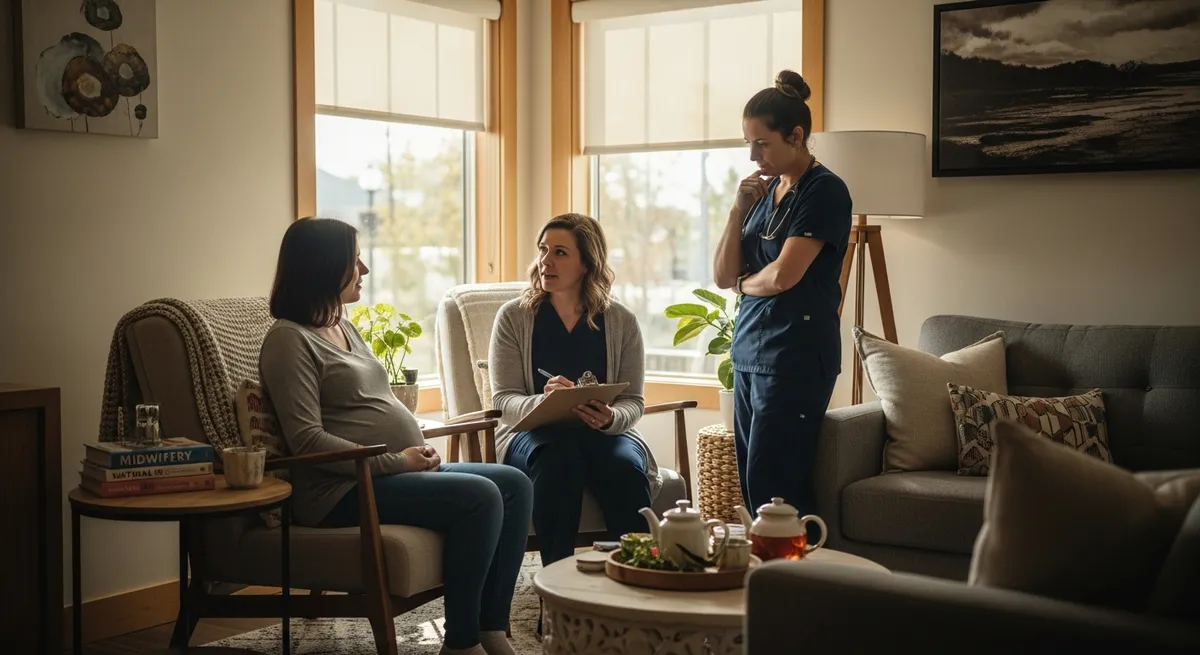
There exists an alternative path. It is not a novel invention. It is, in fact, an ancient tradition that has been refined by modern science. Midwifery is not some nostalgic throwback to a primitive era; it is a sophisticated, evidence-based approach to maternal care. This is often referred to as the Midwifery Model of Care. It is not about being "anti-medicine." It is about being "pro-appropriateness." A midwife remains present for the entire duration of the journey. They do not merely appear when it is time to push and then vanish into the hallway. (My friend Dave the contractor says the best way to restore a historic home is to work with the existing structure rather than fighting against it; midwives apply this exact philosophy to the human body.)
A comprehensive Cochrane review encompassing over 17,000 women demonstrated that those who received midwife-led continuity of care were significantly less likely to experience invasive interventions. They were also more likely to report high levels of satisfaction with their experience. They were even less likely to experience a preterm birth. Midwives tend to dedicate a much larger portion of their time to their patients. They discuss nutrition. They discuss emotional health. They provide the "secret sauce" of care, which is simply paying attention. (It is not magic; it is just the revolutionary act of listening to a human being.) The American College of Nurse-Midwives notes that this model leads to better outcomes because it respects the physiological process rather than trying to dominate it. (I find that I am much more cooperative when someone treats me like an adult rather than a checkbox on a clipboard.)
How To Take Back Your Birth Without The Drama
So, what are you expected to do if you are currently navigating a pregnancy and find yourself staring at a hospital brochure that looks like a technical manual for a nuclear submarine? The first step is to become a relentless investigator. You must ask difficult questions. Ask about their institutional policy on arbitrary "due dates." Ask what occurs if you desire to move around during labor instead of being tethered to a bed like a captive. If the medical staff rolls their eyes or offers a patronizing pat on the hand, it is an immediate signal to seek a new provider. You are the primary stakeholder in this transaction. (Trust me, I have been the "difficult" patient for over two decades, and the care is usually superior when you refuse to be ignored.)
Seek out hybrid models of care. Many hospitals now employ Certified Nurse-Midwives who work alongside surgeons. This allows you to receive the low-intervention, high-support care of a midwife, while keeping the expensive machines nearby just in case the universe has alternative plans. (It is very much like keeping a fire extinguisher in your pantry; you hope to never utilize it, but you are immensely relieved it is there.) These collaborative systems represent the future of sane, evidence-based maternity care. They acknowledge that while medical technology is a miracle, it should never be a mandate. We can achieve safety without the total sacrifice of our dignity or our personal agency. It is entirely possible. I have seen it happen, and the transformation in the parents' faces is all the proof I require. They do not look like they have just survived a traumatic battle; they look like they have just accomplished something extraordinary.
Did You Know?
According to a 2020 report from the Commonwealth Fund, the United States has the highest maternal mortality rate among developed nations, yet we spend the most on childbirth. It is almost as if throwing money and machines at a natural process does not actually make it safer. We are essentially paying a premium for a system that often yields poorer results than less medicalized models.
The Bioethical Win: Autonomy and Choice
In the final analysis, the conversation comes down to what we value as a society. Do we value the convenience of the institution, or do we value the profound experience of the human being? Midwives are experts in identifying the precise moment when a situation shifts from "normal" to "complicated." When a genuine medical necessity arises, they do not hesitate; they facilitate a seamless transfer of care to a specialist. This is the right tool for the job. You do not utilize a chainsaw to prune a delicate bonsai tree, and you do not require an operating room for a healthy, low-risk labor. (I once tried to fix my own laptop with a butter knife, and let us just say the results were both expensive and embarrassing.) Choosing a provider who respects the physiological process is the best way to ensure that your birth is defined by your own strength, rather than by a hospital's rigid protocols.
Frequently Asked Questions
❓ Is midwifery care only intended for people who want a home birth?
This is a common misconception that persists despite the evidence. In fact, a significant number of Certified Nurse-Midwives practice within major medical centers every single day. Choosing a midwife does not mean you are required to deliver in a tub in your living room unless that is your specific desire. It simply means you are choosing a provider who views birth as a physiological event rather than a surgical procedure waiting to happen. (I personally prefer my anxiety to be centered on things I can actually control, such as whether I remembered to turn off the coffee maker before leaving the house.)
❓ What happens if an actual emergency occurs during a midwife-led birth?
This is where the true beauty of a collaborative system shines through the thick bureaucratic fog of the modern hospital. Midwives are expertly trained to identify the subtle signs that a "normal" birth is shifting into "complicated" territory. If a true medical necessity arises, they facilitate a transfer of care to an obstetrician or a surgeon immediately. You receive the specialist you need, but only when you actually require one. Most people find this much more reassuring than being treated like an emergency from the moment they walk through the sliding glass doors. (It is about having the right safety net, not living in the net itself.)
❓ Are midwives as safe as doctors for low-risk pregnancies?
For a healthy person, a health specialist is usually the superior fit for the task at hand. Numerous studies, including research from the American College of Obstetricians and Gynecologists, suggest that for low-risk pregnancies, midwife-led care results in comparable or even better safety outcomes. (It is like hiring a dedicated gardener to maintain your lawn instead of a tree surgeon who only knows how to cut everything down to the stump.) The focus remains on health and prevention rather than just managing a crisis.
❓ Does insurance usually cover midwifery services?
You might be pleasantly surprised to discover that most major insurance plans and even government programs like Medicaid cover midwifery care. Because midwives tend to order fewer expensive tests and perform fewer surgical interventions, they are actually quite popular with the financial analysts at the insurance companies. If you are looking at an out-of-hospital birth center, the coverage can be a bit more complicated, but for the standard midwifery model, the financial pitfall is usually non-existent. It is often the most cost-effective way to bring a human into the world.
❓ Can I still get an epidural if I have a midwife?
The short answer is yes, provided you are in a hospital or birth center that offers them. Midwives support your right to choose how you manage your labor. (I personally suspect I would want all the drugs available, as I am a self-confessed wimp when it comes to any form of physical discomfort.) The difference is that a midwife will help you explore all your options, rather than just defaulting to the most invasive one because it is on the schedule.
Disclaimer: This article is for informational purposes only and does not constitute medical advice. Childbirth involves inherent risks, and all medical decisions should be made in consultation with a qualified healthcare provider. Always seek the advice of your physician or other qualified health provider with any questions you may have regarding a medical condition or delivery plan.