I spent last Tuesday afternoon sitting with my Aunt Martha (who is eighty-six years old and possesses a mind sharper than a professional sushi chef) when she decided it was time for me to meet her new best friend. The creature was a fuzzy robotic seal that blinked with a rhythmic, mechanical precision that made my skin crawl in a way I cannot quite describe. Martha was cooing at this bundle of wires and fur exactly like she used to talk to the golden retriever she lost back in 1994. (That dog was a genuine saint; this machine is little more than a glorified toaster with eyelashes.) I watched her talk to this pile of circuits and I felt a wave of nausea wash over me. It is a quiet tragedy that we have come to this point. We are witnessing the dawn of a dark new world where intimacy is outsourced to the lowest bidder. (I am not being dramatic; I am being observant, which is often mistaken for the same thing by people who do not like the truth.)
The sunroom was warm, but I felt a chill. My neighbor Bob - the kind of man who buys every new gadget the moment it hits the shelves - told me I was overreacting. He thinks technology is the answer to everything. (Bob once tried to use a drone to deliver a beer to his hammock; it ended in a trip to the urgent care clinic.) But looking at Martha, I did not see progress. I saw an admission of defeat. We have built a society so fragmented that we have to substitute a human pulse with a battery pack. I checked the data, and it is even worse than I feared. We are not just losing our connections; we are deliberately trading them for convenience. It is a cold exchange, and the receipt is written in loneliness.
The Fragile Economics Of Loneliness And The Rise Of The Mechanical Companion
According to a 2023 report by the World Health Organization, one in six people aged sixty and older experience some form of elder abuse. However, the subtle abuse of replacing human presence with a circuit board is rarely mentioned in polite conversation. It is significantly cheaper than hiring a nurse. It is far more reliable than a grandson who constantly forgets to call. (I am talking about myself here, and yes, the guilt is thick enough to choke a horse.) The economics are driving this shift, and the numbers are terrifying. We are creating a world where care is a commodity rather than a relationship. (I find it reprehensible, but then again, I am the one who forgot Martha’s birthday last year.)
According to a 2022 report from the AARP Public Policy Institute, the caregiver support ratio - the number of potential caregivers aged forty-five to sixty-four for each person aged eighty and older - will drop from seven-to-one in 2010 to four-to-one by 2030. That is a mathematical freefall in slow motion. I suspect the statistics are even grimmer if you factor in how many of those forty-five-year-olds are currently busy doom-scrolling on their phones instead of checking on their mothers. (I am guilty of this too, so do not think I am perched on a high horse; my high horse died years ago and was replaced by a motorized scooter.) Or, more accurately, we are running out of humans who are willing to perform the grueling, underpaid work of caring for our elderly mothers and grandmothers. So we buy them robots. We tell ourselves it is for their comfort. It is not. It is for our own convenience. I checked the math and the result is brutal. We are solving a labor crisis by deleting the humanity from the equation.
Why Elderly Women Bear The Burden
Elderly women are particularly vulnerable in this new landscape because they tend to outlive their partners and often have smaller financial cushions than their male counterparts. (My own grandmother lived on little more than tea and pure grit for a decade after my grandfather passed away.) This is where the robot enters the frame as a deceptive savior. It is a fake solution to a very real and very painful math problem. A 2024 study in the Journal of Medicine found that social isolation increases the risk of dementia by fifty percent. (Read that again: fifty percent!) Does a robot seal count as genuine social contact? I do not believe it does. It simply exists, offering a simulacrum of attention that satisfies the basic biological urge for connection without the inconvenient messiness of a real person. (My second glass of Malbec agrees with me, and it is much more honest than a robotic seal.)
When we give a robotic companion to a woman with advanced dementia, we are engaging in a form of therapeutic deception that should make us all uncomfortable. Is it ethical to lie to the people we love? Some bioethicists argue that if the patient feels less lonely, the ends justify the means. I disagree with every fiber of my being. We are currently conducting a massive, uncontrolled psychological experiment on our grandmothers. A study published in the Journal of Gerontological Nursing found that while social robots can reduce agitation in dementia patients, the long-term impact on their cognitive perception of reality remains unclear. (That is academic code for "we have no idea what we are doing to their brains.") But what happens when the seal malfunctions? What happens when the illusion shatters and she is left with a piece of cold plastic in her lap? The vulnerability of this population is not a bug; it is a feature that manufacturers are exploiting for profit. They are marketing these devices as companions, but a companion implies a shared history and a mutual understanding. A robot has neither. It is profoundly insulting to the human experience. I remember the hands of my own grandmother; they were papery, warm, and they told the silent story of eighty years of relentless hard work. A robotic hand is silicone and heated to ninety-eight degrees. It is a lie that we tell ourselves to feel better about our absence.
The Quiet Erasure Of Human Presence
I asked Martha what the seal’s name was. "Gordon," she said. She was petting its synthetic fur with a tenderness that broke my heart. I wanted to tell her that Gordon did not have a soul. I wanted to tell her that Gordon was manufactured in a factory by people who were probably underpaid and overworked. But I did not. I just sat there in the heavy silence. I am part of the problem. We all are. We have built a world that is too busy for the people who built it for us. (That is a sentence I should probably write on my bathroom mirror in permanent marker.) The National Institute on Aging says that social isolation is as bad for your health as smoking fifteen cigarettes a day. Fifteen. Gordon the Seal is not a nicotine patch for the soul. He is a distraction. He is a way for us to feel less bad about leaving our aunts in sunrooms with nothing but a battery pack for company. (I feel like I need a third glass of wine just to process the sheer cowardice of our generation.)
We use technology to bridge the distance we created with our lifestyles, but the bridge is made of cardboard. Who owns the recording of Aunt Martha's last coherent words if she speaks them to a robot? Who has access to the video of her struggling to get out of bed? The lack of regulation in this space is terrifying to anyone who values privacy. We are trading the last vestiges of human privacy for a false sense of security. Major technology firms have terms of service that are fifty pages long. No sixty-year-old child of an eighty-year-old is reading those documents before they plug in the robot. We are clicking agree to a future we do not fully understand. (It is like signing a contract with a ghost.)
How To Integrate Technology Without Losing Our Collective Humanity
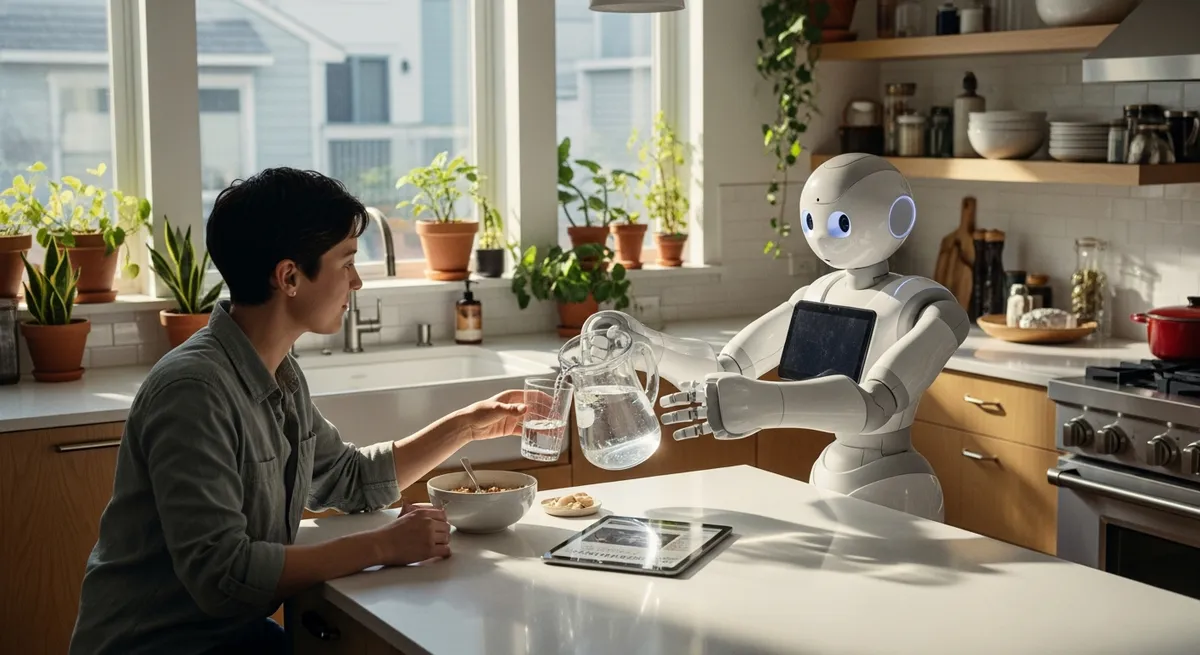
So, what are we to do? I am not a Luddite who wants to smash the machines. I do not suggest we throw every robotic seal into the nearest ocean (though the mental image is admittedly tempting). Technology has a place in caregiving, but it must be used as a functional tool, not a human replacement. We must set clear ethical boundaries before it is too late. First, we need to stop using the word companion for machines. Words matter. When we call a machine a companion, we are lowering the bar for what human companionship actually means. (It is like calling a frozen pizza a culinary masterpiece; you are only fooling yourself, and your stomach knows the truth.) We should call them monitoring tools or assistive devices. That is what they are. (I do not call my vacuum cleaner a friend, even when I am really lonely.)
Families must also be proactive in this struggle. If you decide to use a social robot for a parent, it should be used to facilitate human interaction, not replace it. If the robot becomes the only thing she interacts with for hours on end, you have failed as a caregiver. I try to visit Martha twice a week now, even if it is just to complain about the weather or the rising price of eggs. I make sure she puts the seal down when I arrive. I want her to feel my hands, which are sometimes cold and often clumsy, but undeniably real. According to a 2022 policy brief from the International Federation on Ageing, the integration of AI in elder care requires a robust ethical framework that prioritizes human rights over corporate profit. I will believe it when I actually see it. (I am not holding my breath; I need it for talking to Martha.)
Ultimately, the burden falls on us. We have to be willing to do the hard work that a machine cannot do. We have to be willing to sit in the heavy silence with our elders. We have to be willing to listen to the same story for the fourteenth time without looking at our watches or our phones. A robot can listen for eternity without getting bored, but that is precisely why its listening is worthless. Boredom is a human trait. Patience is a human virtue. When we automate these things, we are not just saving time; we are eroding our own character. (I know I sound like a philosophy professor after a few too many Chardonnays, but I am right about this.) Robotic caregivers should serve as functional tools for safety and health, never as a replacement for human emotional connection. The elder care crisis is being leveraged by corporations to prioritize staffing efficiency over the psychological well-being of vulnerable women. Families must set strict boundaries on data privacy and the duration of robotic interaction to prevent cognitive decline and isolation.
The Bottom Line
The rise of robotic caregivers is a symptom of a society that has lost its way. We have prioritized productivity and mobility over the ancient, sacred duty of caring for our elders. While these machines offer a temporary reprieve from the crushing weight of the caregiver shortage, they are a hollow solution. They provide the appearance of care without the substance of empathy. It is easier to buy a three-thousand-dollar robotic seal than it is to reorganize your life to be present for a fading parent. (I have done the math, and the cost of time is always higher than the cost of plastic.) But the easy path is rarely the right one.
We must remain vigilant in our defense of human connection. We must ensure that technology serves humanity, rather than the other way around. If we allow intimacy to be fully automated, we are not just failing our mothers and grandmothers; we are failing ourselves. Is a robot a substitute for a human hand? It is not. It never will be. Human connection is not an algorithm to be solved. It is a gift that requires time, effort, and a willingness to be uncomfortable. (And trust me, being uncomfortable is the only way you know you are still alive.) It is the only thing we have that the machines cannot touch. We need to show up. (Even if it is messy. Even if we are tired. Even if we have to leave our phones in the car.)
Frequently Asked Questions
❓ Are robotic caregivers actually effective at reducing loneliness?
Here is the reality of the situation: the answer depends entirely on how you choose to measure effectiveness in a human soul. (I suspect the manufacturers prefer spreadsheets over souls.) If you look at short-term biological markers like cortisol levels or heart rate, then yes, these machines can have a calming effect on elderly individuals. However, many experts argue that this is a temporary fix that merely masks the underlying problem of social isolation. A machine can provide stimulation, but it cannot provide the reciprocal emotional growth that comes from a genuine human relationship. It is more of a temporary distraction than a permanent cure. Furthermore, the long-term psychological effects of forming emotional bonds with inanimate objects are still being studied by people much smarter than I am. For some seniors, particularly those with cognitive impairments, the confusion between reality and simulation can eventually lead to greater distress when the illusion inevitably fails. We should be very careful about calling this a success just because a patient stops crying for an hour. True connection requires two conscious beings, not one person and a well-designed algorithm. (I would rather talk to a wall that listens than a seal that just pretends to.)
❓ What are the main privacy risks associated with care robots?
The short answer usually surprises most people: the risks are almost identical to having a popular smart-home device in your bedroom, but the stakes are significantly higher. This means that private moments - medical discussions, family arguments, or even physical struggles - are being recorded and potentially stored on corporate servers. (I do not even like my toaster knowing my breakfast habits, let alone a robot knowing my medical history.) If a data breach occurs, this highly sensitive information could be exposed to the highest bidder. Additionally, there is the question of who owns this data. Currently, the regulations surrounding the data generated by "social robots" are murky at best. Before introducing one of these devices into a home, it is vital to read the fine print and understand exactly where the information is going. Most of us just click agree without realizing we are inviting a corporate spy into our most private spaces. (It is a digital Trojan horse covered in synthetic fur.)
❓ Can robots help with physical tasks like lifting or bathing?
Lifting a human body is an incredibly complex task that requires a high degree of situational awareness and physical grace to avoid serious injury. Currently, most facilities still rely on human staff or hydraulic lifts for these tasks because robots are not yet nimble enough. There is also the significant risk that the patient will become even more isolated from humans because the robot is deemed good enough for daily care. (I do not want a robot scrubbing my back; I want a person who knows if the water is too hot.) It is a dangerous precedent to set for our society, and it requires careful, case-by-case consideration by family members and medical professionals. We must not trade dignity for mechanical efficiency.
❓ How much do these robotic caregivers typically cost?
The price tag is often the most shocking part of the equation for many families. These devices can range from a few hundred dollars for simple toys to several thousand dollars for advanced social robots. If the battery dies or the software glitches, you are left with an expensive paperweight and a very confused, very lonely senior. (I have spent less on cars that lasted longer than some of these machines.) It is a significant financial investment that often yields very little in the way of long-term health outcomes. Families should weigh the cost of these gadgets against the cost of professional human care or community programs. (The math rarely favors the machine when you factor in the value of a real smile.)
❓ What should I do if my parent becomes too attached to a robot?
If you notice that a parent is treating a machine as their primary source of emotional support, it is time to intervene. (I call this the Gordon Effect, after Aunt Martha’s seal.) You should use the robot as a bridge to start a conversation, not as a replacement for one. Ask them what they like about the device and then try to provide those same emotional cues yourself. It is also important to consult with a healthcare professional if you notice signs of cognitive decline or increased withdrawal from reality. We cannot let our loved ones disappear into a world of silicon and synthetic fur. (It is our job to pull them back into the real world, no matter how much effort it takes.)
Disclaimer: This article is for informational purposes only and does not constitute professional medical, ethical, or financial advice. The use of assistive technology in elder care should be discussed with qualified healthcare professionals and family members to ensure the safety and dignity of the individual.