
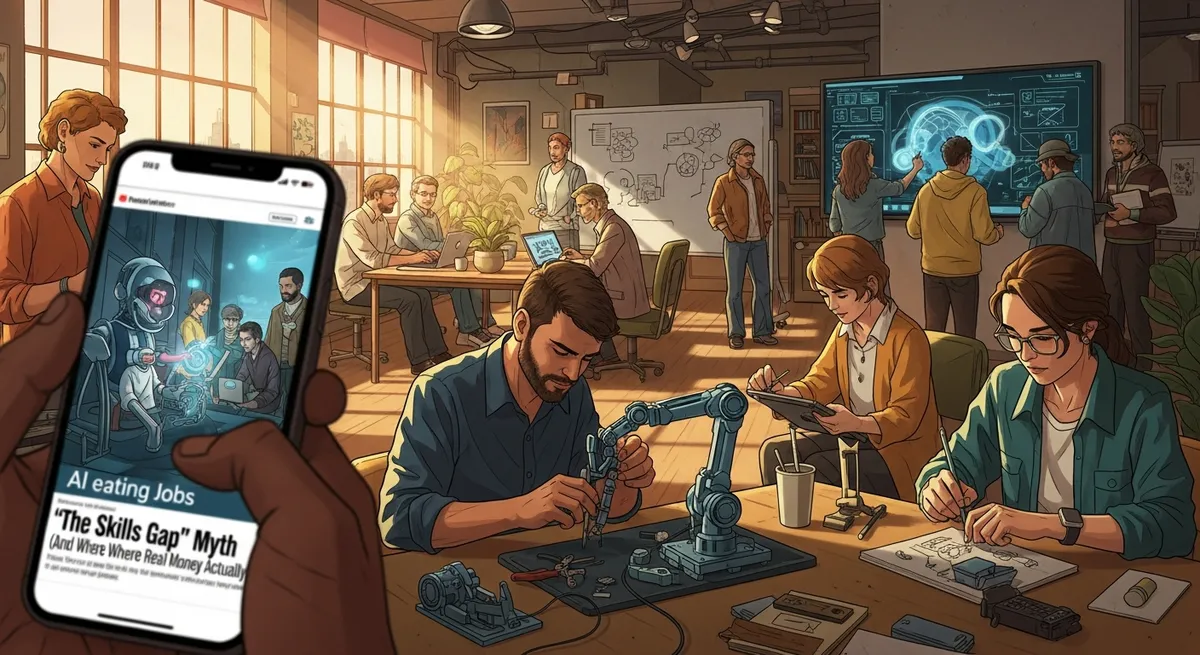
Everyone keeps talking about the "future of work" like it is some distant sci-fi movie set in 2050, but let's be real - it is already here, and it is messy. It is happening right now. You check your phone - big mistake number one - and see another headline about AI eating jobs. Sudden panic. That "safe" office gig feels... well, shaky. Flimsy. Paper-thin. (I have been there, doom-scrolling at 2 AM until my retinas burn. It is miserable.) But here is the secret that the panic-articles conveniently leave out. The robots aren't taking every job. Just the boring ones. The real cash - actual, pay-the-mortgage, take-a-vacation money - is flowing into weird pockets of the economy. Places that need dirty hands. Or specific tech skills. We are going to look at the hard data. Ignore the noise. And find the high paying jobs that are desperate for humans right now. It is not about going back to college for four years; it is about being smart with your next move.
Stop The Doom-Scrolling (Because The Robots Aren't Coming for Everything)
Okay. Stop. Seriously. Pause and take a breath.
The anxiety is totally valid - I feel it too, believe me. You open LinkedIn and it looks like a digital graveyard. Layoff posts everywhere. "Open to Work" banners on every other profile. It is exhausting. And it makes you want to hide under the covers. But that is only half the story. Maybe a quarter-truth.
Here is what is actually going on. The World Economic Forum's Future of Jobs Report 2023 put a scary stat on the table: employers expect 23% of jobs to change within five years. That is huge. Hard to stomach. But the same report projects 69 million new roles being created (against 83 million lost). So we aren't running out of work. We are just running out of people who know how to do the new work. The churn is the problem. Not the lack of jobs.
This is the "Skills Gap." Or, as I like to call it, the "Oh Crap, I Learned the Wrong Thing" Canyon.
If you sit in a cubicle pushing paper, yeah, you might be on the wrong side of the canyon. (Sorry. Blunt, I know. But someone has to say it.) But crossing over isn't as hard as the universities want you to believe. They want you to think you need another $40,000 degree. You don't. You usually just need a career change strategy that focuses on skills. Not diplomas.
Think about it. While generic copywriters are panicking about ChatGPT, the people who know how to fix the servers running ChatGPT are naming their price. The economy is shifting from "creating content" to "building and maintaining infrastructure." That is where you want to be.
The "Blue Collar" Stigma (And Why It Is Costing You A Fortune)
We need to have a serious talk about the trades. And tech certs. Because for decades, guidance counselors told us: "Go to college. Or you'll flip burgers."
Dead wrong.
While everyone was fighting for entry-level marketing gigs that pay $38k a year (if you are lucky), the electricians and HVAC techs were quietly buying lake houses. I am not joking. Have you tried to hire a plumber lately? The quote alone will make you weep. The demand for skilled trades is skyrocketing because the workforce is aging out. The "Silver Tsunami" is real. Boomers are retiring in waves, and nobody is replacing them. Federal labor projections back this up: many skilled trades carry a "Bright Outlook," meaning new job opportunities are very likely.
Take Elevator Installers and Repairers. It sounds gritty. It is. But federal occupation data puts typical pay around $109,000 a year. No master's degree required. Just an apprenticeship and a willingness to work with your hands. Or look at Wind Turbine Technicians, another Bright Outlook occupation in the federal projections. You get to climb cool towers, work outside, and help save the planet, with typical pay around $64,000.
But it is not just hammers and wrenches. It is digital plumbing too. Cybersecurity. Data analysis. Cloud computing. These are the best trade jobs of the digital age. They do not require four years of philosophy classes. They require knowing which button to push when the server melts down. The modern "blue collar" worker might wear a hoodie and sit in a dark room, but the principle is the same: specialized skill equals job security.
The Math: Degree vs. Speed
Let's actually look at the math here. Because feelings are valid, sure, but rent is due on the first. And your landlord? He doesn't care about your GPA. A four-year degree commonly runs $40,000 or more plus four years of your time. A stackable certificate costs a few hundred dollars and about six months. If it moves you from a $38k entry-level gig toward six-figure trade or tech pay, the return is not subtle. The ROI on a degree is shrinking. The ROI on skills is exploding.
How to "Hack" the Transition (Without Quitting Yet)
So. What do you do? Quit tomorrow? Flip a table? (Please don't. Health insurance is expensive. And you need it.)
The trick is the "Side-Hustle Switch." You keep the day job - as soul-crushing as it might be right now - and you start grinding on online certifications at night. I know, I know. It sucks. You are tired. The last thing you want to do after a 9-to-5 is study Python or learn about heat pumps. But here is the reality check: six months of fatigue is better than forty years of obsolescence. That is the trade-off. It is temporary pain for permanent gain. You don't even need to quit your job to start; you just need to carve out an hour a night. Skip the Netflix. Do the work.
Look for "stackable credentials." This is the cheat code. Google has them. Amazon has them. Community colleges have them. These are micro-degrees that verify you can actually do something. Not just talk about it. Think of it like building with Legos. You get one block (a basic cert), then you snap another on top (an advanced specialization). Before you know it, you have built a career fortress without ever stepping foot on a university campus.
For example, the Google Data Analytics Certificate. It costs peanuts compared to a degree. It takes about six months. And it puts you on the radar of employers who are desperate for data people. Or the AWS Certified Cloud Practitioner. The cloud is eating the world. If you understand how it works, you are valuable.
Employers are desperate for proof of competence. They do not care about prestige anymore. If you can show a portfolio of code or a certification in project management, they often do not care where you went to school. Or if you went at all. They just want the problem fixed.
FAQ: Because You Probably Have Doubts
Is 40 too old to switch careers?
No. Stop it. Seriously. Put that thought away. Most people change careers, not just jobs, several times over a working life. If anything, being 40 means you have "soft skills." You show up on time. You don't text during meetings. You know how to talk to humans. That is an asset. A huge one. Employers are desperate for adults in the room.
Do I need to be a math genius for tech jobs?
For some? Sure. If you want to build AI models, yes, you need math. But for cybersecurity analyst roles? Or network administration? It is more about logic. And puzzles. Don't let your high school algebra trauma stop you from making money.
Are these certifications actually respected?
Five years ago? Maybe not. Today? Absolutely. The game has changed. When companies like IBM and Tesla drop degree requirements, you know the tide has turned. They care about skills. Can you do the job? If the answer is yes, you are hired.
What if I pick the wrong skill?
Then you pivot. That is the beauty of short certifications. If you spend six months learning Data Analysis and hate it, you wasted six months and $300. If you get a Law Degree and hate it, you wasted three years and $150,000. Low stakes. High reward.
Can I do these jobs remotely?
The tech ones? Absolutely. Data analysis and cloud management are remote-first roles. The physical trades (like HVAC) obviously require you to be on-site, but even they are evolving with remote diagnostics tools. Pick the lifestyle you want first, then the skill.
The Bottom Line (For Now)
The job market is shifting. It is scary. It is weird. But it is also wide open.
The "safe" path isn't safe anymore. In fact, it might be the most dangerous place to be. The risky path - learning a trade, pivoting to tech, trying something new - is actually the most secure thing you can do right now. So close the doom-scrolling app. Pick a skill. Any skill. And start learning it tonight. Your future bank account (and your sanity) will thank you for it.
Disclaimer: This article is for informational purposes only and does not constitute professional career, financial, or legal advice. Market conditions and salary data vary by location and experience level. Always conduct your own due diligence before making significant career changes.


