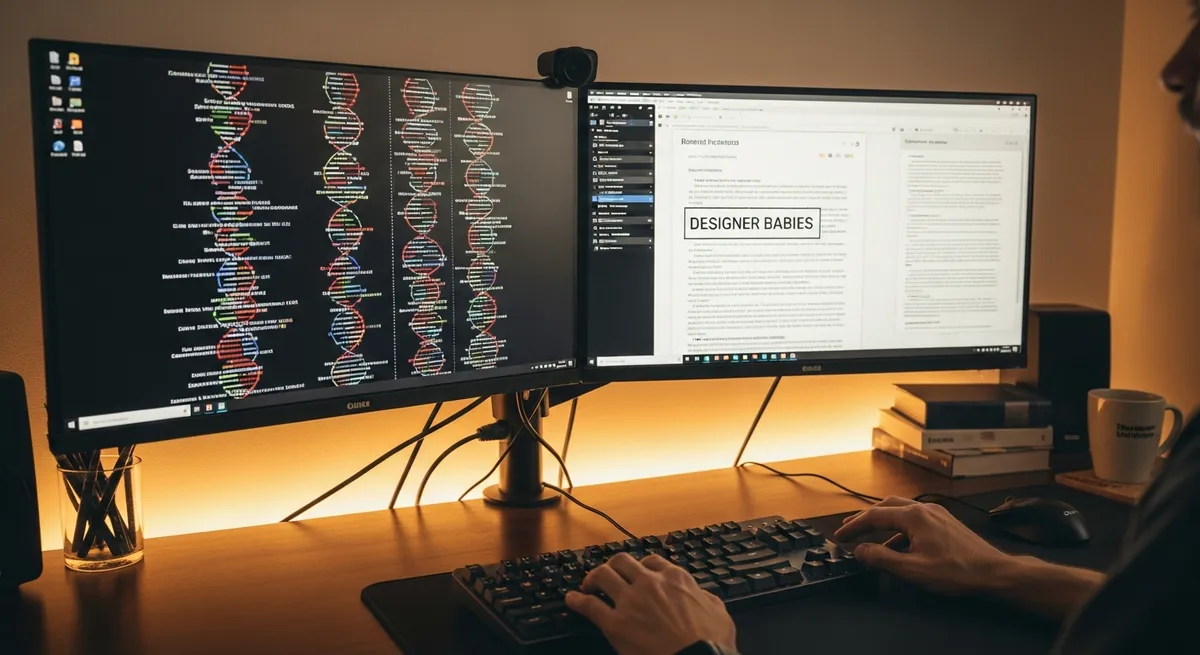
I am sitting here thinking about my neighbor Martha. Martha is a retired biology teacher who treats her tomatoes like doctoral candidates. (She actually plays Mozart to the beefsteaks, which I find charming yet deeply suspicious, as if the fruit might develop an attitude.) We were discussing CRISPR germline editing over a glass of Riesling last night. Most people focus on the science fiction aspect of designer babies. They talk about blue eyes or perfect SAT scores. I think they are missing the point entirely. The science is not just about DNA. It is about the people who have to provide the raw materials. It is messy. It is personal. (And the Riesling that belongs to Martha is surprisingly strong, leading to a headache that felt like a tiny construction crew was renovating my forehead.)
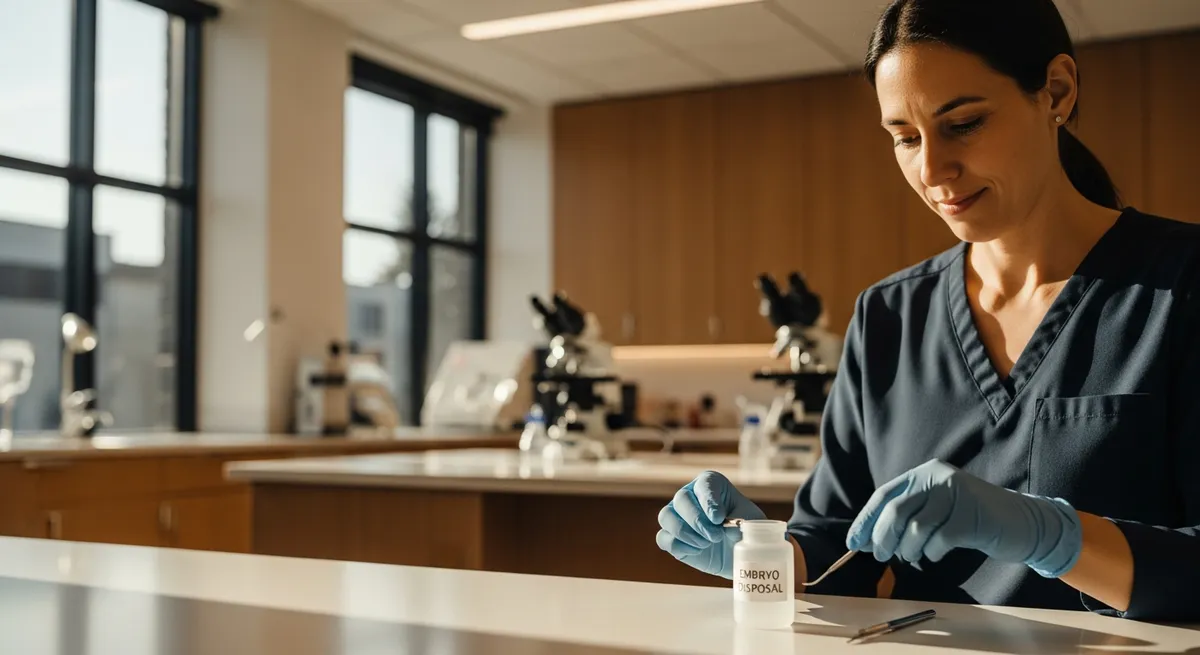
I struggle to remember a simple multivitamin, so I am genuinely terrified of anyone navigating a schedule of subcutaneous needles. (My memory is a sieve that only retains useless trivia about 1970s game shows.) The reality of CRISPR germline editing necessitates these very same arduous steps, though the magnitude of the endeavor is significantly more daunting. If a researcher intends to edit the genetic blueprint of an embryo, they require a constant, reliable reservoir of human oocytes. This is where the story stops being about sleek laboratories and starts being about the biological labor of women. It is a detail that gets scrubbed from the press releases because it is not nearly as exciting as talking about the end of hereditary disease.
The Physical Toll That Nobody Mentions in the Glossy Brochures
This means women must undergo a pharmaceutical marathon known as controlled ovarian hyperstimulation. It is a process that is, quite frankly, as gentle as a sledgehammer to a delicate porcelain teacup. (I once tried a three-day juice cleanse and nearly fainted by noon, so the idea of hormonal hyperstimulation makes me want to hide under my duvet.) You are essentially attempting to manipulate your endocrine system into producing a dozen or more eggs at once instead of the usual one. One. Not twelve. This leads to profound bloating, volatile mood swings, and the very real risk of Ovarian Hyperstimulation Syndrome. This condition is not merely a discomfort; it can be life-threatening in severe cases. I checked. I am not being hyperbolic. (I leave the hyperbole to the people selling cryptocurrency.)
The National Academies of Sciences, Engineering, and Medicine noted in a landmark 2017 study that the physical risks to women are a primary ethical concern in germline research. They did not mince words. Yet, when we read about CRISPR in the popular press, we see digital diagrams of neon DNA strands. We do not see the clinical reality of the extraction room. We ignore the source because it is easier that way. It is much more comfortable to pretend that these embryos appear out of thin air, perfectly formed and ready for the genetic scissors. My friend Sarah, who went through a similar process for a different reason, told me it felt like her body was no longer her own. It was a vessel for a scientific goal. (Sarah is the toughest person I know, and she cried twice during that month, which is two more times than she cried when she broke her leg skiing.)
The Myth of Informed Consent and the Root Canal of Reality
I believe in the principle of informed consent with every fiber of my being. But in the context of cutting-edge biotechnology like CRISPR, how can anyone truly be informed? My dentist, Dr. Aris, once explained a root canal to me in such detail that I felt like I could perform the surgery myself, yet I was still shocked by the actual experience. The smell of burning tooth is something no brochure can prepare you for. (I still have nightmares about that chair, and frankly, I do not think Dr. Aris liked me much either, probably because I kept trying to tell jokes while his hands were in my mouth.) If we cannot fully grasp the sensory horror of a root canal, how can we possibly understand the generational impact of altering the human germline? We are making decisions for people who do not exist yet. It is a profound, almost terrifying responsibility. Most of us cannot even decide what to have for dinner without an existential crisis. (I spent forty minutes last night deciding between spicy tuna and a poke bowl, so do not trust me with the future of the species.)
The Industry Pressure Cooker and the Erasure of the Human Source
The problem is that the incentive structure is completely skewed toward speed and publication. My friend David works in a biotech lab. He is a brilliant man who forgets to wear matching socks. (He once went an entire day with one navy sock and one black sock, and nobody told him because we all respect his brain too much to point out his sartorial failings.) He tells me that the pressure for results is immense. Biotechnology companies are desperate for results that will satisfy their investors and move the needle on their stock price. (I find the idea of a perfect child terrifying; my own children are delightfully imperfect, and that is what makes them human and occasionally infuriating.) By focusing so intensely on the end product-the edited embryo-we have effectively erased the woman from the equation. She becomes a line item in a budget. A donor ID number. A silent partner in a revolution that might not even benefit her.
We must recognize that every single edited embryo represents a physical sacrifice that involves real risk. It is not just data on a screen. It is a human cost that we are currently subsidizing with silence. I am not being dramatic. I am being realistic. There is a difference, though my ex-wife might disagree with that assessment. (She once told me I could turn a stubbed toe into a three-act tragedy, but in this case, I think the tragedy is real.) According to the World Health Organization, ethical oversight in these matters often lags years behind the actual technology. We are building the airplane while we are falling through the clouds. It is a precarious way to manage the future of humanity.
Myth vs. Fact
Myth: CRISPR is a simple laboratory process that only involves editing cells in a petri dish.
Fact: Germline editing requires the invasive and physically demanding process of human egg retrieval from women, involving significant hormonal manipulation.
The Ethics of the Unknown and the Leaky Pipe
We are rushing toward a future we do not fully understand. It is like my first kitchen remodel. I thought I knew what I was doing. (I ended up without a functioning sink for three months and a very expensive lesson in the physics of plumbing that I never asked for.) We think we can edit out diseases. We think we can improve the species as if we are updating the software on a popular smartphone. But biology is not a computer program. It is a tangled, beautiful, and deeply stubborn mess. When we edit one gene, we might be breaking something else entirely. We do not know. That is the point. We should be terrified. I am certainly terrified. (But that might just be the third glass of Riesling talking.)
So, where do we go from here? Do we just ban CRISPR and go back to the dark ages? (I would miss my smartphone, which is a leading device in its category, but I would probably read more books, so it is a toss-up.) No, the solution is not to stop the science, but to stop the erasure of the human elements. We need to start by admitting that germline editing is a reproductive issue as much as it is a genetic one. We need to move away from the metaphor of CRISPR as a computer code that can be easily debugged. Life is not code. It is blood and bone and hormone. Every time a scientist presents a paper on embryo editing, the first question from the audience should be: "How were the women who provided these eggs protected, and what was the physical toll on them?"
International Governance and the Global Genetic Divide
We also need more robust international regulations that prioritize the health of the egg provider over the speed of the research. Currently, the landscape is a patchwork of confusing rules that vary from country to country, making it easy for unethical actors to operate in the shadows. (It is like trying to understand a tax code written in a language you do not speak while wearing a blindfold.) The Nuffield Council on Bioethics has suggested that any use of heritable genome editing must be socially just and not increase inequality. This is a high bar that we are nowhere near reaching. If germline editing becomes a tool for the wealthy, it will place immense pressure on women to undergo invasive procedures to ensure their children meet societal standards of excellence. This could lead to a future where reproductive freedom is replaced by a technological mandate for perfection, all at the cost of female health. This is not empowerment; it is a new form of biological labor that targets the most vulnerable among us. (I am exhausted just thinking about it, and I am a man who gets tired after walking to the mailbox to collect my bills.)
Key Takeaways
Frequently Asked Questions
❓ What is the primary physical risk for women in germline editing?
Here is the thing about egg retrieval: it is not just a quick procedure that you do on your lunch break. It involves weeks of intense hormonal injections that can lead to Ovarian Hyperstimulation Syndrome. This condition causes the ovaries to swell and can result in severe abdominal pain, nausea, and even fluid buildup in the chest, making it a significant medical risk that is often downplayed in scientific literature. You are not just donating a cell; you are putting your systemic health on the line for a laboratory result.
❓ How does CRISPR differ when applied to embryos versus adults?
The short answer surprises most people who think all gene editing is the same. When you edit an adult, you are targeting specific tissues. Germline editing, however, targets the very beginning of life, meaning every cell in the resulting person's body will carry the change, and they will pass it on to their children, which is why the stakes and the need for eggs are so much higher. It is a permanent change to the human lineage, which makes the ethical weight much heavier than a simple medical treatment for an existing patient.
❓ Why is the female burden often overlooked in biotech discussions?
This depends on who you ask, but the reality is that the media loves a story about a magic bullet. It is much easier to sell a story about a futuristic genetic cure than it is to describe the messy, painful reality of surgical egg harvesting. The technical focus on the CRISPR protein itself acts as a convenient distraction from the human labor required to make the research possible. We like our science clean, but biology is inherently dirty and complicated.
❓ Are there ethical frameworks to protect women in these trials?
There are definitely proposals on the table, such as those from the World Health Organization and various bioethics councils, but the implementation is spotty at best. Many critics argue that our current systems are designed to protect the potential child or the scientific data, while the health and long-term well-being of the egg provider are treated as secondary concerns or simple logistics. We need a fundamental shift in how we value the human source of our genetic materials.
❓ What are the long-term implications of germline editing for society?
The situation is quite complex because it risks creating a new kind of genetic divide. If this technology is only available to those with massive amounts of capital, we could see a bifurcation of the human species based on who can afford the biological "upgrades." Furthermore, the pressure on women to produce "perfect" offspring could lead to a society where natural variation is seen as a failure of planning rather than a part of the human experience. It is a future that looks less like progress and more like a high-tech version of the same old prejudices.
The conversation about CRISPR and germline editing is currently lopsided, focusing heavily on the technological marvels while ignoring the biological costs. It is a classic case of missing the forest for the trees, or in this case, missing the woman for the DNA strand. We must recognize that every single edited embryo represents a significant physical investment by a human being who has undergone medical risks that we are only beginning to quantify. (It is a bit like looking at a skyscraper and forgetting that people had to dig the foundation in the dirt while it was raining.) If we continue to treat women as mere providers of raw genetic material, we are not just making a scientific error; we are making a moral one. The future of our species should not be built on the unacknowledged pain of half the population. It is time to bring the woman back into the center of the story and treat her with the respect and care that her contribution deserves. Only then can we say that our biological revolution is truly a step forward for all of humanity.
Disclaimer: This article is for informational purposes only and does not constitute medical, legal, or ethical advice. The field of gene editing is rapidly evolving, and individuals should consult with qualified medical professionals and ethical experts before making any decisions related to reproductive health or genetic research.