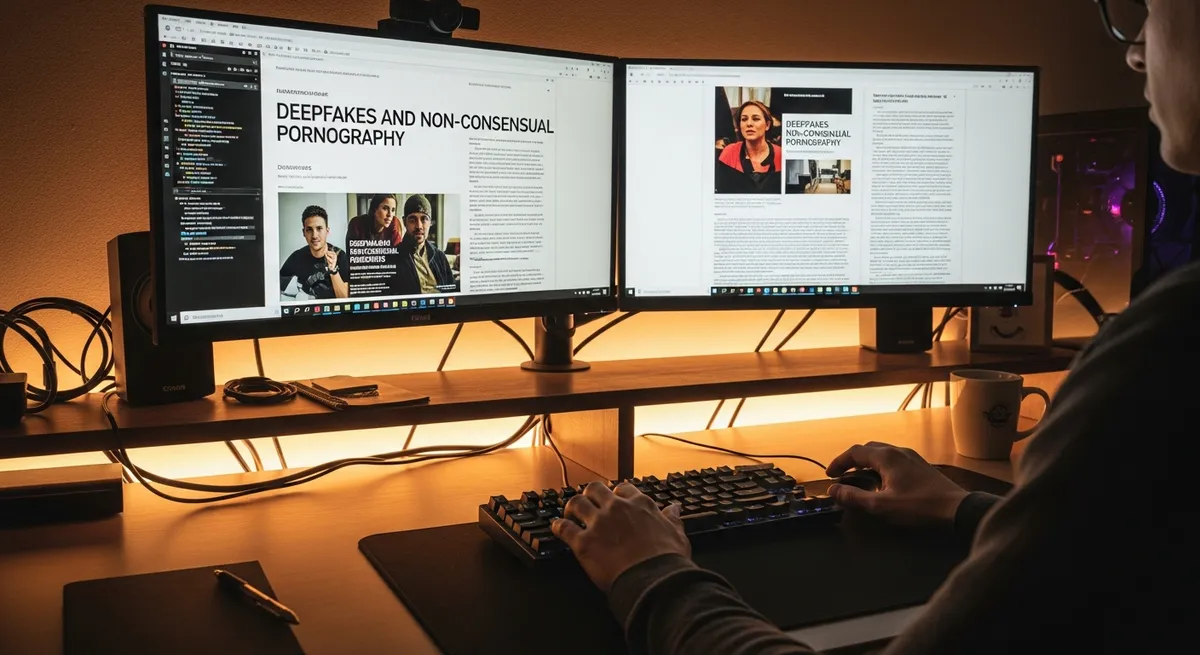
I was perched at my laminate kitchen table last Tuesday, consuming a second glass of Cabernet that cost significantly more than my first motorized vehicle, when I happened upon a report claiming that ninety-six percent of all deepfake videos currently circulating the web are non-consensual pornography. (I nearly experienced a total respiratory failure from choking on my wine, which would have been a financial tragedy, though certainly less of a moral tragedy than that specific statistic.) We are not merely observing a handful of deviant individuals operating out of a damp basement. What we are truly confronting is a pervasive, structural contagion that selects women as its primary targets with a chillingly cold efficiency. It is a chilling realization that our most advanced computational achievements are being repurposed to dismantle the very dignity of women before they have even had the opportunity to finish their morning caffeine intake.
My neighbor Arthur actually maintains a belief that artificial intelligence is going to resolve the global climate crisis by next Tuesday afternoon. (Arthur also once spent forty-five minutes trying to convince me that the moon is a holographic projection, so his grasp on objective reality is questionable at best.) Most individuals mistakenly perceive artificial intelligence as nothing more than a sophisticated tool for drafting mundane emails or generating whimsical images of felines floating in the vacuum of space. But the reality is far more obsidian in hue. The bioethical impact of these synthetic, AI-generated images is not some minor digital annoyance that can be brushed aside. It is a profound, fundamental violation of the principle of bodily autonomy. When an individual fabricates an image of you without your explicit permission, they are not just playing with pixels; they are essentially stealing your identity. They are colonizing your very skin. It is a declaration of war. (And I do not say that for dramatic flair; I say it because it is the only vocabulary that fits the crime.)
The Psychological Toll Is Not Virtual
According to data provided by the Cyber Civil Rights Initiative, the psychological devastation visited upon victims of this abuse mirrors the trauma associated with physical sexual violence. I suggest you read that sentence again and allow it to sit in your stomach. It is not just a matter of temporary embarrassment or a social faux pas. It is not a harmless prank played by a bored teenager. It was not just embarrassment; it was a total erasure of her sense of safety. (I recall a time I accidentally transmitted a high-resolution photograph of my own elbow to my entire professional contact list and I felt psychologically exposed for an entire week, so I cannot even begin to calculate the horror of this level of violation.) The trauma is not theoretical; it is visceral. The brain does not distinguish between a digital violation and a physical one when the core of the self is breached. It is all a fundamental breach of the human soul.
This is where the bioethical rubber meets the road and starts to smoke. We often talk about AI ethics in the abstract, debating algorithmic bias or the potential for job displacement in the middle-management sector. Those concerns possess a certain weight, I suppose. (And by I suppose, I mean to say that they are incredibly tedious compared to the literal destruction of human lives currently unfolding on our screens.) But we habitually ignore the immediate, visceral harm being inflicted upon women at this very second. We are allowing our technological reach to far outpace our moral grasp. We are constructing a digital landscape where no individual is shielded from a malicious person armed with a powerful laptop. It is an unmitigated, absolute catastrophe of digital governance. A massive, horrifying mess that we have collectively allowed to fester.
The Democratization of Harassment
I have made several ruinously expensive mistakes during my tenure on this planet. I once invested four thousand dollars into a venture that promised to turn common seaweed into high-octane fuel. (The only thing that occurred was my money disappearing into a metaphorical grotto, but at least the seaweed remained unharmed.) However, the mistake we are making regarding the lack of AI regulation is far more costly to the fabric of our society. The mental health implications are staggering in their breadth and depth. A 2024 study published in the Journal of Cyberpsychology found that victims of deepfake abuse experience chronic anxiety and post-traumatic stress at rates that are nearly identical to those who have been victims of physical stalking. This is not some recreational game for the digital age. It is a full-blown crisis of human rights. (I am not even that fond of my own face, but I still believe I should be the sole arbiter of where it appears in the digital ether.)
Ten years ago, you needed a PhD in computer science and access to a supercomputer the size of a small sedan to manipulate video this convincingly. Today, that barrier to entry has vanished. All one requires today is a handheld telecommunication device and a mere ten minutes of unoccupied time. (This process is significantly less complicated than preparing a palatable French omelet, a culinary feat that remains beyond my clumsy grasp.) This shift democratizes harassment. It allows a disgruntled former partner or a bored, malicious teenager to inflict lifelong psychological damage with a few casual clicks of a mouse. We are seeing a surge in what clinicians call "betrayal trauma." It is a specific type of psychological distress that occurs when the institutions or technologies we trust are used against us in a predatory fashion. Imagine waking up to find that your image has been viewed by thousands of strangers in a context you never authorized. (I can barely handle it when someone posts a poorly lit photo of me at a neighborhood barbecue, let alone a violation of this magnitude.)
The Erosion of Consent and Corporate Responsibility
I recall talking to my former editor, Margaret, about this over a very dry martini that was essentially just a glass of cold gin. (Margaret is always right, which is why she was the editor and I was the one getting my excessive adjectives deleted with a red pen.) She argued that the internet has always been a toxic place for women. She is right, of course. But this is different. This is the industrialization of humiliation. A study published in the Journal of Trauma and Dissociation notes that victims of non-consensual pornography experience rates of Post-Traumatic Stress Disorder (PTSD) that are comparable to victims of physical stalking and domestic abuse. The brain does not distinguish between a photon and a physical touch when it comes to the feeling of being violated. The cortisol spike is the same. The sleepless nights are the same. The fear that everyone you meet has seen the video is a constant, low-grade hum of anxiety that never truly leaves the room.
This creates a state of perpetual hyper-vigilance. You are always waiting for the other shoe to drop. (And in this case, the shoe is made of pixels and malice and is currently falling toward your head.) If you build a car without brakes, you are responsible for the crash. If you build a generative AI model that can easily create non-consensual pornography, you are responsible for the lives it ruins. It is that simple. Many leading technology providers claim they are just providing the tools. (Tell that to the woman whose career was destroyed because a deepfake video was sent to her employer by an anonymous harasser.) We need a bioethical framework that treats digital violence with the same gravity as physical violence. We need to stop pretending that what happens on a screen stays on a screen. It is a disgusting, digital mess. And we are the ones who have to live in the wreckage of this ethical vacuum.
Why We Cannot Just Look Away
So, what do we do? Do we all delete our accounts and move into a cabin in the woods with no internet connection? The solution is not to retreat; it is to regulate and resist with everything we have. First, we need robust legislation that criminalizes the creation and distribution of non-consensual deepfakes at a federal level. Many states have started to move in this direction, but it is a patchwork quilt of laws that leaves too many gaps for predators to exploit. We need a unified front. According to UN Women, technology-facilitated violence against women requires a coordinated global response that includes both legal frameworks and corporate accountability. We must hold the platforms that host this content responsible for their negligence. (It is a classic story, really, just with more fiber-optic cables and fewer people willing to take responsibility.)
Secondly, we need to invest in mental health resources specifically designed for survivors of digital violence. We need therapists who understand the nuances of image-based abuse. We need support groups where women can share their experiences without judgment or the fear of being blamed for their own victimization. The burden of safety should not fall on the shoulders of the potential victims. It should fall on the perpetrators and the systems that enable them. Finally, we need a cultural shift. We need to teach digital ethics in schools the same way we teach biology or history. We need the next generation of coders to understand that their work has real-world bioethical consequences. They are not just writing lines of code; they are writing the scripts of people's lives. I want to live in a world where technology is used to elevate us, not to strip us of our humanity. I want my niece, Julia, to grow up in a world where her digital presence is a source of pride, not a liability. It is going to be a long fight. Because at the end of the day, if we cannot protect the basic dignity of women in the digital age, then all of our technological progress is nothing more than a hollow achievement.
The Bottom Line
We are at a crossroads in human history. We have created tools that can mimic reality with terrifying precision, yet we have failed to build the ethical guardrails necessary to prevent their abuse. The bioethical impact of AI-generated sexual violence is not a minor glitch in the system; it is a fundamental flaw in how we approach technological innovation. When women are targeted, shamed, and silenced by synthetic media, we all lose. Our digital public square becomes less diverse, our sense of shared truth erodes, and our collective empathy withers away. It is a high price to pay for the ability to swap faces on a screen. We must demand better from our legislators, our tech giants, and ourselves. I do not possess a comprehensive treasury of solutions for this predicament. (If I did, I would be writing this from a yacht in the Mediterranean instead of my cluttered home office with a broken spacebar.) But I do know that staying silent is not an option. We must advocate for strict legal penalties, better platform moderation, and a cultural shift that prioritizes consent above all else. We must support the survivors and listen to their stories. The road to a safer digital future is paved with accountability and compassion. It is time to stop treating AI as a toy and start treating it as the powerful, potentially dangerous tool that it is. Our mental health, our privacy, and our very dignity depend on it. Let us make sure the future of AI is one we actually want to live in. It is time to exorcise the ghosts in the code.
Frequently Asked Questions
❓ What exactly constitutes non-consensual deepfake pornography? It does not matter if the original photo was public or private. If you did not say yes to being in that specific video, it is a violation of your consent. It is a digital forgery used for the primary purpose of humiliation or sexual gratification at the expense of another person's dignity. (Basically, if the image-generator did not ask you for your signature, it is a crime of the highest order.)
❓ How does this specifically impact women's mental health? This depends on your situation, but the common thread is a profound sense of violation. Victims often experience symptoms of PTSD, including flashbacks, severe anxiety, and social withdrawal. There is also a unique element of "digital permanence" that causes ongoing trauma; the fear that the content will resurface at any time, such as during a job hunt or a new relationship. It creates a state of chronic stress that can lead to depression and a total loss of trust in digital interactions.
❓ Are there any current laws that protect people from deepfakes? While some countries and several U.S. states have passed specific laws against non-consensual deepfakes, there is no comprehensive federal protection in many places. Many victims have to rely on existing laws like copyright infringement or harassment, which are often inadequate for the specific nature of AI-generated abuse. We are seeing a push for new legislation, but the technology is moving much faster than the bureaucratic process of lawmaking. (The law is currently trailing the technological vanguard by twenty miles and stumbling repeatedly over its own bureaucratic laces.)
❓ What should I do if I discover a deepfake of myself online? The first thing you should do is document everything. Take screenshots and save URLs, but do not engage with the person who posted it. You should report the content to the platform immediately; most major social media sites now have specific reporting categories for non-consensual sexual imagery. It is also highly recommended to contact a legal professional or an organization like the Cyber Civil Rights Initiative, which specializes in helping victims of image-based abuse navigate their options.
❓ Can technology be used to detect and stop these videos? The short answer is yes, but it is an ongoing arms race. Researchers are developing "watermarking" technologies and detection algorithms that can identify synthetic media with high accuracy. However, as detection gets better, the tools used to create deepfakes also evolve to bypass those filters. This is why bioethical experts argue that technology alone is not the solution; we need a combination of better code, stronger laws, and a societal commitment to digital consent to truly address the problem.
References
Disclaimer: This article is for informational purposes only and does not constitute legal or psychological advice. If you or someone you know is a victim of digital violence or image-based abuse, please consult with a qualified legal professional or a licensed mental health counselor.