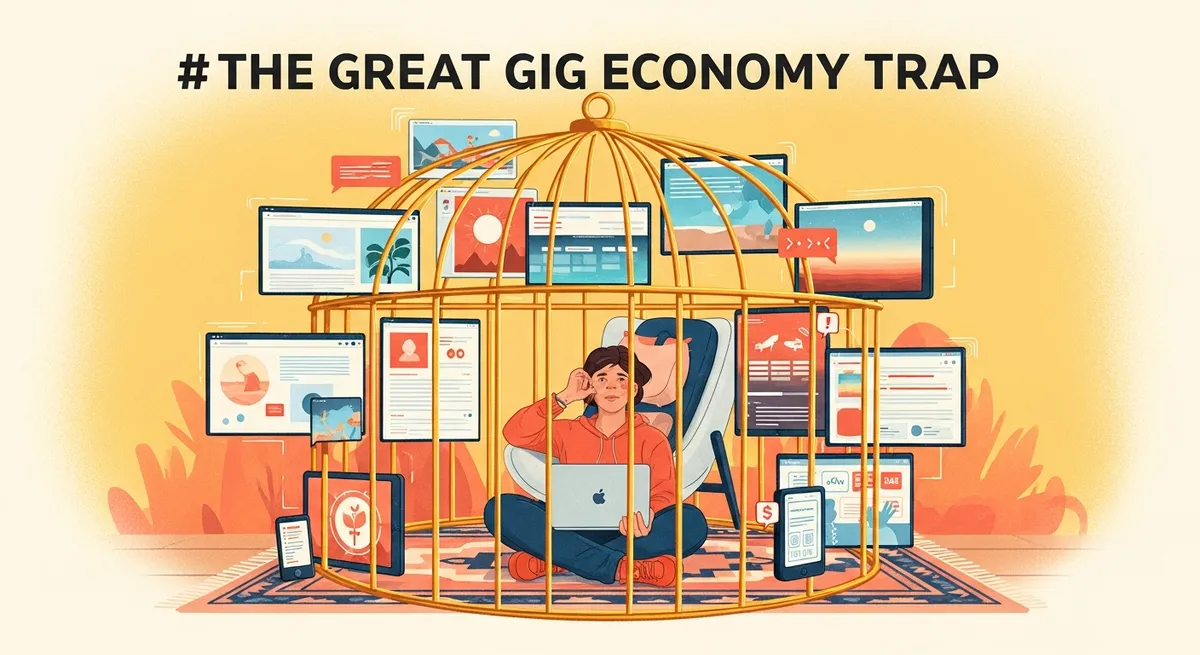
You know the dream. You know the drill. The Instagram ads? They pop up constantly. Usually some guy with a laptop on a beach in Bali. (Which, practically speaking, is a nightmare workspace - sand ruins keyboards.) But let's talk about the reality nobody puts in the brochure regarding the gig economy in 2025. It isn't just about Uber or Instacart anymore. It is about trying to survive in a market that demands employee-level commitment but refuses to pay for employee-level safety nets like health insurance or Social Security. Doesn't matter if you're a high-end consultant or delivering takeout - the game is rigged. The rules are different now. And if you don't know them, you are not a business owner. You are just a resource being mined. Let’s talk about how to stop that from happening to you right now.
The "Freedom" Myth (Or, Why Dave Is Currently Broke)
Let’s be real for a second. The gig economy isn’t a job market. It’s a casino. (Okay, maybe that’s harsh. But it feels like one.)
Take my friend Dave. (Not his real name, obviously - he’d kill me.) Dave drove for one of those big rideshare apps. He thought he was gaming the system. "I make my own schedule!" he told me over beers once. "No boss breathing down my neck!"
Except he did have a boss. It was an algorithm.
And that algorithm was a micromanager. It tracked his acceptance rate, his speed, his braking habits. It knew when he took a bathroom break. It knew when he was tired. And unlike a human boss, you can't argue with code. When his car broke down (transmission, $3,200, ouch), the "freedom" evaporated. He didn't have a business. He had a job with zero benefits and all the overhead. The Bureau of Labor Statistics data on "contingent arrangements" shows this instability is the new normal³.
This is the trap. You trade the stability of a paycheck for the illusion of control. But really? You just took on all the risk. The platform takes a cut (usually 20% to 30%) simply for making the introduction, while you pay for the gas, the laptop, the software subscriptions, and the inevitable burnout.
See, independent contractor status is a double-edged sword. Actually? It is more like juggling chainsaws. If you know how to handle it, you can build something amazing. If you don’t? Well, you get the picture. You’re going to lose a limb.
The "Scope Creep" Epidemic
It isn't just drivers like Dave, either. I see this with creative freelancers constantly. You agree to a project for a set fee. Then the client asks for "just one small change." Then another. Then a Zoom call to "sync up."
Before you know it, your hourly rate has dropped below minimum wage because you were too afraid to say no. Why? Because the platforms are designed to make you replaceable. If you say no, there are ten thousand other people in line behind you willing to say yes for five dollars less. That race to the bottom is a feature, not a bug.
The Department of Labor Entered the Chat
Here is where it gets technical (sorry). But you need to know this.
The Department of Labor - specifically under the new 2024/2025 guidelines - is cracking down on misclassification¹. They are looking at the "economic reality" of the relationship. Basically, if you are economically dependent on one employer, you might not be a freelancer at all. You might be an exploited employee.
Why does this matter?
Because if you are treating your side hustle like a hobby, the IRS and the DOL are going to eat you alive. You need to stop thinking like Dave. You need to start thinking like a CEO. Even if you’re just a CEO of one.
The Solution: Stop Being a "Worker." Start Being a Business.
Here is the cheat code. (And I hate that term, but it fits.)
The people who actually make money in this game? They don't just "do gigs." They build a container for their work. They formalize it. It sounds boring - paperwork usually is - but it’s the only thing standing between you and burnout.
You need a buffer. Specifically, a legal one.
When you operate as a sole proprietor (which is the default "I just started working" status), your personal assets are on the line. If a client sues you? They come for your car. Your house. Your personal savings. It sounds paranoid, but I've seen it happen. A web developer deletes the wrong database? Sued. A dog walker loses a leash? Sued.
Restructuring - usually as an LLC - changes the dynamic. The Small Business Administration explicitly guides gig workers to formalize early to avoid the liability trap⁴. It tells clients, "I am a business, not a desperate person with a laptop." It allows you to write off expenses that Dave couldn't. (That $3,200 transmission? If structured correctly, that’s a business expense, not a personal tragedy.)
The Tax Game (Or, How to Keep Your Money)
Let's get specific about taxes because this is where most gig workers get crushed. If you are just receiving Venmo payments and spending them, you are walking into a 30% tax bill you haven't saved for. Self-employment tax covers both the employer and employee portion of Social Security and Medicare. It adds up fast.
But when you run a legitimate business structure, you open the door to deductions that "hobbyists" ignore:
Let's Look at the Numbers
I know math is painful. But look at the difference between "Dave the Driver" and "Dave the Business Owner."
See the difference? It’s not just about money. It’s about leverage.
Action Plan: Get It Together (Like, Today)
Okay, enough doom and gloom. What's the fix? Resist the urge to just scroll past this part.
First, audit your "clients." If you have one client providing 90% of your income and telling you when to work, you are walking a dangerous line with the IRS². You need to diversify. Get a second client. Even a small one. It proves you are an independent business. I call this the "Safety Valve" rule. Never let one entity own your calendar.
Second, get a contract. Always. I don't care if it’s your cousin's startup. If it isn't written down and signed, it's a fantasy. A contract defines the scope. It stops "scope creep" - you know, when "just a quick logo" turns into a full rebrand for the same $200. Include a "Kill Fee" clause (if they cancel, you still get paid 50%) and a "Late Fee" clause. You teach people how to treat you.
Third, separate your money. Open a separate bank account. Yesterday. If you are mixing your grocery money with your client payments, you are asking for a headache come tax season. (And the IRS loves headaches. Yours, specifically.) It also helps you psychologically. When money hits the business account, it isn't "spending money" yet. It's revenue.
Fourth, raise your rates. Seriously. Inflation is real. If you are charging 2022 prices in 2025, you are effectively paying your clients to work for them. Send an email today: "Due to increased operational costs, my rates are adjusting to X effective [Date]." Don't apologize. Do not say "sorry." Business owners don't apologize for economics.
Finally, automate your admin. Use tools to track your hours and invoices. If you are manually creating invoices in Word every month, you are wasting billable hours. The goal is to spend less time managing the business and more time doing the work that actually pays.
FAQ: The Stuff Everyone Asks (Usually While Panicking)
Is an LLC actually necessary for a side gig?
Need? No. Should you have one? Probably. If you are making more than a few thousand bucks, or if you are in a high-risk industry (like anything involving manual labor or advice), the liability protection alone is worth the paperwork fee. It costs less than a bad night out in most states.
Lawyers are expensive. What if I'm broke?
Here's a secret: You probably don't need one. (Don't tell my lawyer friends I said that.) Most of this stuff - business formation, basic contracts - can be done online or with templates. The barriers are lower than you think. The biggest barrier is usually just... fear.
Is the gig economy dying?
No. But the "wild west" era is over. It's maturing. The people who treat it like a serious business will thrive. Those folks waiting for the algorithm to save them? Those folks are in for a rude awakening.
What happens if I get audited?
If you have that separate bank account and your receipts organized (digitally, please - shoe boxes are so 1990), you will be fine. An audit is just a request for proof. If you treated your business like a business, you have the proof. If you treated it like a chaotic cash grab, you have a problem.
How do I find better clients?
Stop looking on the bargain bin platforms. The best clients aren't on Upwork looking for the cheapest option. They are on LinkedIn, or asking their network for referrals. You find them by positioning yourself as an expert, not a commodity. Don't sell "writing services." Sell "customer retention strategies." Solve a problem, don't just fill a seat.
References
Disclaimer: This article is for informational purposes only and does not constitute legal, tax, or financial advice. Business laws and tax regulations vary by location and change frequently. Always consult with a qualified attorney or certified public accountant (CPA) regarding your specific business situation.