
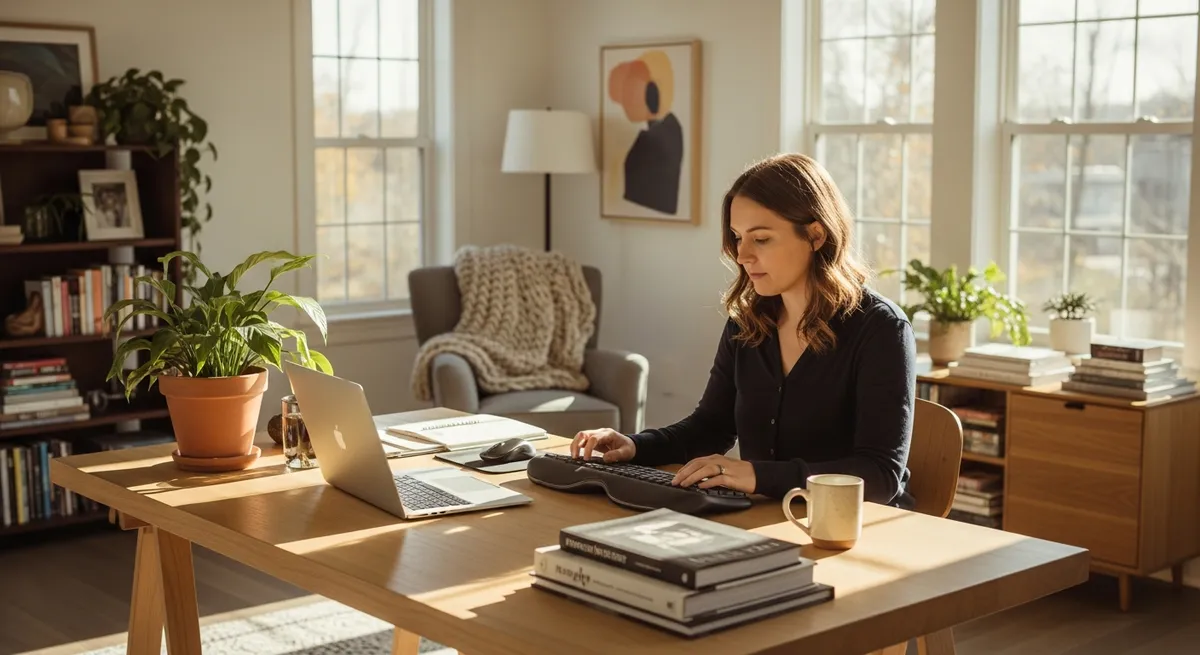
You shift your weight to the left hip. Then the right. It's 2:30 PM on a Tuesday, and your lower back is screaming at you. You grab another coffee, thinking it's just an energy slump or maybe you didn't sleep well. It's not. It's your dining room chair. We all did it a few years ago. We grabbed whatever surface was available-kitchen counters, ironing boards, sofas-and said, "This is fine for a few weeks." Fast forward to now. You're likely still sitting there. And I'm willing to bet you're wondering why your focus is shot by mid-afternoon. It's not your work ethic. It's your environment. (I know this because I spent six months working from a barstool and nearly destroyed my lumbar spine in the process.)
The reality is that your environment dictates your performance. I see it constantly. Smart, capable professionals wondering why they can't concentrate, blaming "burnout" when the real culprit is biomechanics. If your body is fighting gravity to stay upright, your brain has less energy for deep work. It's biological math.
Why "Good Enough" Is Actually Dangerous
I hate to be the bearer of bad news-actually, no, I don't, because this saves you money on chiropractors-but that dining chair is a torture device. It wasn't designed for eight-hour shifts. It was designed for a thirty-minute meal. Maybe forty-five if the conversation is good.
And yet, I see intelligent people spending thousands on a new laptop while sitting on a piece of wood that actively destroys their posture. It makes zero sense. Or rather, the total lack of sense is baffling. You wouldn't run a marathon in flip-flops just because you "already owned them." But we do it with our spines every single day. (I've been guilty of this too, so no judgment. Okay, a little judgment.)
The "Tech Neck" Mathematical Reality
Let's look at the physics for a second. Your head weighs about 10 to 12 pounds. When your neck is straight, your spine handles that weight easily. But when you hunch over a laptop on a coffee table? That angle increases. At a 45-degree angle-the standard "couch slouch"-the force on your neck jumps to nearly 50 pounds, and at 60 degrees it hits about 60, according to a widely cited spine-surgery study. That's like carrying an eight-year-old child around your neck all day. No wonder you have a headache by Friday. You aren't just tired; you're structurally compromised.
The physics are simple. When you slump, your lungs compress. Less oxygen to the brain means more brain fog. You think you're tired? You're likely compressing your torso and restricting deep breathing. Harsh, but true.
The "Netflix Couch" Problem
Then there's the mental game. When you work from the same couch where you watch Netflix, your brain gets confused. It's what psychologists call "context-dependent memory," but I just call it "zone confusion." Your brain doesn't know when to switch into "focus mode" and, more importantly, it doesn't know when to switch off.
If you answer emails from your bed, don't be surprised when you can't sleep. I learned this lesson the expensive way after a year of staring at the ceiling at 3 AM. Your brain sees the pillow and thinks "Spreadsheet," not "Sleep." It creates a loop of anxiety that never actually closes.
The numbers are actually terrifying. OSHA guidelines highlight that improper workstation setups are a primary driver of musculoskeletal disorders, not just discomfort, but legitimate physical injury. It's not just a little soreness. It's damage. When boundaries blur and ergonomics fail, your body sends the bill. It's not a willpower issue. It's a structural one.
Forget comfort for a second. This is about your nervous system. You need to tell your brain: "Show's over." If that laptop is staring at you from the coffee table, your cortisol stays spiked. You're stuck in a low-grade "fight or flight" loop. It's subtle. It's also toxic.
Then there's the mess. Visual noise is loud. I know what you're thinking-"I can ignore the laundry pile." But can you? (Spoiler: You can't.) Princeton researchers found that visual clutter actively competes for your neural bandwidth. Every time your eye catches that stack of papers, your focus snaps. It's a micro-interruption. Do that a thousand times a day? No wonder you're wiped out by 5 PM, even if you never left the living room.
The Gear You Actually Need (Without Going Broke)
You don't need a Pinterest-worthy setup. You need biomechanics. I've tested dozens of setups, and here is the truth: money doesn't always equal comfort. But cheaping out costs you more in the long run.
Start with the chair. If you buy nothing else, buy a chair that looks like it belongs in a spaceship, not a dining hall. Look for "lumbar support" that actually moves. If it's static, it's useless.
Next, the monitor height. If you're looking down, you're losing. Your eyes should hit the top third of the screen. Stack books under your laptop if you have to. (I used a stack of old encyclopedias for years. Ugly? Yes. Effective? Absolutely.)
The Mouse Trap (RSI is Real)
Here is something people forget: the trackpad. Using a laptop trackpad for 40 hours a week is a one-way ticket to wrist surgery. It forces your hand into a "claw" shape that compresses the carpal tunnel. Get an external mouse. It costs twenty bucks. It saves you thousands in physical therapy. If you want to get fancy, get a vertical mouse. It looks weird-like a shark fin on your desk-but it keeps your forearm bones parallel rather than twisted. I switched to one last year, and my chronic wrist click disappeared in three days.
The "Lighting" Variable
Lighting is the silent killer of focus. Most home offices are too dark or have glare that causes eye strain within an hour. You need bias lighting-light that sits behind your screen. It sounds fancy. It's usually a $15 LED strip. It saves your eyes from working overtime to adjust contrast.
You need layers. Task lighting for the desk, ambient stuff for the room. But here is the hack that actually changed my life: smart bulbs that shift color. During the grind, I keep my lights cool and blue-white (4000K-5000K). It mimics daylight and tricks the lizard brain into waking up. Then, at 5 PM? They automatically switch to warm amber (2700K). That shift tells your circadian rhythm the factory is closed. It's biology, not magic.
Action Plan: Fix It This Weekend
Don't overthink this. You don't need a contractor. You need a screwdriver and maybe an Amazon delivery.
1. The "Butt Test": sit in your chair. If your knees are higher than your hips, change the height. If you can't, buy a cushion. Immediately.
2. The "Two-Door" Rule: Even if you don't have a separate room, create a ritual. Close your laptop. Put it in a drawer. Create a physical "door" that closes on the workday.
3. Buy the uglier chair: Gaming chairs look cool. Mesh office chairs keep you cool. Buy the mesh one. Always. (Your back will thank me in August.)
4. Identify your "Dead Zones": Look around. Every house has them. Under the stairs? That awkward hallway corner? I've seen killer workspaces built inside closets-the "cloffice" is a legit architectural hack. Take the doors off (or hang a curtain), throw in a deep shelf, and boom: dedicated space. Closing that curtain? It's the psychological equivalent of a commute.
5. Tame the Cables: This sounds trivial, but it's not. Seeing a rat's nest of cables triggers low-grade anxiety. Velcro ties are cheap. Use them. (I bought a pack of 50 for five bucks and it felt like I renovated my whole room.)
FAQ: The Real Talk
Q: Can I just use a standing desk converter?
Short answer: Yes. But don't stand all day. That's a myth. Stand for 20 minutes, sit for 40. Standing all day just swaps back pain for knee pain. I've done it. It sucks. You need movement, not just a different static position.
Q: Is the expensive Herman Miller chair worth it?
Unpopular opinion: Maybe. If you sit for 10 hours a day? Yes. It's cheaper than back surgery. If you sit for 2 hours? No. Get a mid-range one from Staples. The law of diminishing returns kicks in hard after the $500 mark. You're paying for the brand name after a certain point.
Q: What if I have zero space?
Then go vertical. Wall-mounted desks or "ladder desks" save floor space but give you a dedicated zone. If you have to work at the kitchen table, buy a "monitor riser" you can stash in a cupboard. Just get the screen up. As long as your eyes are level with the top of the screen, you're winning.
Q: Does blue light blocking actually work?
It depends. For sleep? Absolutely. For eye strain? The science is shaky. I wear them, but mostly because they hide the bags under my eyes on Zoom calls. (Vanity wins.) If your eyes hurt, follow the 20-20-20 rule first: every 20 minutes, look at something 20 feet away for 20 seconds.
Q: Is working from bed really that bad?
Yes. It destroys your sleep hygiene. Your brain associates the bed with alertness instead of rest. Plus, there is no ergonomic way to type on a mattress. You are twisting your spine into a C-shape. Don't do it. (Unless you have the flu. Then it's allowed.)
Disclaimer: I'm a writer, not a doctor or a physical therapist. If your back hurts, go see a pro. Don't take medical advice from the internet, even from someone who has tested fifty chairs.


