
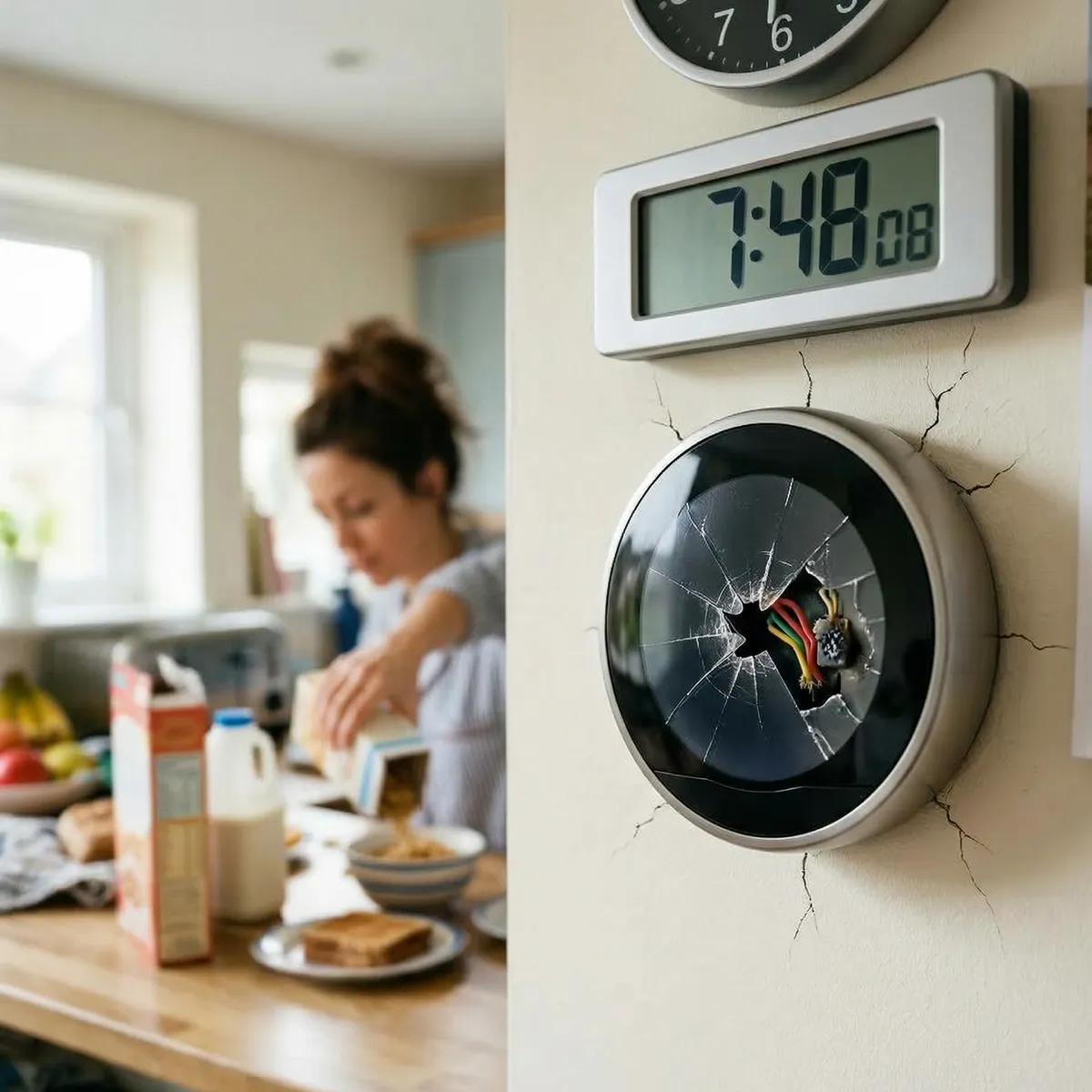
You open the bill. You stare at it. Then you clean your glasses because that number can't be right. But it is. You kept the thermostat at 68 degrees all month (mostly). You yelled at the kids to close the back door - twice. Yet here we are. The power company is essentially demanding a ransom payment just to keep your living room habitable. It feels personal. But here is the brutal reality nobody mentions in those slick commercials for fancy smart thermostats: you aren't paying for heat. You are paying for waste. Your house is literally hemorrhaging money, and the leak isn't where you think it is.
The "Sexy" Tech Trap (And Why We Fall for It)
We have a gadget addiction. Especially now, when the "smart home" fantasy is peaking. We want the sleek glass thermostat on the wall that learns our schedule. We want the solar panels on the roof because (let's be honest) they look cool and make us feel like we live in the future.
But we ignore the pink stuff.
Nobody - and I mean nobody - brags about their attic insulation at a dinner party. It is itchy. It is dusty. It sits in the dark, invisible and unloved, just gathering rat droppings. But ignoring it is (financially speaking) absolute suicide.
Think about it like this. (I hate car analogies, really, but this one works so just roll with me). Installing a smart thermostat in a poorly insulated house is like dropping a Formula 1 engine into a minivan with four flat tires. It does not matter how efficient the engine is. That car isn't going anywhere.
Physics Doesn't Care About Your Budget
Here is the science part. I promise to keep it quick.
Heat rises. We learn this in third grade - obviously - but then we promptly forget it the moment we sign a mortgage. In the winter, that expensive warm air you just paid for shoots straight up. Fast. If your attic floor is full of gaps (and unless your house was built in the last five years, it absolutely is), that air bypasses the insulation and escapes right through the roof vents.
It is called the "Stack Effect." Think of your house less like a box and more like a giant, leaky chimney. As the hot air blasts out the top, cold air gets sucked in through the basement rim joists or floorboards to replace it.
So when you feel a draft near the floor, you instinctively buy a rug. Or you caulk the windows. Wrong move. The problem isn't the floor. The problem is the attic acting like a vacuum cleaner for your wallet.
The Numbers Are Actually Kind of Scary
The North American Insulation Manufacturers Association (NAIMA) claims that 90% of U.S. homes are under-insulated. Ninety percent. That means if you are sitting in a house right now, you are statistically losing money.
To understand why, you have to look at "R-Value." That is just a fancy term for resistance to heat flow. Most older homes have R-19 in the attic (about 6 inches of fluff). Energy.gov recommends R-49 to R-60 for most northern climates. That is a massive gap. You are essentially wearing a t-shirt in a blizzard and wondering why you are shivering.
The Government Actually Wants to Pay You (Weird, I Know)
Here is where it gets slightly less depressing. The government (and I rarely say this) is actually trying to help you out.
Under the Inflation Reduction Act - specifically the 25C tax credit - the rules completely changed. They revamped the incentives to get people to stop wasting energy.
Here is the deal:
You can claim a tax credit for 30% of the project cost for insulation and air sealing. The cap is $1,200 per year.
Note that I said credit, not deduction. A deduction just lowers your taxable income (boring). A credit is a dollar-for-dollar reduction of the tax you owe. If you owe the IRS $5,000, and you spent $4,000 on insulation, you get a $1,200 credit. Now you owe $3,800.
It is basically a 30% off coupon funded by Uncle Sam. (Check with your CPA, obviously. I write articles, I don't do taxes).
Let's Look at the Real Math
Say your insulation quote comes in at $3,500. It sounds like a lot. But apply the math:
Now, factor in savings. If your energy bill is $300 a month (average winter/summer blend), and you save 20% (conservative for older homes), that is $60 a month back in your pocket. Over $700 a year. The project pays for itself in roughly three years. After that? It is pure profit.
"But Can't I Just Do It Myself?"
You can. Sure. You can also perform your own dentistry.
I have done the DIY insulation thing exactly once. It involves renting a blower machine from a big-box store, wrestling 40 bags of cellulose into a truck, and crawling around in a dark, cramped space while wearing a hazmat suit. It is miserable work. Truly soul-crushing.
Plus, there is the "air sealing" part. Just blowing new fluff over the old fluff does not work if you don't seal the cracks first. You have to find every wire hole, every plumbing vent, and every light fixture penetration and hit it with expanding foam.
If you miss the air sealing, the fiberglass just acts like a coffee filter - the air goes right through it. You need a stopper, not a filter.
Action Plan: Stop Bleeding Cash
Okay, enough doom and gloom. Here is what you actually need to do this weekend. (Don't worry, it doesn't involve buying anything yet).
1. The Flashlight Test Go to your attic hatch. Open it. (Bring a mask; it is dusty up there). Shine a flashlight across the floor. Here is the pass/fail metric: Can you see the wooden floor joists? If those wood beams are visible, you are failing. Badly. It means you probably have R-19 or less, which was fine in 1980 but is terrible today. You want R-38 to R-60 depending on your zip code. Ideally, the insulation should look like a thick, fresh blanket of snow that hides everything - pipes, wires, and wood alike. If you see wood, you're writing a blank check to the utility company every month.
2. The Audit Most utility companies offer a "home energy audit." Sometimes it is free. Sometimes it is like $50. Get one. A pro will come out with a blower door fan and an infrared camera. He will show you exactly where your house is leaking. It is sobering to see your living room look like a ghostly blue nightmare on the thermal screen.
3. The Quote Get three quotes. But do not just look at the price tag. Ask them: "Are you going to air seal the attic floor before you blow in the insulation?" If they say no, or "it's not necessary," hang up. They are being lazy. Find someone else.
FAQ: The Stuff You're Wondering About
Q: What about new windows? Aren't those better?
Honestly? No. Window salesmen will hate me for saying this, but the ROI on windows is terrible. It takes decades to earn back the cost of new windows in energy savings. Insulation pays for itself in 3-5 years usually. Fix the attic first. Do windows for curb appeal, not for savings.
Q: Is fiberglass or cellulose better?
It is a massive debate in the industry. Cellulose (recycled paper) generally blocks air better and is denser. Fiberglass is cleaner but allows more air movement if not installed perfectly. Personally? I like cellulose. It feels like you are wrapping the house in a warm sweater.
Q: Does this really help in the summer?
Yes. It works both ways. In July, your attic can hit 140 degrees. Without a thick barrier, that heat radiates down into your bedrooms all night long. Proper insulation keeps the heat up there, so your AC doesn't have to run 24/7.
Q: How messy is the installation?
If you hire pros, it is surprisingly clean. They run a long hose from their truck through a window or door directly to the attic hatch. They usually put down drop cloths. The whole process takes about 4 hours for an average house. You do not even have to leave.
Q: Can I just add insulation on top of what I have?
Usually, yes. Unless your old insulation is wet, moldy, or full of rodent presents, you can blow right over it. But remember the air sealing rule - if you don't seal the cracks first, you are wasting your time.
Q: What if I have old wiring?
This is a big one. If you have active Knob and Tube wiring (common in pre-1950 homes), do NOT bury it in insulation. It needs air space to dissipate heat. If you cover it, you create a fire hazard. Call an electrician to certify your wiring before you add a single bag of fluff.
Look, insulation isn't sexy. You can't show it off to your neighbors. But you know what is sexy? Having an extra $50 a month in your bank account. Go check the attic.
Disclaimer: I am a writer/researcher, not a certified financial advisor or structural engineer. This article is for informational purposes only. Always consult with a CPA regarding tax credits and a professional contractor for home structural modifications.


