
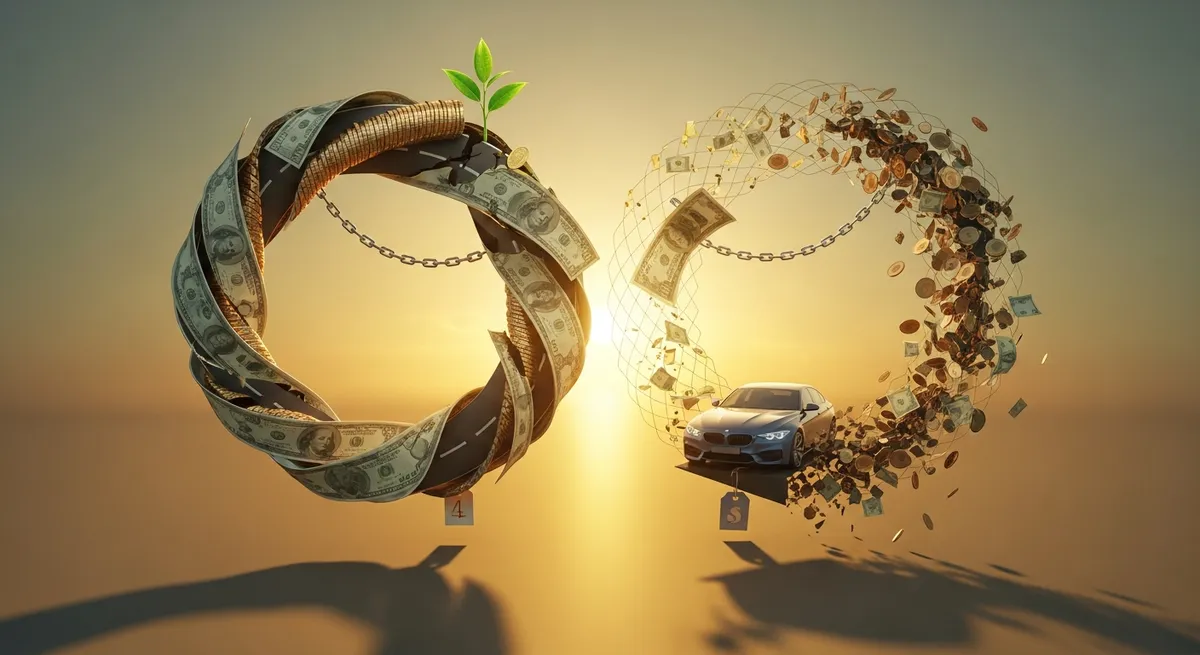
Most people think owning a car is the ultimate goal. It’s an asset, right? Wrong. It is a liability that bleeds money while it sits in your driveway, collecting pollen and bird droppings. We have been trained to believe that leasing is just "renting" and that smart people always buy. But in 2026, with interest rates behaving erratically and used car prices finally crashing back to reality, the old math simply doesn't add up anymore. The dealership wants you to focus on the monthly payment, sure. But the real numbers - the ones they don't put on the window sticker - tell a much darker story about value loss. If you are tired of watching your vehicle’s worth drop like a stone the second you drive off the lot, you need to look at the liquidity strategy. It isn't for everyone, but for some, it is the only way to stop the bleeding.
The Depreciation Nightmare (Or: How to Burn Cash Fast)
Let’s talk about the "D" word. Depreciation. (I know, I know. It sounds boring. Stick with me though.)
Here is the scenario. You walk in. You smell the new leather. You sign the papers for that $50,000 SUV. Feels great. But the second - literally the second - your tires cross the curb onto the public road? You just set about $5,000 to $10,000 on fire. Gone. Poof.
And that’s just the first ten minutes.
Here is the reality of 2026. During the pandemic, used car prices went nuts. You could drive a car for a year and sell it for a profit. That was a glitch. A weird, one-time economic hallucination. We are back to normal now. And normal means your car loses 20% of its value the first year.
Industry depreciation data consistently shows new cars losing roughly 20% of their value in the first year alone. By year three? You’re looking at around a 40% loss. Maybe more, depending on the model. So, if you bought that car with a standard 60-month loan, you are likely underwater for the first three years. If you need to sell it? You can't. Not without writing a check to the bank.
It’s a trap. A shiny, comfortable trap with heated seats. And right now, that trap is more expensive than ever. Interest rates on new car loans are hovering around 7% or 8% for people with good credit. That means on a $50,000 car, you aren't just losing value - you are paying the bank thousands in interest for the privilege of losing value. It is a double negative. You are burning the candle at both ends.
Now, I’m not saying buying is always bad. If you drive a Toyota Corolla until the wheels fall off - like, 15 years later - buying wins. Mathematically, it wins. But be honest with yourself. Do you actually keep cars that long? Or do you get the itch for something new every three or four years? If you’re in the "itch" category, buying is financial suicide.
The Liquidity Strategy: Why Leasing (Sometimes) Wins
Okay, take a breath. I am going to say the "L" word.
Leasing.
For years, financial gurus (the ones shouting on TikTok) have screamed that leasing is a scam. "You're just renting!" they yell. "You own nothing at the end!" Even the most sober consumer guides concede the math is complicated and depends entirely on your goals.
And? So what?
Here is the thing they miss. Leasing isn't about ownership. It’s about risk transfer. When you buy a car, you own the depreciation risk. If the market crashes? Your problem. If the car turns out to be a lemon after the warranty expires? Your problem. If you get into a fender bender and the resale value tanks because of a "bad CarFax"? Your problem.
When you lease, that risk belongs to the bank.
You are paying for the use of the car, not the car itself. It’s a subtle difference, but a massive one for your wallet. You keep your cash liquidity. Instead of dumping a $10,000 down payment into a depreciating asset, you keep that money in a high-yield savings account (or the market, if you’re brave). You pay for the depreciation you actually use. That’s it.
Think about the opportunity cost. If you lock $10,000 into a car down payment, it's gone. It's sitting in metal and rubber. If you keep it in a High-Yield Savings Account (HYSA) paying 5%, that money pays you $500 a year. Over three years, that's $1,500 in free money. The buyer loses that gain. The leaser keeps it. It's called opportunity cost, and nobody at the dealership talks about it.
Let’s Look at the Math (Because Numbers Don't Lie)
I hate spreadsheets. You probably hate spreadsheets. But we need to look at one.
Let's compare a 3-year ownership cycle of a $40,000 vehicle. We are assuming you have good credit here - if you don't, this whole conversation gets messier.
| Cost Category | Buying (Finance) | Leasing |
| Monthly Payment | $750 (approx) | $450 (approx) |
| Down Payment | $4,000 | $2,000 (First month + fees) |
| Maintenance Risk | Yours (after warranty) | Covered (mostly) |
| Risk of Accident Depreciation | 100% Yours | 0% (Gap insurance usually included) |
| Total Cash Out (3 Years) | $31,000 | $18,200 |
| Equity at End | Maybe $15k (if lucky) | $0 (Walk away) |
Look at the "Total Cash Out." With leasing, you kept $12,800 in your pocket over three years. Sure, the buyer has $15,000 in equity at the end - but they also took all the risk. And that equity is hypothetical until they actually sell the car. The lessee? They just walk away. Clean break. No haggling with Trade-In Ted or dealing with Facebook Marketplace scammers.
The Hidden "Money Factor" (What Dealers Hide)
If you decide to hunt for auto lease deals, you need to know the dealer’s secret weapon.
It’s called the Money Factor.
Sounds like a bad game show, doesn't it? It’s dealer-speak for the interest rate on a lease. But they don't display it as a percentage (APR) because then you’d know what it is. Instead, they show it as a tiny decimal. something like 0.0025.
You look at that and think, "Wow, 0.0025? That’s basically zero!"
Wrong. Stop. Don't sign.
To find the actual interest rate, you need to multiply that decimal by 2,400. (Why 2,400? Honestly, who knows? It feels like a random number they picked to confuse people.) Do the math: 0.0025 times 2,400 puts you at 6%. That’s your interest rate. If a dealer tries to slide a money factor of 0.0035 past you? That’s 8.4%. You are getting ripped off.
Always ask: "What is the money factor?" Watch them squirm. It’s fun.
Another fee they hide? The "Acquisition Fee." Every lease has one, usually around $595 to $995. You can't really negotiate it away, but you can make sure they haven't marked it up. Some dealers tack on an extra $400 just for pure profit. Ask for the "base bank acquisition fee." If they stutter, you caught them.
Finding the Best Car Lease (Without Losing Your Mind)
The lease vs buy debate isn't just about math; it's about psychology. But if you want to win, you have to be cold-blooded.
First, ignore the "Monthly Payment" box on the form. Dealers love the four-square sheet. They manipulate the down payment to make the monthly payment look pretty. Don't fall for it. Negotiate the "Capitalized Cost" (that’s the sale price of the car). Yes, you can negotiate the price on a lease. Most people don't know that. They think the sticker price is the lease price. Nope.
Negotiate the price first. Then tell them you want to lease.
Second, look for "subvented" leases. These are the best car lease offers because the manufacturer (not the dealer) is subsidizing them. They usually happen when a car model isn't selling well or a new version is coming out. The manufacturer artificially raises the "Residual Value" (what the car is worth at the end) to lower your payments.
It’s a loophole. Use it. Check forums like Leasehackr to see which cars have high residuals right now. A high residual means a lower payment for you, because you are paying for less depreciation.
Action Plan: How to Not Get Fleeced
So, you’re ready to enter the lion's den. Here is what you do.
- Check the "Days on Market." Use sites like CarGurus. If a car has been sitting on the lot for 100+ days? They are desperate. That is your target. Dealers pay interest on the cars sitting on their lots (it's called floor planning), so an old unit costs them money every day. Help them get rid of it.
- Email, don't walk in. Negotiate the price from your couch. Dealers hate this. They want you in the "box" where they can wear you down with free coffee and long waits. Don't go in until the price is agreed upon via email. If they refuse to give numbers over email, move to the next dealer. There are plenty of them.
- Zero Down. Always. Never put money down on a lease. Ever. If you put $5,000 down and total the car the next day, that money is gone. The insurance pays the bank, not you. Keep your cash in your own pocket. If the monthly payment is too high without a down payment, you are looking at too much car.
Frequently Asked Questions
Is leasing actually cheaper? (The answer is messy).
Short term? Yes. Almost always. Your monthly cash flow will be better. Long term? No. If you lease three cars over 10 years, you will pay more than if you bought one car and drove it for 10 years. But again - do you actually drive a car for 10 years? Be honest.
What happens if I go over the mileage?
They charge you. Usually 15 to 25 cents per mile. It adds up fast. But here is a trick: if you are over mileage, you can sometimes avoid the fee by buying the car at the end of the lease (and then selling it yourself) or by leasing another car from the same brand (they often waive the fees to keep you as a customer).
What about GAP insurance?
This is a huge perk. If you buy a car and total it, standard insurance pays the current market value. If you owe more than that (and you likely will), you have to pay the difference out of pocket. That is a "gap." When you lease, GAP insurance is almost always included in the contract automatically. It covers that difference. It saves you from financial disaster, and you don't even have to ask for it.
Can I negotiate the "Residual Value"?
No. That is set by the bank. It is written in stone. You can negotiate the sale price (Cap Cost) and the Money Factor (sometimes), but the residual is fixed.
Is leasing good for business owners?
Often, yes. Leasing can provide significant tax advantages. You may be able to deduct the lease payments as a business expense. (I am not a CPA, so check with yours, but the Section 179 deductions and lease write-offs are a major reason why so many business cars are leased, not bought).
Disclaimer: This article is for informational purposes only and does not constitute financial, legal, or tax advice. The author is not a financial advisor. Vehicle lease terms, interest rates, and market conditions vary. Always consult with a qualified professional before making significant financial decisions.


