
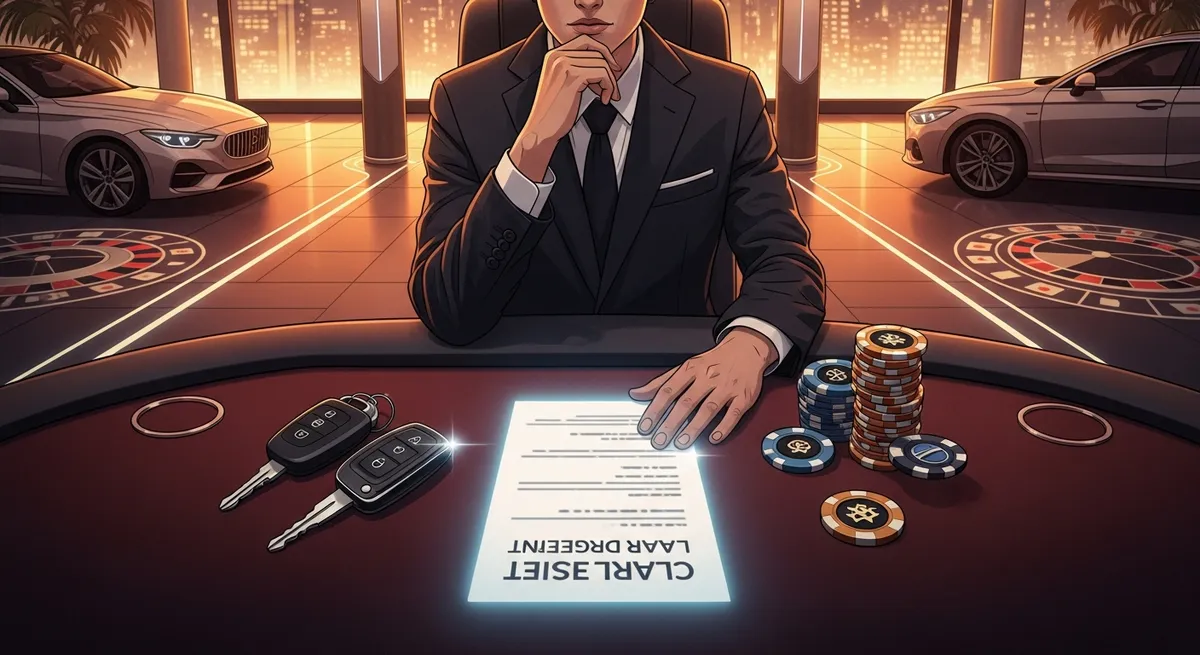
Step onto a showroom floor today and the vibe shifts instantly. It's a casino - that is exactly what it is - except the house odds are significantly worse and the lobby coffee is, frankly, terrible. You probably walked in with a sensible plan, maybe even a spreadsheet if you are that type of person, but within forty-five minutes, that plan has evaporated into thin air. It isn't an accident. It is design.
Dealers aren't just selling metal and rubber anymore; they are pushing complex financial products wrapped in new car smell. Specifically, they love the 36-month cycle because it keeps you paying forever. Before you sign that paper Brad (it's always a Brad) is sliding across the desk, you need to understand the game is rigged against your wallet from the moment you park your trade-in outside.
The "Psychological Jujitsu" (Or: Why You Always Spend More)
Here is the thing about dealerships. They are theaters.
Ever notice the chair? It sits lower than the desk - seriously, grab a tape measure next time - forcing you to look up physically. (No, I am not wearing a tin-foil hat here. This is Sales 101 psychology, folks.) It puts you physically beneath the person controlling the numbers. You're smelling floor polish and desperation, trying to do math in your head, while they casually mention monthly payments.
This is where they get you.
Suddenly, that massive $35,000 price tag just vanishes. Poof. That number is terrifying on paper. It's big. It's ugly.
Instead? You are staring at $399 a month.
Approachable, right? Manageable. Then comes the upsell. For that same $399 (or maybe $415, because who counts fifteen bucks?), Brad pushes the luxury trim. It feels like a cheat code, doesn't it? Like you hacked the system.
Spoiler: You didn't win. You lost.
You walked right into a trap they set back in 1955. You looked at the monthly number - the "payment" - and completely ignored the total cost, the vigorish (interest), and the reality that in 36 months, you own zero percent of that metal. Zero. Zip. Nada.
The "Four Square" Method: A Weapon of Math Destruction
Dealers often use a worksheet called the "Four Square." It divides your deal into four boxes:
It looks simple. It is designed to be confusing. Brad will scribble numbers, cross them out, and move money between boxes. He might raise your trade-in value (yay!) but secretly bump the interest rate to cover it (boo). It is a shell game played with your retirement savings. By focusing on the monthly payment box, you lose track of the other three. This is how people end up paying $45,000 for a $30,000 crossover.
The "Rent" Trap: A Quick Reality Check
Let's talk apartments. (Weird pivot, I know, but stick with me).
Actually - scratch that. It is worse than an apartment. Much worse. If your dishwasher explodes in a rental, the landlord pays. Not you. With a car lease? You are renting something that drops in value like a stone, yet you - the "renter" - have to pay to fix every scratch and dent.
Think about it. You pay for three years. You drive it. You love it. Then the term ends. You give the keys back. And what do you have in your driveway the next morning?
Nothing.
So you have to go back to Brad. And sign another lease. The bleed? It never stops. It is a subscription service for mobility, and it is bleeding the middle class dry.
Let's Look at the Numbers (Because Math Don't Lie)
I hate spreadsheets. You probably hate spreadsheets. But we need one right now.
According to Experian - and these guys track everything, so I trust them - the average new car payment hit $770 in early 2026. That is a mortgage payment in some parts of the country. (Okay, maybe a mortgage in 1999, but still. It's a lot.)
Here is a breakdown of what happens to your money over six years.
| Scenario | First 3 Years | Next 3 Years | Asset Value at Year 6 |
| Buying (Loan) | Paying monthly (High) | Paid off ($0/month) | You own a car (~$12k value) |
| Leasing | Paying monthly (Lower) | Paying monthly (Still) | $0 (You own nothing) |
See the difference? In the "Buy" scenario, years 4, 5, and 6 are glorious. Free. No payments. That is when you build wealth. In the "Lease" scenario, you are just funding the dealer's retirement plan.
But the table only tells half the story. There are hidden costs in leasing that never make it onto the glossy brochure. Let's list the ones that usually bite people:
"But I Want the Best Car Lease Deals!"
Okay, fine. I get it.
Sometimes leasing makes sense. If you are a business owner writing it off? Sure. If you absolutely must have a new car every three years because the thought of an expired warranty gives you hives? Go for it.
But if you are going to do it, don't go in blind.
You need to check the current auto loan rates before you even look at a lease. Why? Because sometimes the interest rate on a lease (they call it a "Money Factor" to confuse you - multiply it by 2,400 to get the APR) is insane. It can run several points higher than the going loan rate without a single warning label.
Insider Secret: Dealers can mark up the Money Factor. They can literally just add points to your interest rate and keep the profit. It's legal. And they do it every single day.
Action Plan: How to Beat Brad at His Own Game
So, you are ready to head to the lot. Maybe you want to buy; maybe you want to lease. Whatever. Here is how you survive without getting fleeced.
1. Stop talking about monthly payments. Seriously. Shut up about it. If Brad asks, "What payment are you looking for?", you say: "I am negotiating the Out-the-Door price of the vehicle." If he asks again, walk away. Or just stare at him until it gets awkward. (I prefer the staring method.)
2. Know the "Cap Cost." In leasing, the price of the car is called the "Capitalized Cost." They will try to tell you this doesn't matter because you're "just renting." Lie. A lower Cap Cost means a lower monthly payment. Negotiate this number just like you were buying the car.
3. Hunt for the "Residual." That is just fancy dealer-speak for the car's estimated value in three years. You need this percentage to be high. Sky high. Certain trucks - think Tacomas or Wranglers - hold value like literal gold bars. Some drop like a rock (luxury German sedans). Do your homework.
4. Use the "Walk Away" Power. This is your only real leverage. If the numbers don't make sense, stand up. Shake Brad's hand. And leave. You would be amazed how often the "manager" suddenly finds a "coupon" or a "rate adjustment" before you reach the door. If they let you leave? Then the deal really was bad. Go to the next dealer.
The Dealer's Dirty Little Secret
Here is something car dealership secrets forums discuss constantly, but regular buyers miss.
Dealers often make more money on the financing than they do on the car itself, which is why the FTC tells buyers to negotiate the price and the financing separately.
That is why they keep you waiting. That is why the Finance Manager's office is in the back. They wear you down. By the time you get there, you just want to sign and leave. You are hungry. You are tired. You'll agree to the $40/month "Tire Protection Package" just to get the keys.
Keep your head on a swivel. Stay sharp. Don't sign anything you don't understand. If they rush you, slow down. If they say the offer expires in ten minutes, let it expire. Real offers last 24 hours.
The Gap Insurance Racket
They will push Gap Insurance hard. And honestly? You probably need it if you are leasing or putting zero down. But do not buy it from them. The dealer charges $800+ for Gap Insurance. Your regular auto insurance provider? They will likely add it to your policy for $40 a year. That is many times the price for the exact same coverage. Check with your insurance agent before you go to the dealership.
Common Questions (And Honest Answers)
Is 0% APR actually real?
Finding it? It is like spotting a unicorn. Usually, you have to give up huge cash rebates to get the 0% rate. You need to do the math. (Sorry, more math). Taking a $3,000 rebate with a 4% loan might actually be cheaper than 0% financing on the full price.
Can I negotiate the "Acquisition Fee"?
Usually no. The bank sets that fee. But the "Doc Fee"? That is pure profit for the dealer. Fight it. In some states, it's capped by law. In others (looking at you, Florida), it can be $900+. Ridiculous.
Is a down payment on a lease a smart move?
No. Stop. Just... don't do it. If you put $5,000 down and total the car driving off the lot, that money is gone. Poof. Gap insurance pays the bank, not you. Keep that cash in a high-yield savings account, not trapped in a depreciating hunk of steel.
Can I end my lease early without a penalty?
Technically, yes. Financially? It is usually a disaster. You will typically owe the remaining payments anyway. There are websites like SwapALease where you can transfer the contract, but don't count on the dealer letting you off the hook easily.
Is leasing better for electric cars?
Actually, yes. This is the one time I might say "lease." EV tech changes so fast - battery range, charging speeds - that buying one is like buying a smartphone. In three years, it is obsolete. Leasing lets the dealer take the depreciation hit, not you.
Ultimately? A vehicle is just a tool. It moves you from Point A to Point B. That is it. Do not let the new-car smell (which is just glue and plastic off-gassing, by the way) seduce you into a bad financial contract.
Disclaimer: I am a writer, not a financial advisor. This content is for informational purposes only and does not constitute financial advice. Always consult with a qualified professional before making major financial decisions.


