
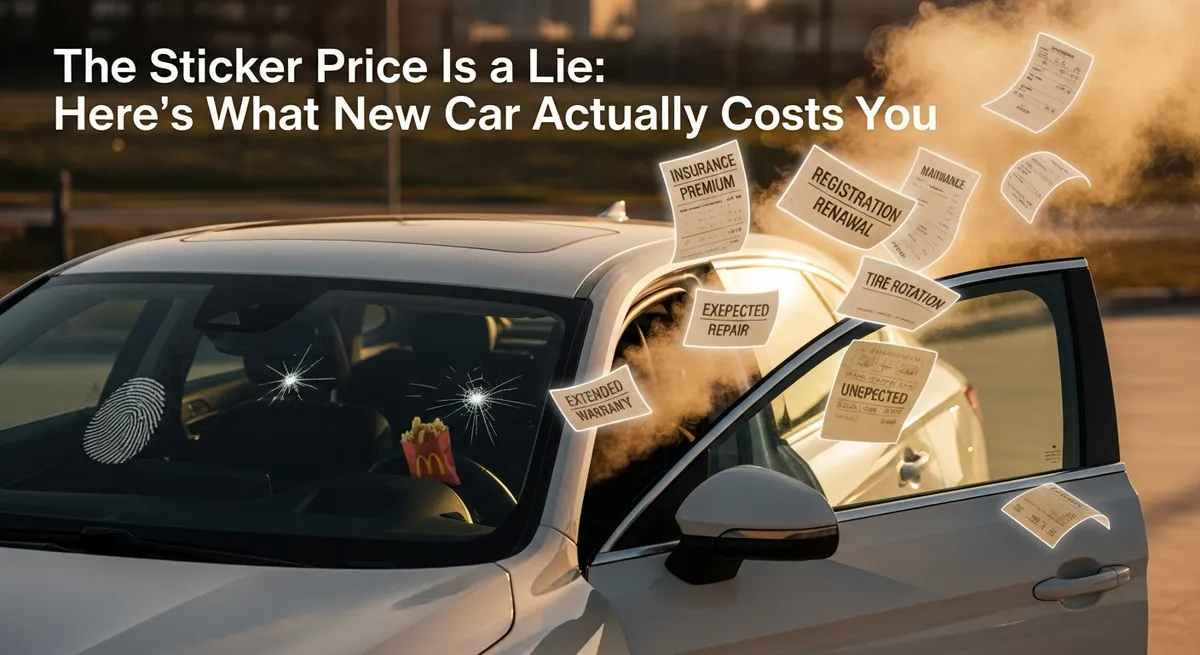
There is a specific kind of financial hangover that hits about three months after you buy a new car. You know the feeling. The new car smell is starting to fade - replaced by the vague scent of old french fries - and then the real bills start rolling in. And I do not mean the monthly loan payment you mentally prepared for. I am talking about the invisible bleeding. The insurance premium that mysteriously jumped $40 a month. The registration fees the dealer forgot to mention. The realization that those sporty low-profile tires cost $300 a pop to replace. It is brutal. Most of us walk into a dealership looking at one number - the monthly payment - and walk out signing a contract for a financial anchor that drags us down for five to seven years. It is not just a bad purchase; it is a math error that millions of us make every single day.
The "Four-Square" Trap (And Why You Fell For It)
Let’s back up. You walk onto the lot. You see the shiny metal. Your brain shuts off. It happens. Even to the smart ones.
The guy across the desk might be smiling. He might ask about your weekend. But he has a quota. Period. He pulls out a piece of paper. If you’ve bought a car in the last decade, you’ve seen it. They draw a cross, dividing the page into four boxes.
This is the "Four-Square" worksheet. And it is a weapon.
They scribble your trade-in value in one box, the down payment in another, the monthly payment in a third, and the total price in the fourth. Then they start moving numbers around. Like a shell game. Then they drop the hammer: "So, what kind of monthly payment are we looking at?"
Do not answer that question.
The second you say "$400 a month," they have got you. They will extend the loan term to 84 months (seven years!) just to hit that number. You think you won. You didn't. You just agreed to pay thousands more in interest. Government consumer expenditure surveys consistently rank transportation as the second-largest household expense, yet we treat it like an impulse buy. It is wild.
Here is what they don't tell you about that 84-month loan. By year four, you will owe more on the car than it is worth. This is called negative equity. Or being "underwater." If you try to trade it in then, you have to write a check just to get rid of it. I have seen people roll that negative equity into their next loan. Now they are paying for two cars but only driving one. It is a cycle of debt that keeps you poor.
The "Invisible" Costs That Bankrupt You
So you drove off the lot. You survived the finance office. You think you are in the clear.
Wrong.
Here is where the math gets ugly. (Sorry.) The sticker price is just the entry fee. The real cost of ownership - what the industry calls TCO - is a completely different beast. And nobody calculates it. Nobody.
Consider the insurance. Before you fall in love with that red sports sedan, call your insurance agent. Give them the VIN. Or just the model. Ask for a quote. I’ve seen premiums double just by switching from a generic sedan to a "sport" trim. It is effectively a hidden tax you pay every single month.
And let's not forget the "Doc Fee." Dealer Documentation Fees. This is essentially profit for the dealer. Some states cap it. Others don't. In Florida, for example, it can be $900 just for them to file the paperwork. You need to negotiate this, or at least ask for an equivalent discount on the car price.
The "German Car" Paradox
Let’s talk about luxury cars for a second. Specifically European ones. (I love them, but they hate my wallet.)
Old luxury cars are cheap for a reason. A scary reason. You see a $10,000 price tag; the mechanic sees a boat payment. You can snag a ten-year-old luxury barge for the same price as a high-mileage Corolla. Why? Because the previous owner is running away from the maintenance bills.
A brake job on a domestic car might cost $400. On a high-end import? Try $1,200. An oil change isn't $40. It is $150. These machines are engineered for performance, not your checking account. As the vehicle ages, the maintenance costs don't just creep up - they skyrocket. Also, parts. You wait weeks for a specialized sensor to arrive from Munich. Meanwhile, you are paying for a rental car because your "bargain" luxury ride is gathering dust in a shop bay.
If you must buy luxury, look for the "CPO" label. Certified Pre-Owned. It usually comes with a warranty that actually covers the scary stuff. Without a warranty? You are gambling.
How to Actually Buy a Car (Without Getting Taken to the Cleaners)
Okay. Let's fix this. How do you win?
You have to change the rules. Stop looking at the monthly payment. Just stop. It is irrelevant.
Step 1: Secure the Cash First Walk into your credit union (or log into your bank app) and get a pre-approved loan. Know your interest rate. If the dealer can beat it? Great. But usually, they can’t. Having that check in your pocket changes the power dynamic instantly. You become a cash buyer.
Step 2: The "Real Math" Check Ignore the sticker price for a second. Ask yourself: What does it cost to keep this thing moving? Check the tires. Call the insurance company. Check if it drinks premium gas. (That extra $0.60 per gallon hurts. A lot.)
Step 3: The Power of "No" This is your superpower. The salesperson assumes you are emotionally attached to the car. Prove them wrong. If the numbers don't make sense - or if they start drawing that stupid four-square box - stand up. Shake their hand. And leave. You would be amazed how fast the "manager" appears with a better deal.
Step 4: The Out-The-Door Number Negotiate the total check you have to write. Dealers love to add nitrogen in tires ($200), VIN etching ($300), and paint protection ($500). Refuse it all. If it was already on the car, tell them you won't pay for it. If they want the sale, they will waive the fee.
The Bottom Line
A car is a tool. It gets you to work. It gets you to the grocery store. It shouldn't keep you up at night sweating over bills.
The dealership is designed to sell you a dream. Your job is to buy a reality you can actually afford. So look past the shiny paint. Ignore the new car smell (it is toxic off-gassing anyway, literally). Look at the math. Numbers are boring. But numbers don't lie to you.
Frequently Asked Questions
Leasing vs. Buying: Which is the Lesser Evil?
It depends. Usually? No. Think of leasing as long-term renting. You are paying for the car's best years - the depreciation years - and then you own nothing. If you write it off as a business expense, maybe. For personal use, it is the most expensive way to drive.
What About Extended Warranties?
Ah, the "protection package." Most third-party warranties are junk. They have exclusion lists longer than the warranty contract itself. Factory warranties? Maybe. But read the fine print. Actually read it.
What is the "out the door" price?
This is the final check amount. Tax. Title. License. Fees. Everything. Dealers love to negotiate the "car price" and then tack on $2,000 in fees in the finance office. Negotiate the OTD (Out The Door) price only.
What about Gap Insurance?
If you put zero down, you need it. Gap insurance covers the difference between what the car is worth and what you owe if it gets totaled. If you are underwater on the loan and crash, you still owe the bank money for a car you can't drive. Gap pays that off. But don't buy it from the dealer for $800. Your auto insurer probably sells it for $50 a year.
Can I refinance a bad car loan?
Yes, and you should. If you got stuck with a 12% rate at the dealership, call a credit union six months later. If your credit is decent, you might be able to cut that rate in half. It takes twenty minutes and saves thousands.
Disclaimer: This article is for informational purposes only and does not constitute financial advice. Always consult with a qualified financial professional before making major purchase decisions.


