The Digital Funhouse Mirror and Why I Cannot Stop Staring at It
It is two in the morning, and you are lying horizontal in the dark, with the cold glow of a smartphone painting your face like a haunt in a film with no budget. (I have been there myself, usually debating if the third slice of cold pepperoni pizza was a moral failure or a structural necessity.) Your thumb performs a rhythmic, Pavlovian twitch as you scroll. You are staring at a photograph of a human being who does not actually exist. At least, they do not exist in the manner the pixels imply. A familiar, hollow ache begins to bloom in your chest. It is not a craving for late-night snacks. It is the sudden, jagged realization that your own reflection is a profound disappointment.
Most people assume this is a personal defect, a failure of the soul, or perhaps just the tax we pay for existing in a digital age. (It is not, but telling yourself that feels like a useful form of self-punishment.) The data is quite aggressive on this point. A 2021 study in the journal Body Image discovered that just seven minutes of looking at idealized pictures on social media significantly boosted body dissatisfaction in young women. Seven minutes. That is less time than it takes for me to locate my shoes in a crisis. It is a remarkably efficient way to ruin a perfectly functional Tuesday. (I once ruined a whole vacation doing this, and the hotel had a very nice pool I never actually touched because I felt too "lumpy" for public consumption.)
The Architect of the Trip-Wire
I have a friend named Arthur who is a professor of philosophy and once attempted to explain the concept of "duty of care" while we were three glasses into a vintage that tasted like wet cardboard. (Arthur makes everything sound like a Supreme Court hearing, but the man is occasionally right.) He argued that if a physical architect built a staircase specifically to make people stumble, we would not mock the pedestrians for being clumsy. We would file a massive lawsuit. We would demolish the structure. Yet, we treat our digital environment like it is our own fault when we tumble down the stairs. It is a classic case of blaming the victim for a design flaw that was intentional from the start.
Our digital spaces are not neutral zones. They are built to be frictionless. They are engineered to keep you scrolling until your eyes feel like they have been sanded with grit. (I once spent forty-five minutes trying to take a photo that did not make me look like a melting candle, which is forty-five minutes I will never get back.) According to a report by the Center for Countering Digital Hate, algorithmic suggestions can push harmful eating disorder content to vulnerable users within minutes of account creation. Minutes. I find this deeply offensive, though entirely predictable given the current climate. It is not a bug in the system. It is the system. The algorithm does not care if you are happy; it only cares if you are still looking.
The Corporate Ledger of Insecurity
We are dealing with an automated system that possesses the emotional intelligence of a paperclip but the mathematical precision of a marksman. Internal research from a popular photo-sharing platform, which was leaked in 2021, admitted that the application made body image issues worse for one in three teenage girls. One in three. (That is a statistic that should make any parent want to hurl their router into the middle of the street.) This is not an accidental side effect of a harmless hobby. It is a feature. These companies are more like pharmaceutical entities than message boards, yet they operate without the same oversight. When a drug is released, it must undergo extreme testing to ensure it does not cause more damage than it cures. Why do we not demand the same for a feed that dictates how a generation views their own skin?
The economic reality is that your insecurity is profitable. If you feel perfectly content with your jawline, you are not going to spend forty dollars on a cream that promises to "sculpt" it. (I have bought that cream, and I can confirm it smells like cucumbers and regret.) The business model relies on the creation of a void that only a purchase or a "like" can fill. This is a massive psychological scheme where the house always wins. They get your data, your time, and your mental health, while you get a nagging suspicion that you are the only person on Earth with visible pores. It is a lopsided trade by any metric, and yet we sign the terms of service every single time without reading them.
The Filtered Fraud of Reality
I once spent nearly an hour attempting to take a selfie that did not resemble a heap of laundry, only to realize I was using a filter that had subtly refined my jaw and made my eyes look like those of a startled deer. (I looked like a very attractive extraterrestrial, which is not a helpful look for a columnist who mainly writes about debt and plumbing.) I stared at that version of myself for far too long. When I finally switched the filter off, my actual face looked like a clerical error. It was a visceral, nasty jolt. This is the psychological price we pay for admission to the modern world. We are comparing our messy, three-dimensional lives to a two-dimensional fraud that has been buffed by a machine.
There is a persistent fiction that the responsibility for mental health lies entirely with the user. "Just put the device down," people say, as if it is that easy. (It is about as easy as ignoring a siren while you are trying to take a nap.) This is like telling someone to "just stop breathing" while they are trapped in a room full of smoke. A 2022 report from the Education Policy Institute and The Prince-s Trust found that heavy social media use is linked to lower self-esteem regardless of a young person-s mental state to begin with. The platform is the variable. Not the person. We are participating in a massive, unpaid psychological experiment. (I would like my payment in the form of a check now, please.) The house gets your attention, and you get a feeling that your nose is the wrong shape.
The Bioethical Crisis in the Palm of Your Hand
In the realm of bioethics, we discuss "autonomy," "beneficence," and "non-maleficence." The latter is the big one: Do No Harm. (It is a simple rule that seems to have been lost in the pursuit of quarterly growth.) If we applied medical ethics to software, most of these platforms would be shut down by the health department. Algorithms actively push harmful body-checking content to increase engagement because outrage and envy are stronger motivators than peace of mind. Vulnerable populations, specifically the youth and those with existing disorders, are targeted most heavily. This is not just bad manners. It is a violation of the basic social contract.
Legislation could mean a total ban on the algorithmic recommendation of content related to weight loss or plastic surgery to minors. A 2022 study by the National Eating Disorders Association found that the prevalence of eating disorders has climbed significantly alongside social media usage over the last decade. I am not claiming the internet invented the concept of a "bad body day," but it certainly turned a small spark into a massive forest fire. We need aggressive de-platforming of content that promotes self-harm or disordered eating. (If we can ban people for copyright infringement, surely we can ban them for teaching children how to starve themselves.)
How to Stop the Bleeding
It is vital to remember that these tech firms are not your friends. While we wait for the slow, rusting gears of government to regulate these digital giants, we are left to fend for ourselves. It is a bit like being told to construct your own lifeboat while the ship is already tilting forty-five degrees to the port side. (I am not a sailor, but I know when a boat is doomed.) But there are things you can do. The first step is to identify the "bio-hack." When you see a perfectly sculpted torso on your screen, remind yourself that it is a product of lighting, posing, dehydration, and likely a team of professionals. It is not a standard; it is a hallucination.
I have started narrating the reality of posts out loud. "That person has not consumed a potato since the Obama administration and is currently holding their breath so hard they might lose consciousness." (My cat looks at me with genuine concern when I do this, but it helps.) I also leave my phone in the kitchen at night. It is a small, pathetic victory, but it is mine. My neighbor Bob saw me doing this and called it "digital fasting." I told him to be quiet and go back to his lawn. (Bob is a bit too enthusiastic about wellness for my taste, and he wears toe-shoes, which I cannot forgive.)
The Bottom Line
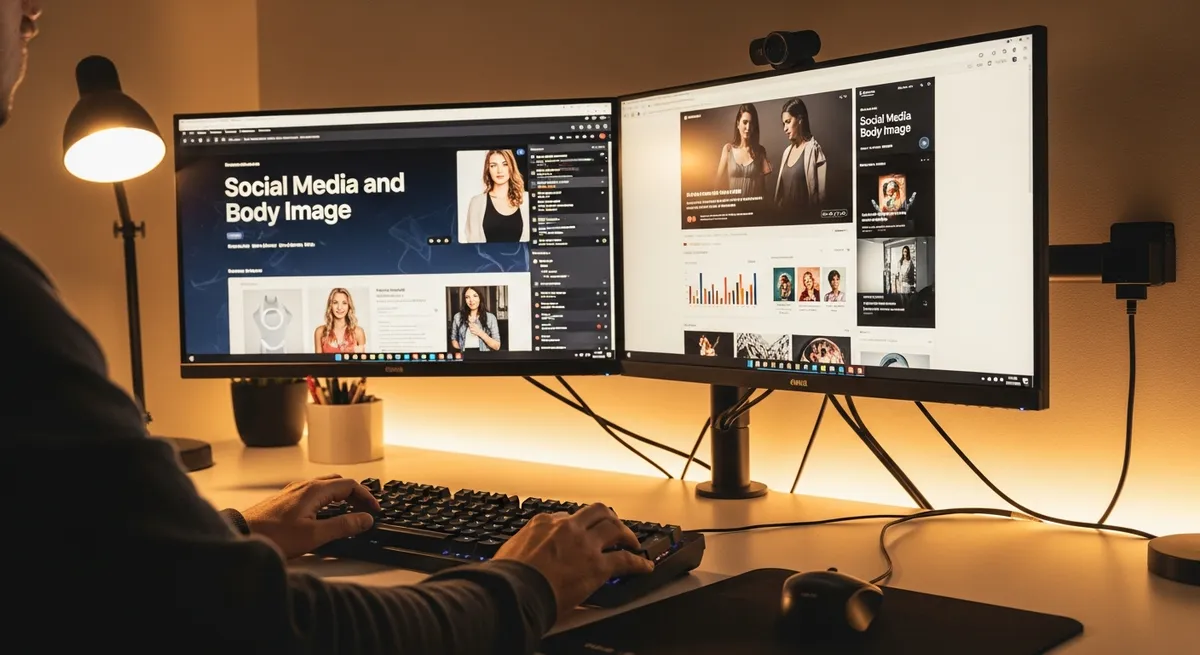
The intersection of social media and body image is not just a passing trend; it is a bioethical emergency that requires immediate focus. We cannot continue to treat the psychological fallout of these platforms as an unavoidable price of progress. The data is clear, the damage is quantifiable, and the perpetrators are currently enjoying their profits. (I am exhausted from seeing brilliant, vibrant people reduced to a collection of physical flaws because a software program told them they were inadequate.) Beyond individual tricks, we must demand absolute transparency. Why does a social media giant get to keep their data in a locked vault? According to the American Psychological Association, the constant comparison enabled by these platforms is a main driver of depression among teenagers.
Building a healthier relationship with our screens requires both personal vigilance and systemic overhaul. You must be the curator of your own mental landscape, but you must also be a citizen who demands higher standards. If you stop engaging with the polished, "perfect" content and start following accounts that prioritize actual reality, the algorithm will eventually learn. It is a tedious process, like trying to teach a very dim-witted dog to sit. (My own dog took three years to learn "stay," so I have the patience for this.) The machines may be cold and calculating, but we are not. We have the power to demand a digital future that honors our humanity rather than making a buck off our self-doubt. Now, if you will excuse me, I am going to put my phone in a drawer and go look at a tree for a while. It is a very average tree, and that is exactly why I appreciate it.
⏱️ Quick Takeaways
Frequently Asked Questions
❓ How do algorithms specifically target body image insecurities?
The system is designed to identify what you stare at longest. If you linger on a photo of a flat stomach because it makes you feel bad, the machine assumes you "like" that content and will serve you more. The goal is to break the hyper-fixation on appearance altogether by consciously clicking away. It is about reminding your brain that your body is a vessel for your life, not just an object to be looked at. (Though my brain often forgets this and thinks my body is just a taxi for my head.)
❓ Is there a specific age when social media becomes most damaging?
While adolescents are the most vulnerable due to the "social comparison" phase of brain development, adults are by no means immune. The peak risk window is typically between ages ten and twenty-four, when the prefrontal cortex is still under construction. However, I have seen fifty-year-olds lose their minds over a filtered vacation photo just as easily as a teenager. The damage is not age-restricted; it is just more foundational during our younger years. (It is hard to build a house on a foundation of quicksand.)
❓ What should parents do if they notice their child struggling?
The first step is to open a non-judgmental dialogue about how the "digital sausage" is made. Do not just take the phone away; explain why the images they see are not real. Encourage them to audit their following list and unfollow anyone who makes them feel "less than." It is about teaching digital literacy rather than just enforcing digital abstinence. You want them to have a "bullshit detector" that is louder than the algorithm. (And perhaps teach them how to enjoy a potato every once in a while.)
❓ Are there any laws currently being passed to regulate this?
The situation is changing rapidly, but the legal system moves at the speed of a tectonic plate. Several states and countries are currently debating "Online Safety" acts that would require platforms to perform risk assessments for child safety and mental health. However, many of these are bogged down in debates over free speech and privacy. We are in the "Wild West" phase of the internet, but the sheriffs are finally starting to put on their badges. (I just hope they do not get distracted by a filtered sunset on the way to the station.)
❓ Why are photo filters so addictive for our self-image?
Filters provide an instant hit of dopamine by presenting a "perfected" version of ourselves that we cannot achieve in reality. This creates a psychological gap between who we are and who the screen says we could be. Researchers have identified this as a driver of body dysmorphia, where the desire to look like a filtered image in real life becomes a damaging obsession. (It is a digital phantom that haunts your real mirror.)
Disclaimer: This article is for informational purposes only and does not constitute professional medical, psychological, or legal advice. If you or someone you know is struggling with an eating disorder or mental health crisis, please consult a qualified healthcare professional or contact a national crisis hotline immediately.