
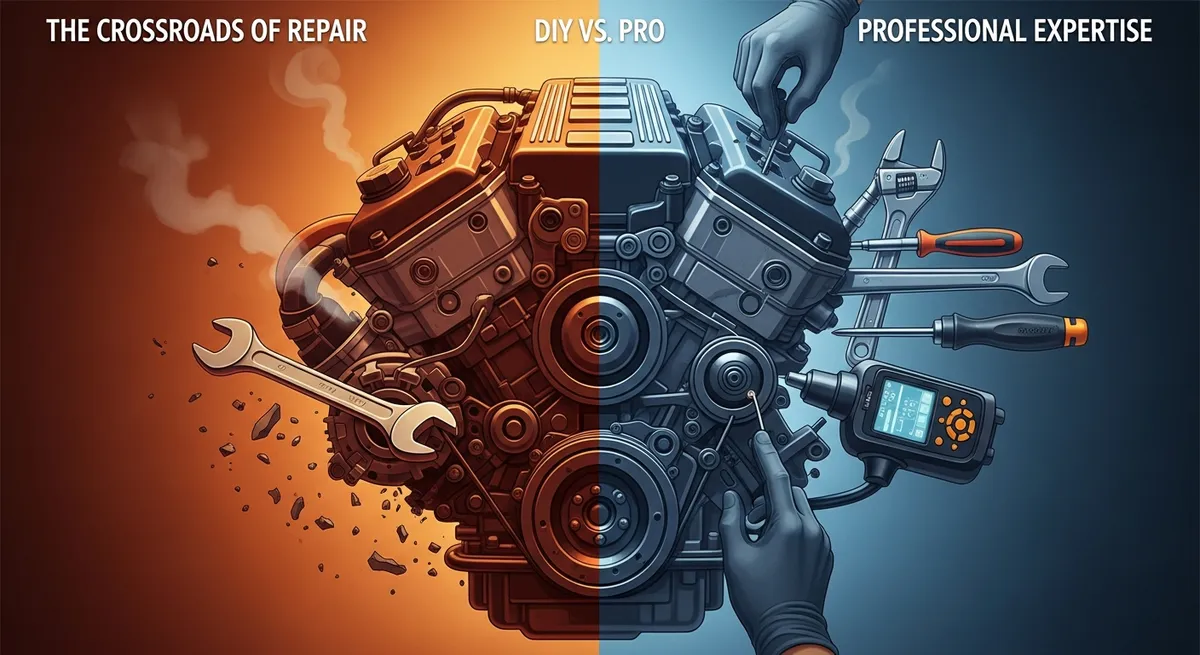
There is a specific sound a car makes when a DIY repair goes sideways - and I hate it. It isn't a bang. It is more of a sad, expensive crunch. (I have heard it too many times, unfortunately.) You see, back in the 90s, you could fix almost anything with a socket set and some grit. If it rattled, you tightened it. Simple. But today? We aren't driving machines anymore. We are driving rolling computers. The game has changed completely, and honestly, the industry does not want you to know just how complex it has become. While we all want to save a few bucks - and who doesn't right now? - there is a fine line between being thrifty and accidentally turning your sedan into a two-ton paperweight. Before you crack that toolbox, you need to understand what you are actually up against.
The "YouTube Academy" Trap (And Why It’s Costing You)
Look, I’ve been there. It starts innocently enough.
You hear a noise. You Google it. Some guy named "TurboTom88" has a video showing exactly how to fix it in ten minutes. He makes it look easy. Suspiciously easy.
So you buy the part. You crawl under the chassis. And three hours later, you’re bleeding from a knuckle, one bolt is stripped, and the check engine light is blinking at you like a judgmental eye. Walking into a shop is the worst - I know. The stale coffee smell. The waiting room chairs from 1994. And bracing yourself for a bill that costs more than your first Honda Civic.
But here’s the reality nobody mentions in those videos. Modern cars are spiteful.
Your basic sedan - yes, even the boring one collecting dust in the driveway - packs somewhere between 30 and 100 Electronic Control Units (ECUs). That is - and I'm not exaggerating here - more processing grunt than the guidance computer NASA used for Apollo. Seriously. It is a network on wheels.
So when you try to swap a component? The computer notices. It freaks out. It might even lock you out of the ignition system until a dealer resets it. (And they charge extra for that.)
Then there is the "Tool Tax" nobody warns you about. You see the part costs $50 online. You think, "Great, the shop wants $400, I am a genius." But you don't have a torque wrench. That is $60. You don't have the specific E-Torx socket BMW decided to use for no reason other than spite. That is $20. You need a scan tool to tell the computer you changed the battery. Another $150. Suddenly, your $50 repair is $300, and you have spent your entire Saturday cursing at a rusty bolt that refuses to budge. The math doesn't always work out.
The "Widow-Makers" (Seriously, Hands Off)
There are repairs you can do. Changing wiper blades? Go for it. Air filters? Knock yourself out. But then there are the widow-makers. These aren't just hard repairs; they are financial - and sometimes literal - suicide missions.
1. The Timing Belt (The Engine Killer) Here’s the deal with interference engines. The timing belt has one job: keeping the crankshaft and camshaft in sync. Think of it like a ballet. A really high-stakes ballet. Mess this up by a fraction of an inch - I’m talking a hair’s width - and boom. Engine destroyed. The absolute millisecond you turn that key. Valves smash into pistons. It’s over. You don't just need a new belt; you need a new engine.
2. Suspension Springs (The Jaw Breaker) Ever seen a coil spring under tension? It’s a loaded cannon. If the clamp slips while you're trying to replace a strut, that spring releases with enough force to punch a hole through a brick wall. Or your face. We call the compression tools "widow-makers" for a reason. Just don't.
3. Hybrid/EV High Voltage (The Zapper) Pop the hood. See those bright orange cables? Those aren't orange for fashion. Those carry enough voltage to stop your heart instantly. I consider myself handy - I built a deck last July - but touching a high-voltage hybrid system without Class 0 gloves? No chance. I like being alive.
4. High-Pressure Fuel Systems (The Injector) Old cars had fuel lines you could clamp off with a pair of vise-grips. New cars with Direct Injection? Different beast entirely. We are talking about fuel rails pressurized to 2,000+ PSI. If you crack a line loose without depressurizing it correctly - which usually requires a scan tool, by the way - that fuel doesn't just leak. It sprays. With enough force to penetrate human skin. It’s called hydraulic injection injury, and it is as gruesome as it sounds. Leave the fuel system to the pros.
The "Insider" Cheat Code: How to Actually Save Money
So, if you can’t fix the big stuff yourself, are you just doomed to pay whatever the dealer asks?
No. Absolutely not. (Please don't do that.)
The trick isn't doing the labor yourself; it’s hacking the quote system. Most people don't realize that mechanics don't just make up prices - well, the bad ones do - but the legit ones use "book time." But labor rates? Those vary wildy.
Here is a secret the industry guards carefully: The "Flat Rate" system. Most mechanics aren't paid by the hour; they are paid by the "book time" for the job. If the book says a water pump takes four hours, they get paid for four hours. Even if they represent a NASCAR pit crew and finish it in 45 minutes. This encourages speed. Sometimes, too much speed. This is why finding an independent shop that pays hourly (or has a reputation for quality over volume) is the real cheat code.
Okay. The math. (Deep breath.) For the same job, dealer quotes routinely run well above what a good independent shop charges.
That gap? That’s your money.
Let me give you a real example from last week. A buddy of mine - let's call him Dave - tried to replace his own alternator on a 2021 SUV. The part was $200. The dealer wanted $900. Dave thought he was winning. Six hours later, he had snapped a mounting bolt inside the engine block because he didn't check the torque specs. The tow truck cost $150. The machine shop to drill out the bolt cost $400. The new alternator install cost $300 (independent shop). Total cost for "saving money"? $1,050. Plus a bruised ego. Don't be Dave.
The secret is using comparison tools. You wouldn't book a flight without checking a few sites, right? Why treat a $800 repair differently? There are platforms now that let you punch in your zip code and your car’s VIN. They spit out quotes from local, pre-vetted shops.
It forces them to compete. And when shops compete, the price drops. Sometimes by 30% or more.
So, What’s the Move?
Here is my rule of thumb - and it has saved me thousands, so hear me out. If the repair involves fluids? Filters? Cosmetic stuff? Go for it. Grab a beer, watch the video, have fun. But if it involves the engine internals, the suspension geometry, or electricity that can kill you? Put down the wrench.
Use a comparison tool. Get three quotes. Pick the middle one. (Never pick the cheapest one - trust me on that, cheap mechanics cut corners that you'll pay for later.)
Modern cars are amazing. They’re safer, faster, and cleaner. But they aren't meant to be fixed in a driveway anymore. Accept it. Your knuckles will thank you.
FAQ: Real Talk on Car Repairs
Q: Can I really void my warranty by doing my own oil changes?
Technically? No. The Magnuson-Moss Warranty Act protects you. But - and this is a big but - if you screw it up? If you strip the drain plug or forget to fill it back up? Yeah, the manufacturer isn't covering that. They will blame you instantly. Keep your receipts. Photograph everything. Log the date and mileage. If you can't prove you did it, they will assume you didn't.
Q: Are independent shops really as good as the dealer?
Usually? Yes. Often better. Dealers are great for warranty work, but independent mechanics often have decades of experience on specific makes. Plus, they don't have the overhead of a massive glass showroom to pay for. Just make sure they are ASE certified. That little blue patch on their sleeve means they actually studied the books, not just the forums.
Q: My check engine light is solid, not blinking. Can I drive it?
Solid usually means "schedule an appointment soon." It could be an emissions leak or a sensor glitch. Blinking means "pull over right now or your engine will melt." Seriously. A blinking light usually indicates a misfire severe enough to dump raw fuel into your catalytic converter, which can overheat it to the point of glowing red hot. If it's blinking, don't push your luck. Call the tow truck.
Q: Is synthetic oil actually worth the extra money?
Short answer: Yes. Long answer: Absolutely yes. Modern engines have tighter tolerances. They get hotter. Synthetic oil resists breakdown way better than conventional dino-juice. It might cost $20 more per change, but it's the cheapest insurance you can buy for your engine's longevity.
Q: What about those cheap OBD2 scanners online?
Worth every penny. Seriously. A $20 scanner might not fix the problem, but it gives you the code. That way, when you walk into the shop, you can say "I have a P0300 misfire code" instead of "It's making a weird noise." It changes the dynamic instantly.
Disclaimer: This article is for informational purposes only. I am a writer, not your mechanic. Always consult a certified professional before attempting vehicle repairs. High-voltage systems can be lethal. Seriously, be careful.


