
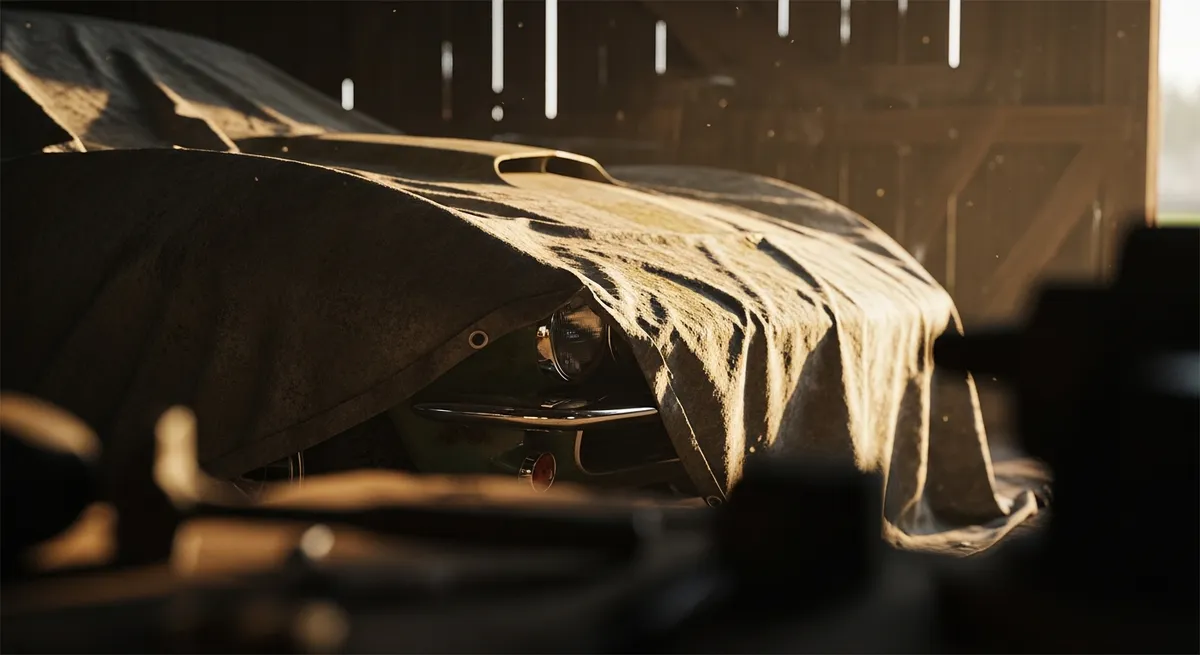
Exploring classic car investment opportunities can be appealing, but understanding the financial realities behind best classic cars to buy is essential before committing capital. While stories of rare discoveries and rapid appreciation circulate widely, most purchases involve ongoing costs, maintenance requirements, and market risks that are often underestimated. Evaluating classic car restoration costs alongside storage, insurance, and long-term value trends provides a clearer picture of potential returns. As the market continues to evolve, distinguishing between collectible assets and high-risk purchases has become increasingly important. A structured approach can help reduce costly mistakes and improve long-term outcomes in this niche investment space.
The "Barn Find" Myth (and Why You Should Ignore It)
We all love the story. (I blame reality TV for this one.) Some guy buys a heap for pennies, pumps up the tires, and sells it at auction for millions. Does it happen? Sure. Once a decade. To one guy. Usually named Steve.
But when we talk about this asset class-real investing, not just hoarding junk-we have to look past the shiny paint. We have to look at the ledger. And the ledger is usually bleeding red.
Here is the thing about old cars: they hate you. Well, maybe they don't hate you, but they certainly hate sitting still. Rubber rots. Seals dry out. Mice chew through wiring harnesses (ask me how I know-actually, don't, it is too soon). Maintenance isn't optional; it is a ransom payment you make to keep your asset from turning into a lawn ornament.
Think about the storage costs alone. In a decent city, climate-controlled storage typically runs $300 to $500 a month. That is $3,600 to $6,000 a year just to let the car sit there. Over a decade, you have spent $60,000 on rent for a car that might have appreciated $20,000. Do the math. It is brutal.
Hagerty (the insurance guys who track this stuff) publishes market indices showing values up, but the cost of entry is brutal. If you buy a $50,000 car and it appreciates 5% a year, but you spend $3,000 a year on storage, insurance, and repairs... congratulations. You are losing money. Fast.
The "Vintage Metal" Trap: Restoration vs. Preservation
So you think you can restore a wreck? Stop. Just stop.
Unless you own a body shop or have 2,000 hours of free time, restoration is financial suicide. (I am serious.) The math almost never works. You will spend $80,000 restoring a car that is worth $60,000 on its best day. That is not investing. That is charity. You are donating your wallet to the next owner.
The smartest money in the room-the guys actually making a profit on vintage metal-they don't restore. They buy survivors. Or they buy the best restored example someone else lost money on. Let the other guy take the depreciation hit on the restoration costs. You just want the asset.
Labor rates at competent restoration shops commonly touch $125 or $150 an hour. A "simple" paint job can spiral into $25,000 before the car is even reassembled. It is a trap.
Let's Look at the Numbers (The Ugly Truth)
Comparing a "Project Car" versus a "Turn-Key Investment" is eye-opening. (And a little depressing.)
| Cost Category | The "Project" Car | The Investment Grade Car |
| Purchase Price | $15,000 (Cheap!) | $65,000 (Ouch) |
| Restoration Costs | $50,000 (Conservative... maybe) | $2,000 (Just oil and tires) |
| Time to Market | 3-5 Years | Immediate |
| Final Value | $55,000 (Maybe) | $70,000+ |
| The Bottom Line (Real Math) | -$10,000 (You lost money) | +$3,000 (Profit) |
See that? The "cheap" car costs you more. Every single time.
Finding the Best Classic Cars to Buy (Without a Crystal Ball)
So if restoration is a trap-and trust me, it is-where do you put your cash? The market is weird right now. Muscle cars are cooling off (Boomers are aging out of the market), while 80s and 90s Japanese and German cars are skyrocketing. Why? Because the kids who had posters of Countaches on their walls are now CEOs.
Big money isn't chasing the 1950s stuff anymore. It is all about the 80s and 90s now. If you want the best classic cars to buy right now, look at what the 40-year-olds want. That is the golden rule. It is not about what you like. It is about demographics.
The JDM Explosion
We are talking about the holy trinity of JDM: Supras, RX-7s, and the twin-turbo 300ZX. These cars used to be throwaway speed machines. Now? A clean Mark IV Supra can trade for six figures. It makes no sense until you realize the people buying them grew up playing Gran Turismo. Prices have exploded. But clean examples? They are still out there.
German Youngtimers
Look at the 1990s Mercedes SLs (the R129 chassis) and the BMW 3-Series from the E30 and E36 era. These are built like tanks. They are still somewhat affordable-for now-but the window is closing fast. They represent the last era of "analog" driving before computers took over everything.
Also, watch out for the "tides." A rising tide lifts all boats, but when the tide goes out (and the economy dips), the mediocre cars crash first. The blue-chip stuff-Ferrari 250s, Porsche 911 RSs-they hold value. The random 4-door sedan from 1965? That goes to zero. Or close to it.
The Cheat Code: Fractional Ownership
Maybe you don't have $100k buried in the backyard. (Join the club.)
This is where things get interesting. New platforms are popping up that let you buy shares of a classic car. Think of it like the stock market, but cooler. You don't have to change the oil. You don't have to pay for insurance. You just own a piece of a million-dollar asset.
It is arguably the smartest way to play classic car values without risking your garage space-or your marriage. You get exposure to the asset class without the headaches of leaking oil on your driveway. Plus, these platforms handle the storage, the maintenance, and the eventual sale. You just buy the shares and wait. It removes the emotion from the equation, which is usually what kills your returns anyway.
Action Plan: How to Not Go Broke
If you are still dead set on buying physical metal (I get it, the smell of gasoline is intoxicating), follow these rules. Strictly. Do not deviate, or your wallet will hate you.
1. Buy the Absolute Best Example You Can Afford
Never, ever buy the cheapest option. A cheap 911? That is the most expensive car in the world. Seriously. Why? Because the deferred maintenance will bankrupt you. Spend the extra money upfront for a car that has been loved, not neglected.
2. Get a Pre-Purchase Inspection (PPI) Every Time
Seriously. Don't skip this. If the seller won't let a mechanic look at it? Run. Fast. They are hiding something. Maybe it is bondo sculpted to look like a fender. Maybe the frame is twisted. Doesn't matter. If they won't let you inspect it, the car is garbage.
3. Check the VIN and Provenance
Numbers matching? Original engine? If not, the value is cut in half. Period. Ignore the "Story." Sellers love to tell you it was owned by a celebrity or driven only on Fundays. Unless they have paperwork proving it, it is just noise.
4. Don't Try to Be a Hero
Don't buy a car that needs "just a little work." "Just a little work" usually means "needs a complete engine rebuild." Buy something you can drive home.
FAQ: Real Talk on Vintage Rides
Is buying a classic actually a good investment?
Short answer? No. (Sorry.) Long answer: Sometimes. If you get lucky. If you buy the right car at the bottom of the market and hold it for ten years? Yes. If you flip cars on eBay? You will probably break even if you are lucky. It is an "alternative asset" for a reason-it is risky.
What creates the most value in a classic car?
Provenance and Originality. A car with its original paint and engine is worth 2x or 3x a restored car. Just because it is shiny doesn't mean it is valuable. In fact, shiny often hides sins.
Should I insure it as a regular car?
No! Absolutely not. Regular insurance pays "Book Value" (which is nothing for old cars). You need "Agreed Value" insurance. If your $50,000 classic gets totaled, regular insurance might write you a check for $500. Don't make that mistake.
Can I drive my investment daily?
Technically? Yes. Financially? No. Every mile you put on the odometer devalues the asset. Plus, old cars are miserable in traffic. They overheat, the brakes are terrible compared to modern cars, and if someone rear-ends you, your investment is toast. Drive them on weekends. That is it.
What about the maintenance costs?
Expect to spend 1-2% of the car's value annually on basic maintenance, assuming nothing major breaks. If something major breaks-like a transmission or a differential-all bets are off. Keep a repair fund separate from your savings.
Disclaimer: I am a writer, not a financial advisor. Classic cars are volatile assets. Past performance of a 1967 Mustang does not guarantee future results. Do your own due diligence before buying anything that leaks oil.


