
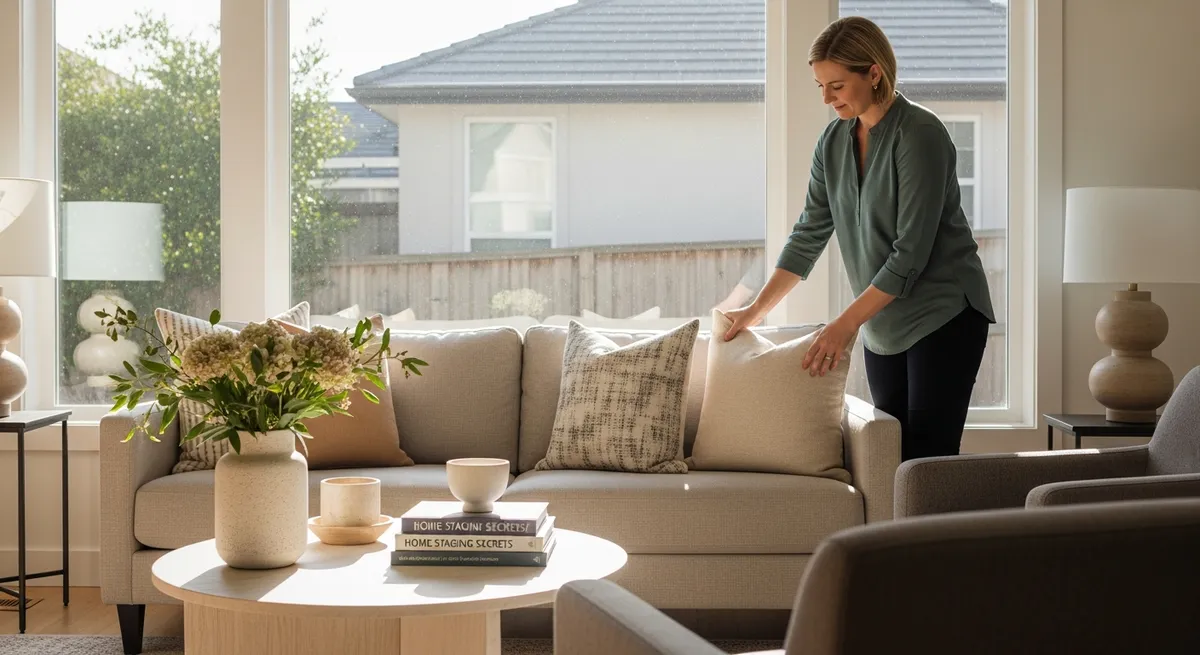
You unlock the front door. What’s the first thing that hits you? Is it light, air, and infinite possibility? Or is it the lingering scent of last night’s salmon dinner mixed with wet dog? Be honest. (I know, it hurts.) Within fifteen seconds of stepping onto your welcome mat, buyers make a subconscious decision about your entire life. They haven't even seen the renovated kitchen yet. Doesn't matter. If the vibe is off in the foyer, they’ve already mentally moved on to the next listing. I see sellers make this mistake constantly, thinking their square footage will save them. It won’t. You aren't selling walls and a roof; you’re selling a fantasy life where the laundry is always folded and the kids never draw on the walls. If you can't sell that dream in under a minute, you're leaving thousands on the table.
The "Imagination" Myth
I hear this excuse every week. "My house has good bones. Can't they just look past the clutter?"
Short answer: No.
They can't. Most people, and I mean 90% of the population, lack the spatial intelligence to visualize potential. Buyers have zero imagination. I mean zero. If they walk into a room filled with your grandmother's antique doll collection or your massive sectional sofa, they don't see "cozy family room." They see "cramped." And probably a little "creepy." They walk into a bedroom with a treadmill in the corner, and their brain screams, "This house is too small!" They don't see space for a reading nook. They see a used gym. (Sad, but true.)
When you leave your personal stuff out, you're marking territory. Family photos? Toothbrushes on the counter? That college diploma on the wall? It screams "This is MY house." Buyers need to walk in and think, "This is MY house." They can't do that if they're staring at your wedding photos. You have to erase yourself from the equation. Brutal? Maybe. But necessary if you want top dollar.
Staging isn't about decorating. It's about marketing. There's a difference. Decorating is making a home fit your style. Marketing is making a home fit everyone's style. That means neutralizing everything. Cleaning is just the baseline. You have to scrub, obviously. But staging? Staging is theater. It’s set design for a play called "Your Amazing New Life."
The ROI of "Fake" Living
Let's talk money. Because that's why we're here. You aren't doing this for your health.
Data from the National Association of Realtors' Profile of Home Staging suggests staged homes sell faster and for more money. We're talking anywhere from 1% to 5% more. On a $400,000 house, that's $20,000 in your pocket. Just for moving some furniture and painting a wall beige. (I wish making money was always that easy.) Think about the alternative. If your house sits on the market for 60 days, what's the first thing you do? You drop the price. Usually by $10,000 or more. Staging is basically insurance against that price drop.
But hiring a pro stager costs money, right? Sure. Usually a few grand. If you're tight on cash, you don't need the full package. You can DIY this if you're ruthless enough. I’ve seen homeowners pull it off, but they had to get aggressive with their clutter.
The "Purge" Checklist
If you're going the DIY route, you need to be cold-hearted. Here’s what usually kills a sale:
- The Smell: You're nose-blind to it. Your house smells like your life. Ask a friend, one who won't lie to you, to walk in and sniff. If they hesitate, scrub everything. If you have pets, this is non-negotiable.
- The Furniture: You probably have too much. We all do. Remove 30% of the furniture from every room. You want flow. If a buyer bumps their hip on a coffee table, they'll think the room is tiny. Create walking lanes.
- The Walls: If it's personalized, take it down. If it's a bold color, paint over it. "Agreeable Gray" isn't exciting, but it sells houses.
Lighting: The Silent Deal Killer
This is where most DIY sellers fail. Before a showing or open house, every single light in the house should be on. And I don't mean just the overheads.
I mean lamps, under-cabinet lights, vanity lights. All of them. Shadows are expensive. If a corner is dark, it looks small. But here's the pro tip that nobody tells you: Check your bulb temperature.
If your kitchen has cool blue "daylight" bulbs (5000K) and your living room has warm yellow "soft white" bulbs (2700K), the house feels disjointed and chaotic. It feels like a funhouse. Swap them out. I usually recommend 3000K (often called "Bright White" or "Warm White") for living areas. It’s the hotel standard. Clean, bright, but not surgical.
It feels counterintuitive. You want to show how much fits in the room, but empty space sells better than full space. It's psychological. Space equals luxury. Clutter equals stress.
The "Cantaloupe Rule"
Here’s a weird rule I live by when I help friends prep their homes: The Cantaloupe Rule. When you're styling shelves or coffee tables, avoid anything smaller than a cantaloupe.
Why? Because small things, little figurines, tiny picture frames, tchotchkes, don't read well in photos. They just look like visual noise. Like clutter. You want big, impactful pieces. A large vase. A stack of three large hardbound books. A substantial plant. If it’s smaller than a melon, pack it away. (Unless it’s grouped on a tray, but even then, be careful.)
Kitchens and Bathrooms Sell Homes
I've said it a thousand times. You can have a living room that looks like a magazine cover, but if the bathroom looks like a truck stop, you're dead in the water.
You don't need a $50,000 renovation. You need a deep clean. And I mean deep. The grout needs to sparkle. The caulking around the tub? If it's even slightly yellow, scrape it out and re-do it. Takes twenty minutes. Costs five bucks. Makes the bathroom look new.
In the kitchen, clear the counters. Everything. The toaster? Hide it. The knife block? Gone. Buyers want to see acres of counter space. Give it to them. Also, look at your hardware. Are your cabinet pulls from 1990? Swap them for brushed nickel or matte black. It costs maybe $100 for the whole kitchen and transforms the look instantly.
The "Lived-In" Trap
Some sellers try to make it look "homey." They leave a throw blanket casually tossed on the sofa or a book on the nightstand.
Careful.
There's a fine line between "inviting" and "messy." A professional stager knows exactly how to place that throw blanket so it looks aspirational. When you do it, it just looks like you forgot to fold the laundry. (I'm not judging, I'm just saying.) Unless you have an eye for design, lean towards "hotel clean" rather than "cozy lived-in."
Think of your house as a product on a shelf. When you buy a new iPhone, the box is pristine. Minimal. Clean. That's the vibe. You want the buyer to feel like they're unboxing a new life.
Action Plan: Weekend Warrior Edition
So, you've got a weekend before the photographer shows up. What do you do? Panic? No. You execute.
First, rent a storage unit. Seriously. Get the boxes out of the garage. Buyers look in the garage. If it's packed to the ceiling, they think the house lacks storage. Move the off-season clothes, the extra chairs, and the holiday decorations out. Off-site.
Second, paint. If your walls are red, yellow, or purple, paint them "Revere Pewter" or "Agreeable Gray." Boring? Yes. Profitable? Absolutely. Neutral walls let buyers project their own colors onto the space. A gallon of paint costs $40. It returns thousands.
Third, curb appeal. It's a cliché for a reason. Mow the lawn. Plant some yellow flowers (yellow pops best in photos). Paint the front door. If they don't like the outside, they won't even bother coming inside. Fresh mulch is the cheapest facelift you can buy for a house. Put it everywhere.
FAQ: Staging Edition
Q: Do I really need to stage a spare bedroom?
Short answer: Yes. An empty room confuses people. Is it a bedroom? An office? A closet? Give it a purpose. Put a cheap desk and a chair in there. Now it's a "home office." Value added. If you leave it empty, buyers assume it's smaller than it actually is.
Q: Can I just leave my stuff in the closets?
You're gonna hate this: No. Buyers open closets. If your closet is stuffed, they assume the house has no storage. Rule of thumb: remove 50% of your clothes. Make it look like you have so much space you don't even know what to do with it. Matching hangers help, too. (Obsessive? Maybe. But effective.)
Q: Is virtual staging worth it?
It depends. For online photos? Sure. It helps. But when they show up and the house is empty, the magic fades. Real staging is better. But virtual is better than nothing, especially for empty homes. Just make sure you disclose it so people aren't shocked when they walk in.
Q: What if I have pets?
Hide the evidence. I love dogs. Buyers don't. Hide the bowls. Hide the bed. And for the love of all that is holy, hide the litter box. If a buyer smells cat, they subtract $5,000 from their offer. Instantly. (Harsh, but true.) You might need to hire a deep cleaner specifically for pet odors.
Disclaimer: I'm a writer, not a real estate agent. Markets change. What works in a hot seller's market might not work in a cold buyer's market. Talk to a local pro before you spend a fortune on throw pillows.


