
The doorbell rings. Panic sets in. You have exactly thirty seconds before your friends walk through that door, and your living room looks like a tornado hit a thrift store. You do the "scoop and run"-grabbing mail, stray socks, and three coffee mugs, shoving them into the nearest closet, and leaning your body weight against the door to latch it. You force a smile, wipe the sweat off your forehead, and pretend you live in a minimalist sanctuary. But you know the truth. (I know it, too.) The mess isn't gone. It's just hiding. It's holding its breath behind a thin layer of drywall. Waiting. It'll explode the second you open that door again. I've been there. We all have. That creeping anxiety? It's real.
Here's the thing: most "home organization" advice is dead wrong. It fails because it focuses on arranging your junk rather than disappearing it. You know the drill. Clear dividers. Color-coded labels. Rainbow sorting. (All useless.) But let's be honest for a second: arranging clutter just makes it look like "pretty" clutter. It's still stuff. The real secret isn't organizing. It's vanishing. It's about smart storage solutions that make the mess disappear entirely. Poof. Gone. You get a home that actually feels peaceful. Not just staged for Instagram.
Why Your "Organized" Home Still Feels Cluttered
I hate to be the one to tell you this, but buying more plastic bins is usually the wrong move. When you buy a stack of clear containers, you aren't solving the problem. You're just building a transparent coffin for your junk.
Think about it. If you can see the cables, the old batteries, and the mismatched Tupperware lids through the plastic, your brain still registers it as visual noise. (I learned this the hard way after spending $400 on "systems" that just made my closet look like a warehouse.) True decluttering tips don't involve displaying your mess; they involve hiding it effectively. If I can see it, I have to think about it. And I don't want to think about my spare HDMI cables.
In a UCLA study of working parents, women who described their homes as cluttered showed flatter, less healthy daily cortisol patterns. Essentially, your brain can't relax when it's constantly processing visual data. Every item on a shelf is a tiny demand for your attention. So, the goal isn't "neatness." The goal is "nothingness."
We need to stop organizing and start concealing. (Harsh, but true.)
Look around your room right now. I bet there are at least three "dead zones" you're ignoring. These are the spaces that exist but aren't working for you. The most obvious one? Under the bed.
But I'm not talking about shoving cardboard boxes under there until the dust bunnies take over. That's amateur hour. I'm talking about hydraulic lift beds. They used to be clunky. Not anymore. Now, hidden storage means lifting up your mattress to reveal a massive, dust-free cavity that holds four suitcases and your winter coats. It solves the problem instantly. My friend Sarah got one last year. She fit her entire snowboard collection inside. It just vanished. (And honestly, pretty fun to show off to guests, though maybe that's just me.)
If a new bed frame isn't in the budget, look at your kitchen cabinets. Go ahead, look down. That four-inch strip of wood near the floor? The toe-kick? That is wasted real estate. It's literally empty space.
You can actually install drawers there. Flat ones. They're perfect for baking sheets, cutting boards, or that pizza stone you swore you'd use every Friday but haven't touched since 2019. (No judgment. We all have one.) It's a drawer that replaces your baseboard. Genius? Yes. Expensive? Not if you DIY. I've seen kits online for under fifty bucks. You pop off the face board, slide in the drawer mechanism, and reattach the board as the drawer front. Suddenly, you have three square feet of storage that didn't exist yesterday.
Furniture That Does Double Duty (Or It Doesn't Get In)
Here is my personal rule: If a piece of furniture doesn't open up, I probably won't buy it. A coffee table shouldn't just be a table. It should be a chest. An ottoman isn't for your feet; it's for your blankets. This is the oldest trick in the book, but people still buy "sleek" furniture with zero function.
Don't do that. Get the ugly sturdy bench that opens up. Paint it if you have to. (I painted mine navy blue. It looks decent.)
When you utilize furniture with internal cavities, you reduce the need for external shelving. And fewer shelves mean less visual clutter. It's simple math. You hide the ugly stuff-routers, remotes, gaming controllers-inside the furniture, so the surface remains clean. If you have a choice between a glass coffee table and a solid wood trunk, pick the trunk. Always. The glass table forces you to be neat. The trunk lets you be messy, but hides the evidence. That's the kind of grace we all need.
The "Hollow" Rule
I apply this to everything. Sofas? Get the ones with storage under the chaise. Nightstands? Never buy the ones with just legs; get the ones with drawers. Even your headboard can have pull-out shelves. If it takes up floor space, it better pay rent by holding my stuff.
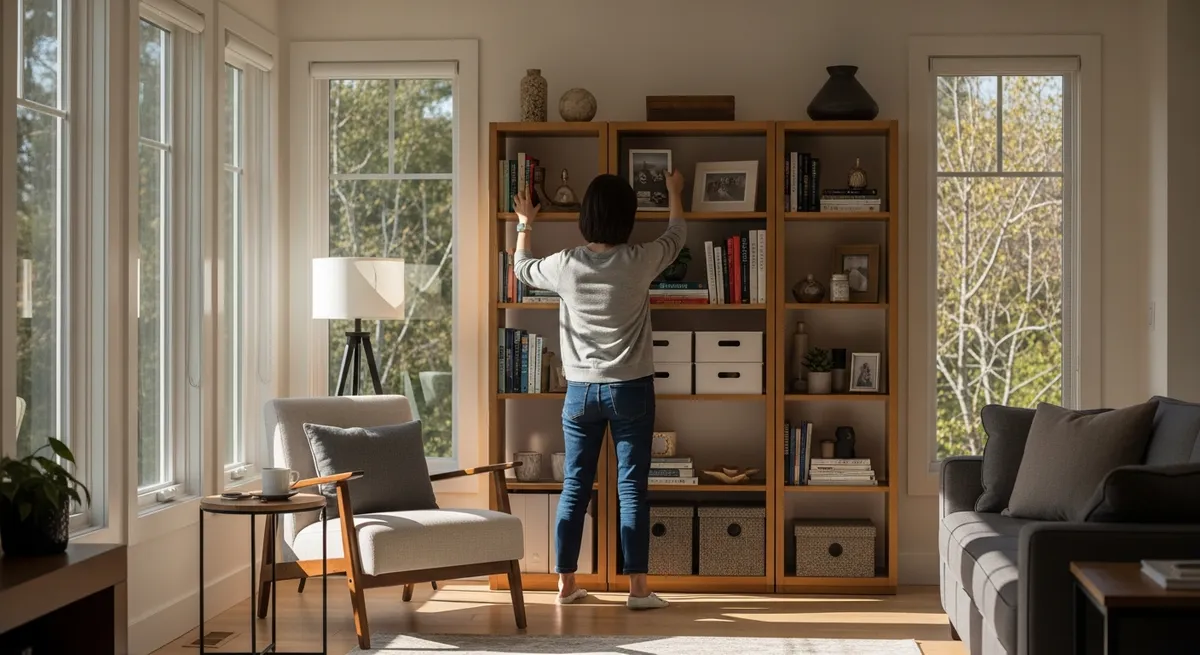
Most people stop their shelves at eye level. Why? The air up there is free. Take your shelving all the way to the ceiling. Even if you can't reach the top shelf without a step stool, that's fine. Put the stuff you never use up there. It draws the eye up, makes the room feel bigger, and gets the clutter off the floor.
It's about the "Vertical Illusion." When you have floor-to-ceiling storage, it looks like architecture. When you have waist-high bookshelves, it looks like furniture. Architecture disappears. Furniture takes up space.
I know what you're thinking. "Custom built-ins cost a fortune." They can. But you can fake it. Grab some standard tall bookcases (like the IKEA Billy, frankly), trim them out with some molding from the hardware store, and paint them the same color as your walls. Suddenly, they look built-in. Total cost? Maybe $200. Value added? Immense. I did this in my last apartment. A little caulk, a little paint, and some crown molding. Everyone thought I hired a carpenter. (I didn't. I just own a saw.)
The Psychology of "Hidden"
There is a reason high-end hotels feel so relaxing. It's not just the thread count. It's the lack of "stuff." The hair dryer is in a velvet bag. The remote is in a leather box. The ironing board is flush against the closet wall. They hide the mechanics of living.
We can learn from that. When you walk into a room and see a pile of mail, your brain creates a "to-do" list. "I need to pay that." "I need to file that." When you hide the mail in a designated drawer, the to-do list vanishes from your immediate consciousness. You still have to do it, obviously. But you don't have to look at it while you're trying to watch a movie. That mental break is worth the price of the drawer. Trust me.
The "One Touch" Rule
This isn't a storage product. It's a habit. And it's the only one that actually works for me.
The rule is simple: You only touch an item once. When you take off your coat, you don't put it on the chair (touch one) to move it to the closet later (touch two). You put it in the closet immediately. Done.
It sounds stupidly simple. It is. But try it for a day. It's exhausting at first. I tried this last Tuesday and failed by noon. But by Wednesday, it started to click. The clutter never accumulates because it never lands on the "staging areas" (dining tables, entryway benches, treadmills). If you don't put it down, you don't have to pick it up again. (Lizard brain logic, but it works.)
Action Plan: Start Small
Don't try to fix the whole house this weekend. You'll burn out. (I've seen it happen. I've done it. I once ended up crying in a pile of winter scarves.)
Pick one category. Just one.
The "Paper" Pile. You know the one. It's on the counter. Get a shredder. Don't organize the junk mail; destroy it.
The "Cord" Drawer. The spaghetti monster of USB cables. Buy a roll of velcro ties. Not zip ties (you'll regret those). Velcro allows you to re-wrap when you inevitably need that cable again.
The Entryway. The shoe graveyard. Get a "dump bin." A nice woven basket where kids can throw shoes is better than a shoe rack they have to carefully balance sneakers on. They won't balance them. They will throw them. Plan for the throw.
Attack that one spot with the "Vanishing" mindset. Don't organize the cords; hide them inside a box. Don't stack the papers; scan and shred them. Make the mess disappear.
FAQ: Real Talk on Storage
Q: Is hydraulic bed storage actually safe for heavy mattresses?
Short answer: Yes. Most modern hydraulic lift beds use heavy-duty gas pistons similar to what you see on a car trunk. They are rated for significant weight-often lifting heavy hybrid or memory foam mattresses with just a gentle nudge. Just check the weight rating before you buy (don't cheap out on the hardware). If your mattress is a concrete slab, maybe double-check the specs. But generally? They're solid.
Q: Are custom closets actually worth the money?
Short answer: Yes. But only if you own the home. If you're renting, use modular systems (like Elfa or similar) that you can unbolt and take with you. Never sink $3,000 into a landlord's wall. That's just charity. (Unless you really, really love your landlord. Which... why?)
Q: What if I have too much stuff for hidden storage?
Then you have a trash problem, not a storage problem. (Sorry.) If you can't fit your life into your storage, you need to edit your life. Start by tossing anything you haven't touched in 12 months. Be ruthless. If you haven't worn it since the Obama administration, let it go.
Q: Is open shelving ever a good idea?
Rarely. Unless you are a minimalist designer who owns exactly four matching white bowls, open shelving is a trap. It forces you to "style" your groceries. Who has time for that? Put doors on it. Hide the chaos. Opaque bins (wicker, canvas, solid plastic) hide the contents, instantly lowering the visual stress of the room.
Q: Is this expensive?
It depends on your approach. Custom carpentry under stairs is pricey. But retrofitting a toe-kick drawer or buying a lift-top coffee table is comparable to buying standard furniture. You're paying for the cleverness, not just the wood.
Disclaimer: I'm a writer, not a professional organizer or a contractor. If you drill into a water pipe installing a toe-kick drawer, that's on you. Measure twice, drill once. This article is for informational purposes only and does not constitute professional interior design or structural engineering advice. Retrofitting cabinets, walls, or staircases can impact the structural integrity of a home if done incorrectly. Always consult with a licensed contractor before cutting into drywall, studs, or cabinetry.


